



Planting and Growing Aucamp's living stone

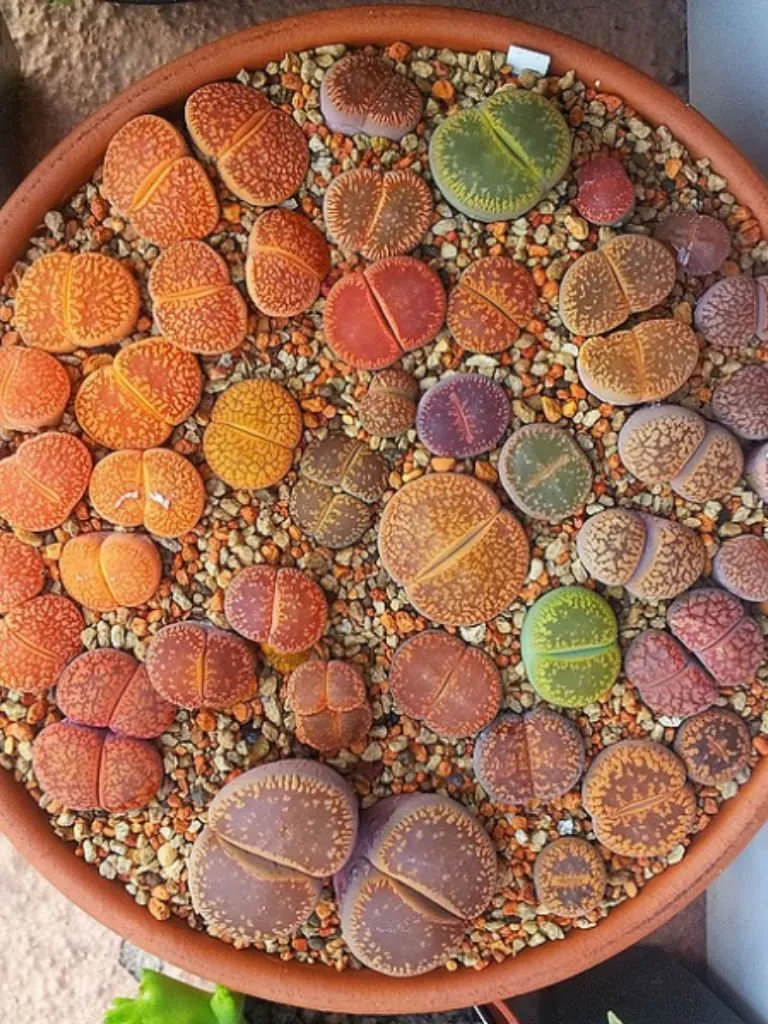
| Care difficulty | 4 / 5 |
|---|---|
| Watering schedule | Water only when substrate fully dry, nearly no water through cold winter |
| Sunlight requirements | Full sun |
| Ideal temperature | 12 – 24 °C |
| Soil type | Loam · Sand |
| Soil pH | Acid · Alkaline · Neutral |
| Soil moisture | Well drained |
| Fertilizing | Extremely diluted low-nitrogen succulent feed monthly growth |
| Toxicity | Information to be completed |
How to Water Aucamp's living stone?
Originating from arid regions, living stones has evolved to store water efficiently, mirroring its drought-tolerant nature. These succulents require minimal watering, thriving with a schedule of once every three weeks to mimic their natural dry habitat. Given their preference for well-draining soil and sparse watering, living stones is exemplary in water conservation among plants. Typically grown indoors due to their size and ornamental appeal, living stones is an evergreen plant that maintains hydration even when the surrounding environment lacks moisture.
Learn more →What Are the Sunlight Requirements for Aucamp's living stone?
Living stones thrive best in full sun, requiring intense and direct light to flourish optimally. Exposure to bright light for at least a few hours daily is crucial for their unique photosynthesis process, promoting vibrant coloration and proper development of their stone-like leaves. While living stones can tolerate partial sun, insufficient light may lead to elongated, pale growths as they stretch toward the light source. It's ideal to position them outdoors in spaces where they can receive ample sunlight without obstruction. Adaptively, living stones can slightly alter their leaf orientation to maximize light absorption.
Learn more →What Is the Ideal Temperature Range for Aucamp's living stone?

Living stones is suitable to grow in mild temperature in spring and autumn, and does not have good resistance to extreme cold weather. If you are not in hardiness zones 9-10, it is not recommend to plant it directly in the garden, but as a potted plant. When the temperature is higher than 30 ℃ in summer, living stones may enter its dormancy. When the temperature is lower than 5 ℃ in winter, it is recommended to move it indoors to avoid irreversible frostbite or even death. Its growing season is in spring and autumn, and it needs a little water; in summer and winter, when it enters the dormancy period, watering should be reduced.
Learn more →What Soil Is Best for Aucamp's living stone?
Soil is very important for the growth of living stones, which must be loose and ventilated. Generally speaking, the soil is divided into three layers from top to bottom, namely, the top deco layer, the middle planting layer, and the lower hydrophobic layer, which requires different types of soils. The top deco soil is paved on the soil surface for the decoration and fixation of plants. Some can prevent diseases and insect pests. When it's completely dry, it's time to water. There are many types of soil that can be used as top deco soil, such as white pebble, akadama soil, kiryuu sands, kanuma soil, etc. You can select proper ones according to different pots and plants. The middle layer soil can fix plants and provide nutrients for plants to grow. You can buy the configured succulent planting soil directly in store, or buy soil materials to mix by yourself. The common soil formulation for this layer is peat moss:perlite:volcanic rock:vermiculite = 4:2:2:2. The soil of the lower hydrophobic layer is placed at the bottom of the flowerpot or garden pit. It can evacuate the excess water in the succulent root system and prevent the root system from rotting due to water accumulation. The hydrophobic layer can be made of ceramsite, volcanic stone or other large-scale culture media. Coal slag or charcoal are also good choices. If it is planted in the garden, it is necessary to make sure that the bottom drainage layer is in good water permeability.
- Soil type
- Loam · Sand
- Soil pH
- Acid · Alkaline · Neutral
What Are the Moisture Requirements for Aucamp's living stone?
Well drained
Learn more →How to Fertilize Aucamp's living stone?

Most succulent plants are used to growing in the wild where the environment is poor, so they do not need fertilization in their growth cycle. You can add a little slow-release fertilizer in early summer, and it's fine if you do not apply fertilizer. Please remember, don't fertilize it during its dormancy period, because too many nutrients that it can't absorb may cause damages to its growth.
Learn more →How to Prune Aucamp's living stone?

In order to keep beautiful shape, some large succulent plants may need pruning. For example, in California, for echeveria planted in the garden, some redundant branches and branches that are too dense need to be cut off in spring and autumn. This depends on what you think and what the succulent plant is used for. Tools for pruning mainly include knife, scissors, and some medicines (such as sulfur powder). In order to propagate new plants, we can also cut some leaves in spring and autumn for cutting. Stout stems with 5-6 leaves are often selected: cut it off with a knife, then smear the wound with sulfur powder, and plant it after the wound is healed. At this time, it is recommended to use a watering can to slightly wet the soil used for cutting.
Learn more →How to Propagate Aucamp's living stone?

There are many ways of propagation of succulent plants; seeds can be collected for sowing, but they are difficult to germinate. It is more common to use leaves for cutting propagation, generally in spring and autumn. Select a whole leave of a healthy plant, cut it off with a knife, and lay it flat on the slightly humid soil, with the leaf base close to the soil. Provide it with suitable temperature (25 ℃) and light (bright scattered light). In a week or two, a bud will grow at the leaf base.
Learn more →How to Transplant Aucamp's living stone?
The perfect timing to transplant living stones is in the gentle embrace of late spring or as autumn colors herald the approach of winter. Choose a sunny spot with good drainage to foster robust growth. A kind reminder: handle with care due to their delicate nature.
Learn more →How to Care for Aucamp's living stone in Winter?

Information to be completed
Learn more →How to Plant Aucamp's living stone?
When planting, you can first add the soil of the lower hydrophobic layer to the flowerpot, and then add a small amount of soil of the planting layer. Then spread out the root system of the plant and put them in. Cover the plant root with planting soil slowly, then add the top deco soil, and finally pour water once. If it is planted in the garden, you need to dig a pit 1.5-2 times the size of the root system first, and then follow the above steps. In order to make it grow better and faster, or if the roots are too dense or unhealthy, it needs to be repotted. It is recommended to repot in spring and autumn. Before repotting, stop watering a few days in advance, after the soil is dried, you can gently knock the pot outside. Or you can use a knife to separate the soil from the pot. When pulling the plant up slightly, you can easily take out the plant, and then follow the steps described in the previous paragraph. It should be noted that, though you can plant different colors of succulent plants together, it is better to avoid planting succulent plants with different growth habits together. Some succulent plant growing in summer needs water, while other succulent plant in dormancy period does not need water. If they are planted together, the succulent plant in dormancy period will become sick due to excessive watering, while the succulent in growing period will wither due to insufficient water.
Learn more →How to Repot Aucamp's living stone?
Flower Pots
Learn more →How to Harvest Aucamp's living stone?

Information to be completed
Learn more →Common Pests & Diseases

Diseases
Generally disease free
Pests
Susceptible to aphids and mealybugs
Explore the plant health library →The Toxicity of Aucamp's living stone
Information to be completed