



Planting and Growing Japanese spindle 'Aureomarginatus'

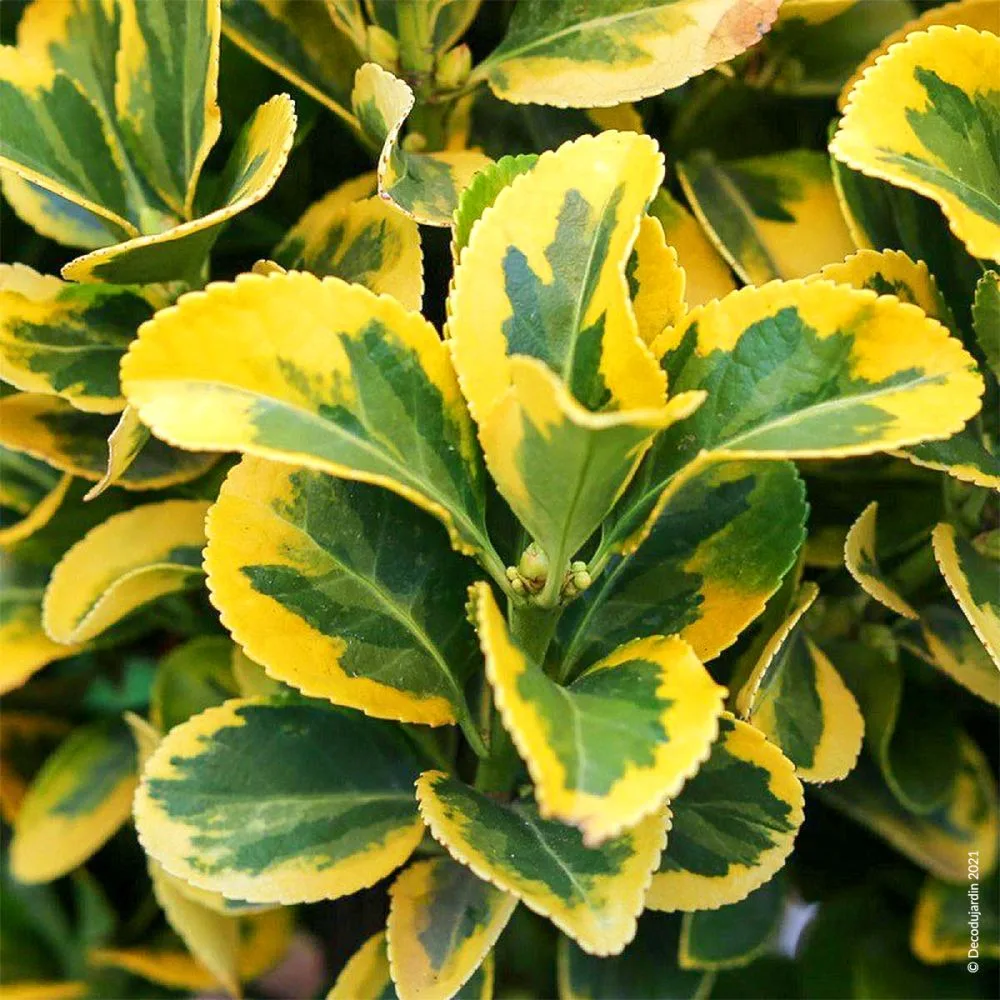
| Care difficulty | 2 / 5 |
|---|---|
| Watering schedule | Water regularly to keep soil moist, especially in first year |
| Sunlight requirements | Full sun · Partial shade |
| Ideal temperature | 15 – 25 °C |
| Soil type | Chalk · Clay · Loam · Sand |
| Soil pH | Acid · Alkaline · Neutral |
| Soil moisture | Moist but well drained |
| Fertilizing | Once in spring and once in fall with balanced slow-release fertilizer |
| Toxicity | Harmful if eaten. Wear gloves and other protective equipment when handling |
How to Water Japanese spindle 'Aureomarginatus'?
Watering needs of evergreen spindle 'Aureomarginatus' are critical during the first year of growing, once roots are established it becomes dependent on its roots for moisture absorption from the soil. Generally, evergreen spindle 'Aureomarginatus' needs 1 mm of water per day in the initial growth stages that may increase up to 3 mm per day with the established plant whereas it is capable to evaporate excessive moisture in the atmosphere. On the other hand, it is capable of withstanding drought when fully developed. Watering in the winter climates is also critical to avoid early desiccation. So keep watering, not flooding your evergreen spindle 'Aureomarginatus'.
Learn more →What Are the Sunlight Requirements for Japanese spindle 'Aureomarginatus'?
Overall Euonymus varieties need diverse sun exposures, such as bigger trees and giant shrubs require more sun. Some ground cover species need a part and full shades, while some creeping species reach up to the foliage of the host plant foliage to acquire light as their need. They are medium shade tolerant.
Learn more →What Is the Ideal Temperature Range for Japanese spindle 'Aureomarginatus'?

Evergreen spindle 'Aureomarginatus' showcases robust temperature tolerance, enduring cold down to -15℃ (5℉) and heat up to 41℃ (106℉). This makes it resilient to a variety of climates. In colder regions, protecting evergreen spindle 'Aureomarginatus' with mulching and frost cloth during severe freezes is advisable to prevent leaf damage or dieback. In extreme heat, providing shade and consistent watering helps avoid scorched leaves and dehydration. Symptoms of overcooling include wilted or blackened leaves, while overheating can lead to leaf curling or browning. Implementing these care strategies ensures evergreen spindle 'Aureomarginatus' thrives despite temperature fluctuations.
Learn more →What Soil Is Best for Japanese spindle 'Aureomarginatus'?
Evergreen spindle 'Aureomarginatus' is adaptable from poor to rich soil with medium water holding capacity that is well-drained and aerated. Damp calcareous soils equally favor its growth including compact and dry soils. It is also adaptable to a variety of soil pH where it can successfully grow in acidic to high alkali soils of varying pH ranging from 5.6-7.2. Evergreen spindle 'Aureomarginatus' can also grow in swamplands, bottomland hardwood forests, thickets and slopes near or on the stream banks. When it becomes fully established, it is exceptionally drought tolerant.
- Soil type
- Chalk · Clay · Loam · Sand
- Soil pH
- Acid · Alkaline · Neutral
What Are the Moisture Requirements for Japanese spindle 'Aureomarginatus'?
Moist but well drained
Learn more →How to Fertilize Japanese spindle 'Aureomarginatus'?

Usually, evergreen spindle 'Aureomarginatus' doesn’t need fertilizers for its growth and development but it can be added if you are growing for the purpose of hedging in the landscape gardening during the first year only. NPK(20:20:20) is a major essential nutrients fertilizer that can be added twice to the young plants, i.e. once in the spring and then in early winter. A general recommendation is 1 tablespoon per plant.
Learn more →How to Prune Japanese spindle 'Aureomarginatus'?

Pruning is often practiced on the evergreen spindle 'Aureomarginatus' grown for hedge formation in the landscapes. Medium to heavy pruning is advised if the purpose is to shape or topiary formation otherwise it goes well unpruned. Winter is the best pruning and trimming time for the evergreen spindle 'Aureomarginatus' other than evergreen shrubs.
Learn more →How to Propagate Japanese spindle 'Aureomarginatus'?

Propagate by semi-ripe cuttings in summer
Learn more →How to Transplant Japanese spindle 'Aureomarginatus'?
Evergreen spindle 'Aureomarginatus' thrives when transplanted from early spring through late spring or from late fall to early winter due to moderate temperatures. Choose a sunny spot with well-draining soil for optimal growth. Ensure roots are undisturbed during relocation.
Learn more →How to Plant Japanese spindle 'Aureomarginatus'?
Planting is done through digging a pit of suitable size at the selected location in the garden that is well aerated and suits the needs of the variety being planted. Dig a pit double the size (in-depth and width) of the pot carrying your plant. Remove all garden soil out of the pit to make an even surface for planting. Add 5 to 8 cm of the similar garden soil into the pit that was previously removed before placing your plant into the pit, gently. Fill in the pit with remaining garden soil to the surface of the garden soil. Water frequently till the newly added soil becomes settled into the pit. Keep on watering for the initial 4-5 days and add more garden soil to the desired pit level as needed. Water your plants during the first year of growth regularly until it establishes its root system. The spacing of evergreen spindle 'Aureomarginatus' to establish hedges is recommended 1 to 1.3 m apart while spacing for the shrubs or small trees is often observed from 2.5 to 3 m apart.
Learn more →Common Pests & Diseases

Diseases
May be susceptible to powdery mildews, a leaf spot and sometimes honey fungus
Pests
May be susceptible to vine weevil, horse chestnut scale, euonymus scale and caterpillars
Explore the plant health library →Troubleshooting
Leaf Scorch, Yellowing Chlorosis, or Root/Crown Decline
Japanese spindle 'Aureomarginatus' (Euonymus japonicus 'Aureomarginatus') depends on deep, well-drained soil and appropriate sun/moisture balance; waterlogged roots, drought stress, or unsuitable soil pH quickly show in foliage color.
| What you notice | Possible explanation | What to check next |
|---|---|---|
| Leaf margins turn brown and crispy in summer heat, or young foliage wilts despite adequate sunlight | Drought stress, drying winds, or afternoon sun scorch (especially on newly planted trees/shrubs) | Check soil moisture 10–15 cm (4–6 inches) deep and assess afternoon sun and wind exposure |
| Leaves turn pale yellow between dark green veins or whole canopy yellows and thins | Unsuitable soil pH locking up iron/manganese or poor drainage causing root rot | Test soil pH and inspect root-zone drainage after heavy rain or irrigation |
- Plant in well-drained soil suited to its pH needs (Acid, Alkaline, Neutral pH) in full sun or partial shade, mulching the root zone with organic bark or leaf mold kept clear of the trunk.
- Water deeply during dry spells, especially in the first two years after planting: Water regularly to keep soil moist, especially in first year.
- Protect frost-tender or container-grown woody species before winter freezes.
If sudden branch dieback with dark vascular streaking or mushroom growth at the base occurs (suspected Verticillium wilt or honey fungus), prune out dead wood cleanly and consult local extension diagnostics.
Poor Flowering/Fruiting or Sap-Sucking Pests and Mildew
Insufficient sunlight, improper pruning timing, or dense unpruned canopies can reduce blooms and fruit while encouraging aphids, scale, caterpillars, or powdery mildew.
| What you notice | Possible explanation | What to check next |
|---|---|---|
| Vigorous leafy shoots with few flowers or poor fruit set | Excessive shade, high-nitrogen fertilizer, or pruning off old-wood flower buds at the wrong season | Review daily sun hours, fertilizer ratio, and pruning timing |
| Curled sticky new shoots, white powdery leaf coating, or chewed foliage | Common pests (May be susceptible to vine weevil, horse chestnut scale, euonymus scale and caterpillars) or fungal issues (May be susceptible to powdery mildews, a leaf spot and sometimes honey fungus) | Inspect shoot tips, leaf undersides, and inner canopy airflow |
- Prune at the appropriate seasonal window: Usually little pruning is needed. Lightly shape if necessary, removing dead, damaged or diseased shoots. Prune after flowering..
- Thin crowded interior shoots to improve sunlight penetration and air circulation, and clean up fallen leaves in autumn.
- Blast aphids off sturdy shoots with a firm water spray or use insecticidal soap per label instructions.
Avoid late-summer nitrogen feeding, which forces soft late growth vulnerable to early autumn frost.
The Toxicity of Japanese spindle 'Aureomarginatus'
Harmful if eaten. Wear gloves and other protective equipment when handling