
Planting and Growing Perennial Hibiscus: Tips for Bigger Blooms
Learn how to plant, grow, and care for perennial hibiscus. With huge tropical blooms, these flowers attract butterflies & hummingbirds to your garden.
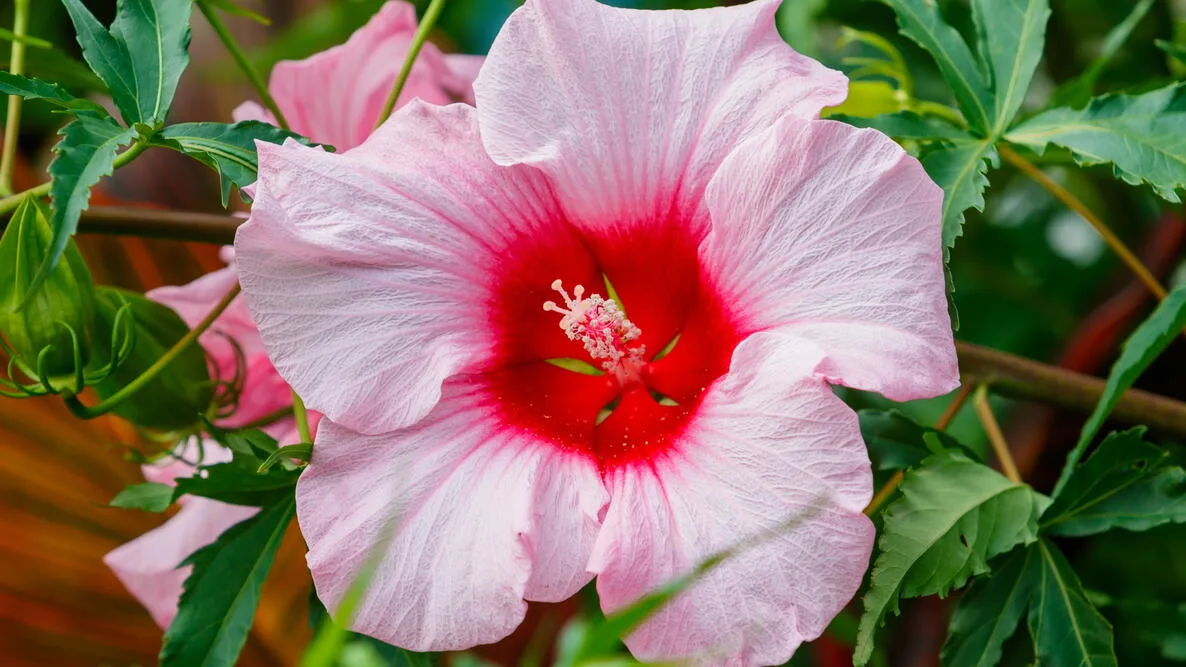
With huge, colorful, dinner-plate-size flowers, perennial hibiscus plants add a bold, tropical effect to the garden. They are also highly attractive to butterflies and hummingbirds! Here’s how to plant, grow, and care for hibiscus flowers.
There are many types of hibiscus. This growing guide covers perennial hibiscus grown for their strikingly beautiful, big, disc-shaped, hollyhock-like flowers that can measure up to 12 inches across!
Perennial hibiscus can grow up to 8 feet tall, but dwarf varieties are only 2 to 3 feet tall.
Hibiscus are members of the mallow family, which has over 300 members that include annuals, perennials, trees, and shrubs.
Planting
When to Plant Hibiscus
Hibiscus can be purchased as young plants from nurseries and are best planted in the spring. Or they can be rooted from a cutting in the spring.
If you wish to grow hibiscus from seed, sow indoors 12 weeks before the last spring frost date. Soak seeds in very warm water for 1 hour before sowing. Alternatively, seeds can be sown outdoors after the last expected frost date.
Choosing and Preparing a Planting Site
- Choose a site that gets full sun; the plants will grow in partial sun but will not flower as well.
- Hibiscus prefer well-draining soil with plenty of organic matter. They prefer neutral to slightly acidic soil.
- To avoid breakage of the long stems, plant hibiscus where they won’t be exposed to strong winds.
How to Plant Hibiscus
- Plant potted hibiscus plants so that their stems are just at the soil surface.
- To root a cutting in the spring, cut off a branch 5 to 6 inches long and strip off lower leaves. Plant the cutting in a pot with a mix of 3 parts sand and 1 part peat. Roots should form within a few weeks. Transplant the cutting from the pot into the ground.
- The hibiscus species that die back each year can be spaced 2 to 3 feet apart. Consider the potential height and width (up to 12 feet and 10 feet, respectively) of a mature plant before planting.
- Water the plants well at the time of planting.
Growing
How to Care for Hibiscus Shrubs
- Hibiscus needs frequent watering, especially when young and new. When watering, do so deeply and thoroughly, drenching the plant.
- Mulch around the plant to retain moisture and to provide winter protection for the roots.
- To encourage rebloom, either remove the spent flowers before they form seed heads or prune plants back by one-third after a flush of bloom is finished.
- Perennial hibiscus will freeze back to the ground each winter; cut old stems to the ground.
- Hibiscus blooms on new wood (this year’s growth), so pruning is best done in the spring.
- In early spring, remove dead stems from established plants and apply a balanced fertilizer.
- Over the growing season, hibiscus can benefit from a fertilizer that is high in potassium, medium to medium-high in nitrogen, and low in phosphorus, as the plant can be sensitive to phosphorus.
- Mature plants can be divided in the spring, not fall.
Pests and Problems
Insect pests of hibiscus include aphids, Japanese beetles, and whiteflies.
Clean up all plant debris to avoid fungal diseases, which can cause leaf spots. Don’t crowd plants, and keep mulch from touching the stems to avoid blight.
Types
Scarlet swamp hibiscus (Hibiscus coccineus): This plant, also known as Texas star, has five-petaled, brilliant-red flowers. It grows to a height of 7 feet each growing season, dies back to the ground every winter, and resprouts in spring.
Rose mallow (H. moscheutos): This is the classic dinner-plate hibiscus due to the large size of its flowers. These large, fast-growing plants bloom from August to October, and each plant may flaunt several 10- to 12-inch-wide flowers at once. A few of the many popular cultivars are:
- ‘Anne Arundel’ has pink flowers, 9 inches in diameter, on plants 5 feet tall.
- ‘Kopper King’ has light pink to white flowers with a burgundy center, 12 inches in diameter, with coppery red deeply cut leaves.
- ‘Lady Baltimore’ is a popular old variety with pink flowers and red centers on 5-foot-tall plants.
- ‘Lord Baltimore’ is another old variety with red flowers on 5-foot-tall plants.
Wit and Wisdom
- The plant has been used to soothe headaches, aching limbs, coughs, and inflammations.
- Hibiscus tea is made from parts of a different type of hibiscus, Hibiscus sabdariffa—also known as roselle or Florida cranberry. It’s native to West Africa but is now grown across Central America, the Caribbean, and even Florida.
- In Victorian times, giving a hibiscus blossom to a person meant that the giver acknowledged the receiver’s delicate beauty. Learn more about the language of flowers.
- The yellow hibiscus is the state flower of Hawaii.