
How To Grow a Banana Plant in a Container
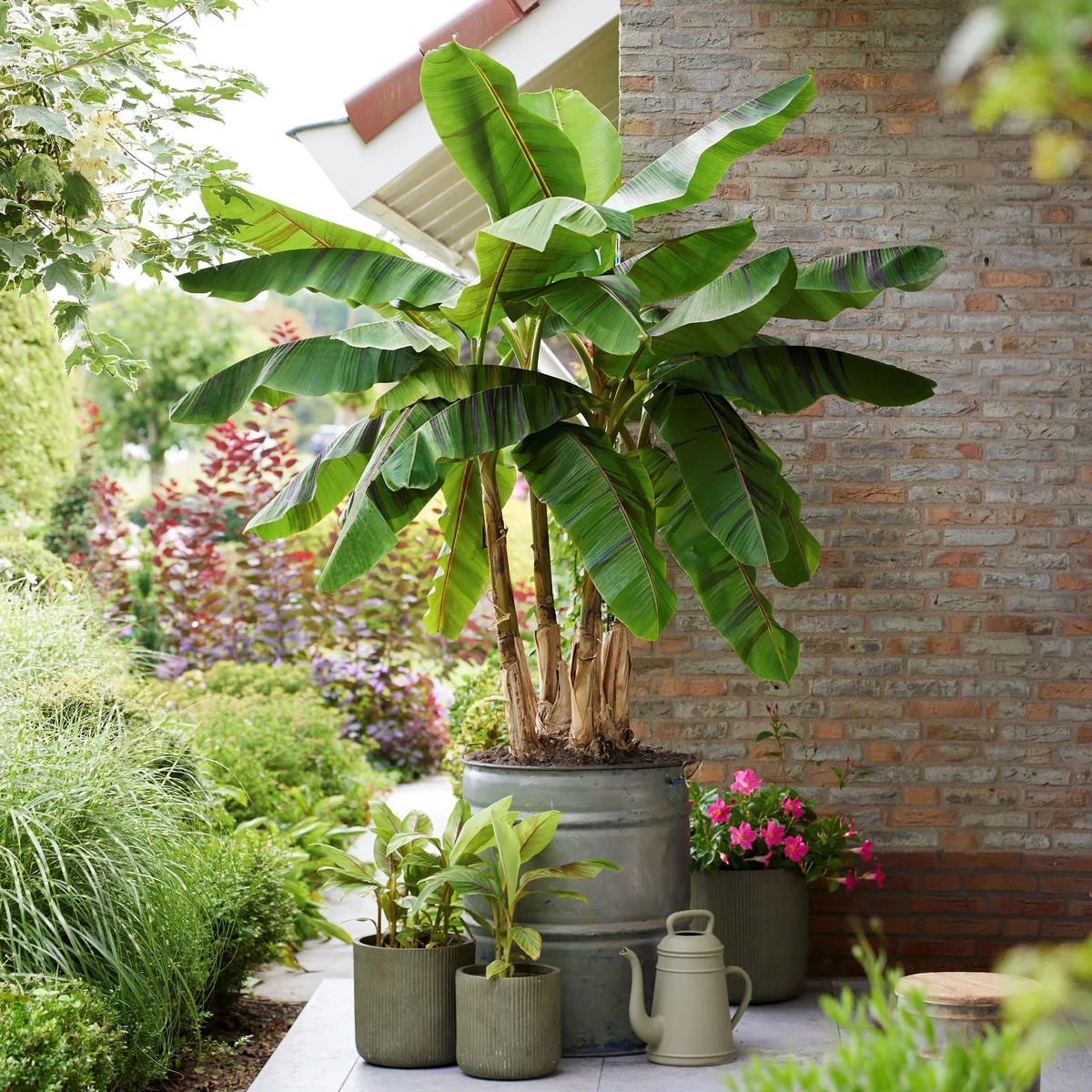
Banana plants are houseplants best grown in containers, which can go outside in warmer months. They lend a tropical air to any setting—a pool, patio, pond, or property—with their luxurious foliage, elegant profile, and a larger-than-life impact.
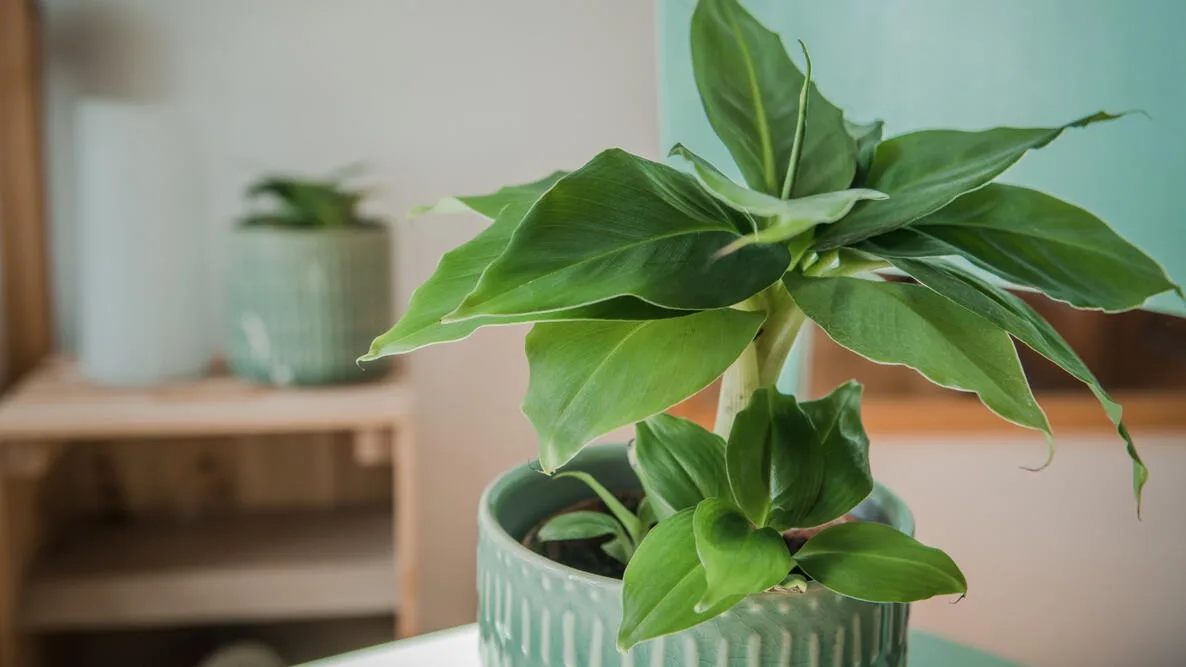
Banana plants are so “a-peeling!” These houseplants are best grown in containers, which can be moved outside during warmer months. They lend a tropical air to any setting—a patio, terrace, pond, pool, or property—with their luxurious foliage, elegant profile, and larger-than-life impact.
Learn how to grow and care for a banana plant in this guide.
What Exactly Is a Banana Plant?
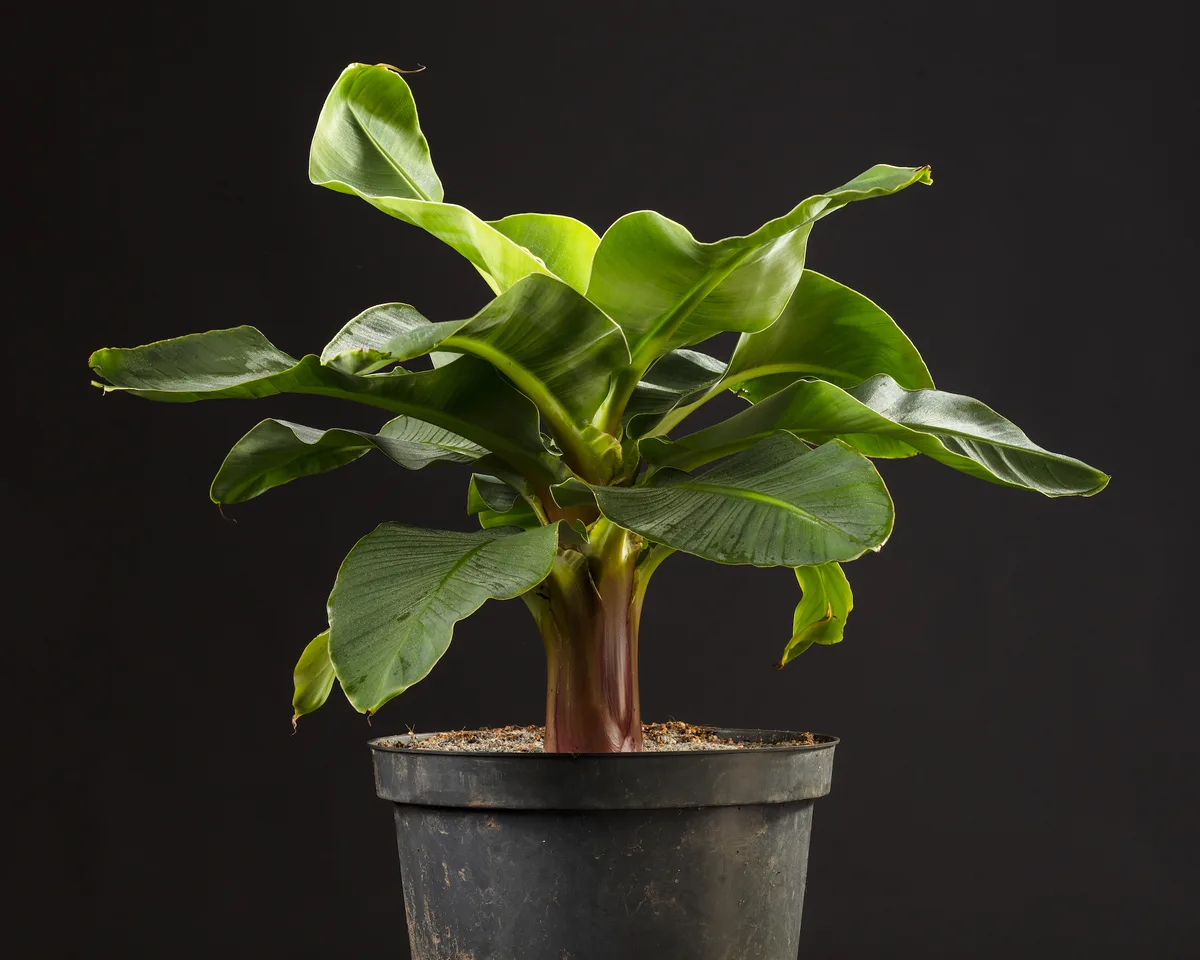
First, a banana plant is not a tree. It is a large herbaceous perennial with a pseudostem rather than a trunk. The stem is not woody but fleshy, growing upright with large green leaves crowning the top. The vibrant green leaves are long and broad, sometimes streaked with red or purple. A large flower stalk develops at the plant’s peak, which matures into clusters of bananas.
In the U.S., bananas only grow outdoors in USDA hardiness zones 10a to 11b. For this reason, most of the bananas we eat (the Cavendish variety) come from humid tropical regions worldwide. As mentioned in the section on recommended varieties below, a few ornamental banana plants, such as Musa basjoo, can be grown outdoors in Zones 5 to 10 if the plant is mulched during winter. These are grown for their exotic appearance in the landscape, not for their small, inedible fruit.
This banana plant guide will focus on growing banana plants in containers at home for patios and outdoor areas. Dwarf varieties (such as Dwarf Cavendish) are the most common container plants, growing between 3 and 6 feet tall. Note that container plants must be moved inside during winter unless you plan to treat them as annuals. If the pots are too heavy to move or you don’t have room, this may not be the best ornamental plant for your lifestyle.
Planting
Choosing a Container
Purchasing a banana plant is advised. The most important consideration may be the container. Think big, and then think bigger: While a banana plant may be started in a 1-gallon pot, a mature one may do best in a 15- to 25-gallon container.
Location
Your banana plant should grow outdoors, but wait 3 to 4 weeks after the last frost to place it outside. Avoid exposing the plant to temperatures below 60°F, as growth will stop at 50°F, and the risk of injury will increase. If temperatures are expected to drop below 60°F, bring the container inside.
Select a spot outside where the plant will receive full sun, but be prepared to provide partial shade or filtered sun during the heat of the day. Choose a sheltered location near the house and protect the foliage from winds that may cause leaf damage.
How to Plant
When potting or repotting a banana plant in your container:
- Use a potting mix amended with compost and/or aged manure. These plants love rich growing medium with excellent drainage. The pH should be slightly acidic, between 5.5 and 6.5.
- When potting, also add a slow-release fertilizer. Bananas are heavy feeders.
- Water thoroughly when planting or transplanting.
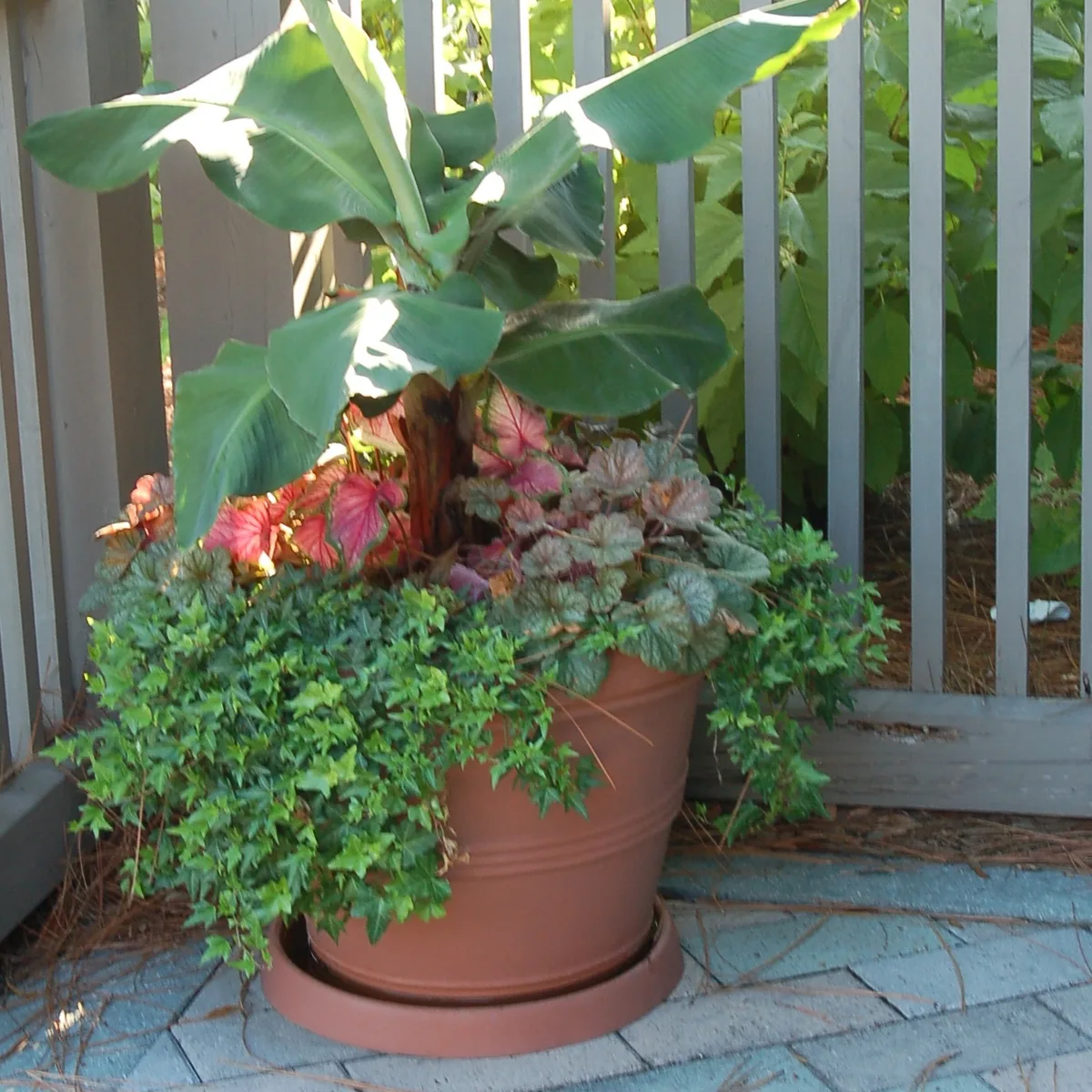
If you’re mixing the banana plant with other flowers in a container, be mindful of its needs, as it will require more nourishment than the other plants.
Growing
Banana Plant Care Requirements
Watering: As with most houseplants, keep the potting mix consistently moist but not saturated; do not allow it to dry out. If you stick your finger into the medium, it shouldn’t be dry more than an inch below the surface. Persistent drought will cause leaf burn.
When the container is outdoors, you can also add mulch to help retain moisture. You’ll need to water more frequently in hot weather.
Fertilizing: Fertilize every 4 to 6 weeks with a balanced, slow-release formula. You can also supplement by occasionally adding compost and organic matter.
Overwintering
If you’re overwintering potted plants, prepare to bring them inside before the first fall frost by one of two methods.
- Bring the potted plant into a large, sunny room and then reduce its water and fertilization, or
- Cut off the potted plant’s foliage before storing it in a cool, dark, frost-free area (for ease in handling, the plant can also be cut back close to the top of the medium).
Provide it with occasional light watering. If the plant and container are too large to move, trim off the foliage, remove the plant, wrap the roots in plastic, and store in the basement or garage as above—but avoid watering.
Propagating
Banana trees are pretty simple to propagate; the best way to do this is by division. The first step is to select a healthy sucker, one that is around 12 inches tall and has its own roots.
Water the mother plant to ensure the surrounding medium is softened, then dig around the base of the sucker to expose the rhizome. Use a sharp knife or spade to cut the sucker away from the main plant, and make sure you get some of the roots. Gently lift the sucker out and replant.
Pests and Problems
The most common pests for banana plants are those which you’ll often find with other houseplants, namely:
- Aphids
- Mealy bugs
- Scale insects
- Spider mites
Diseases to be on the lookout for include:
- Panama disease: a fungal infection that causes yellowing and wilting leaves
- Southern bacterial wilt (aka “Moko disease”): affects fruit, leaves, and the plant’s vascular system
- Viruses (including cucumber mosaic virus): can stunt growth and cause deformed leaves
Outdoor plants are also susceptible to banana weevils, weakening your plant. Look out for jelly-like sap and remove any infested plants when you spot signs. Another way to get rid of this pest is to attract and trap weevils or use natural predators such as ants.
Types
Banana plants come in a wide variety of types and sizes, some producing edible fruits and others ornamental. Each type requires different conditions to thrive, so make sure you choose your plant based on the species requirements below.
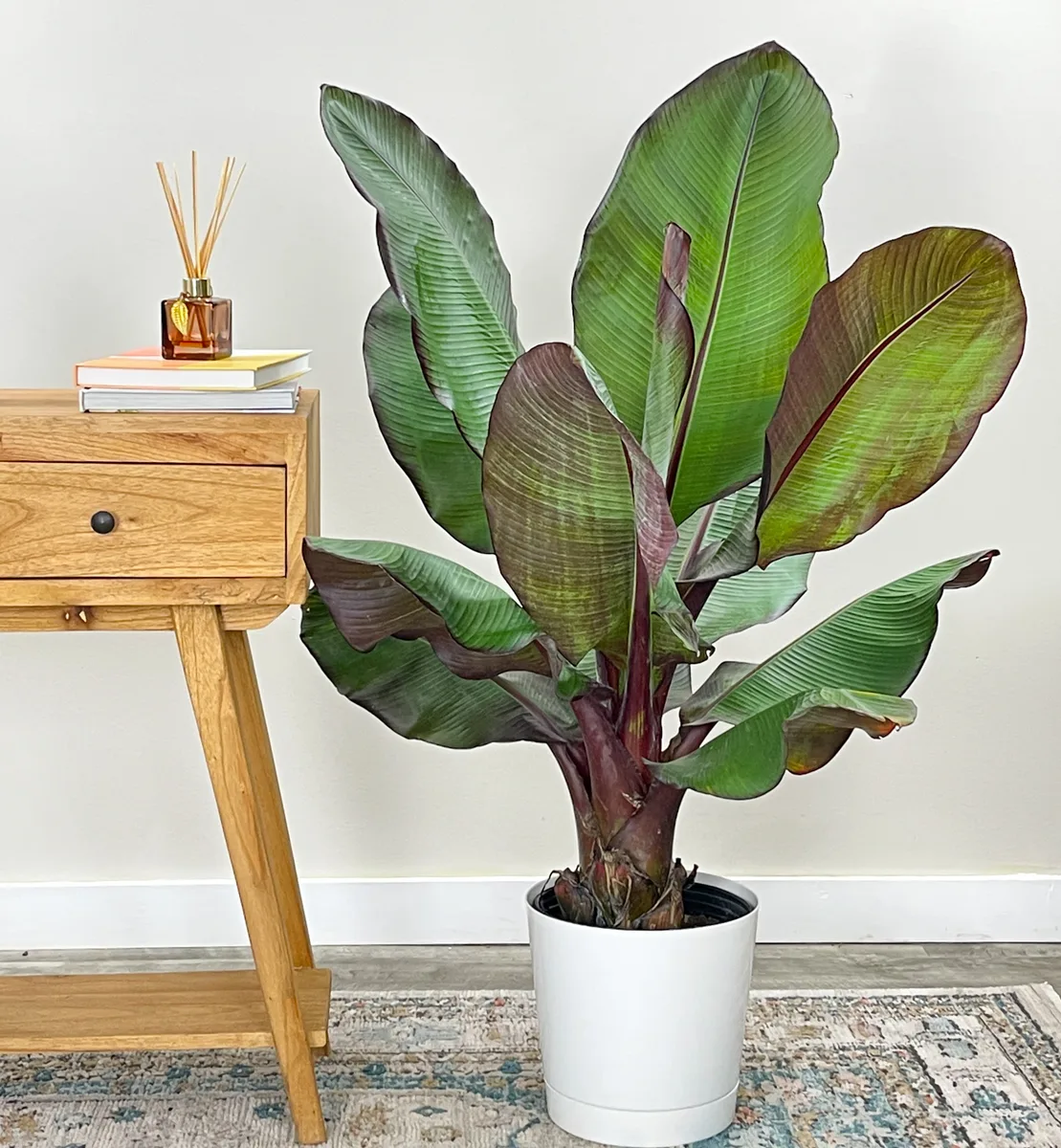
- Ensete ventricosum ‘Maurelii’, aka red/Abyssinian/wild banana: a fast-growing ornamental plant, similar to those in the Musa genus; winter-hardy in Zones 10 and 11, overwinter indoors elsewhere; grows 8 to 10 feet tall in temperate regions, with maroon-red tints on paddle-like foliage and leaf axils; white flowers, usually after 3 to 5 years (although not on those cut back for overwintering); fruit is inedible
- Musa acuminata ‘Dwarf Cavendish’, aka Chinese/ladyfinger banana: winter-hardy in Zones 9 to 11, overwinter indoors elsewhere; grows 4 to 8 feet tall, with paddle-shaped green leaves; cream to yellow flowers, usually in year 2 or 3 (although not on those cut back for overwintering); fruit is edible but seldom appears on overwintered plants
- M. acuminata ‘Dwarf Orinoco’: winter-hardy in Zones 7 to 11, overwinter indoors elsewhere; grows vigorously to 5 to 6 feet tall, with large, paddle-shaped foliage; pink flowers may appear on mature plants (although not on those cut back for overwintering); fruit is edible but seldom appears on overwintered plants
- M. basjoo, aka Japanese (fiber) banana: an ornamental plant; winter-hardy in Zones 9 and 10, overwinter indoors elsewhere; grows 6 to 14 feet tall, with paddle-shaped green leaves up to 6 feet long and 2 feet wide; cream-to-yellow flowers may appear on mature plants (although not on those cut back for overwintering); fruit is inedible
- M. ‘Siam Ruby’: an ornamental plant; winter-hardy in Zones 9 to 11, overwinter indoors elsewhere; compact habit, grows up to 8 feet tall; foliage and pseudostems are dark maroon red, with spots/streaks of chartreuse; provide full sun for deepest red color; plant may produce tubular, cream-color flowers, although seldomly; fruit is inedible
- M. velutina, aka pink/hairy banana: winter-hardy in Zones 7b to 11, overwinter indoors elsewhere; grows 4 to 6 feet tall, with paddle-shaped, dark green foliage; cream/yellow/pink flowers may appear (although not on those cut back for overwintering); peels are pink; the flesh is white and edible but heavily seeded
- Musella lasiocarpa, aka Chinese dwarf/golden lotus banana: an ornamental plant; winter-hardy in Zones 7 to 10, overwinter indoors elsewhere; grows 3 to 6 feet tall, with 1- to 4-foot-long, gray-green leaves; prized for its yellow flowers (usually in its second year, then annually); fruit that follows the inflorescence (especially in warm zones) is inedible
Wit and Wisdom
- As a houseplant, the banana plant has an extra benefit in purifying and improving air quality
- A banana plant is a large herb that rises on a pseudostem, a thick cylinder of overlapping, tightly packed leaf sheaths that grow from its fibrous root system. It is not a tree with a stem or trunk.