
How to Grow Gaura: A Guide to the Graceful Whirling Butterfly Flower
Learn how to plant, grow, and care for gaura flowers (aka whirling butterflies)—delicate, drought-tolerant blooms perfect for borders and wildflower gardens.
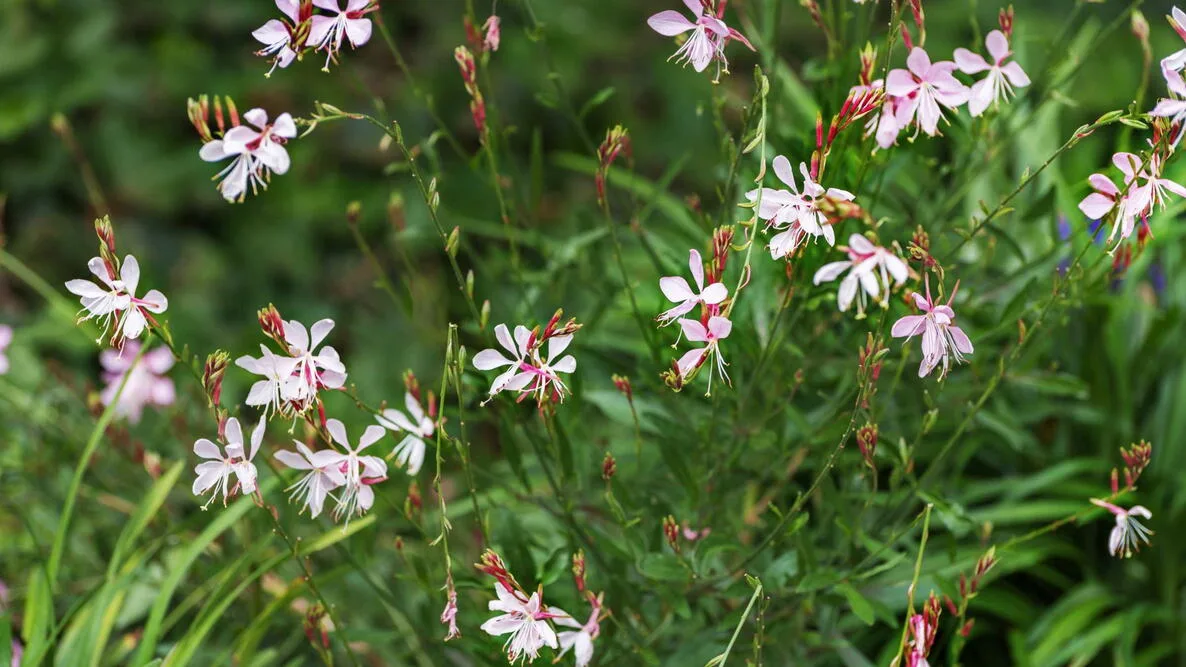
If you’re searching for a flower that flutters like a butterfly and thrives like a champ, look no further than gaura! Also called “whirling butterflies” for its airy blooms that dance in the breeze, gaura is a carefree stunner that adds grace to any garden bed, container, or wildflower patch.
Native to the southern U.S. and Mexico, this perennial is perfect for pollinators, tolerant of drought, and just downright pretty. Let’s dive into how to grow gaura and keep it blooming all season long!
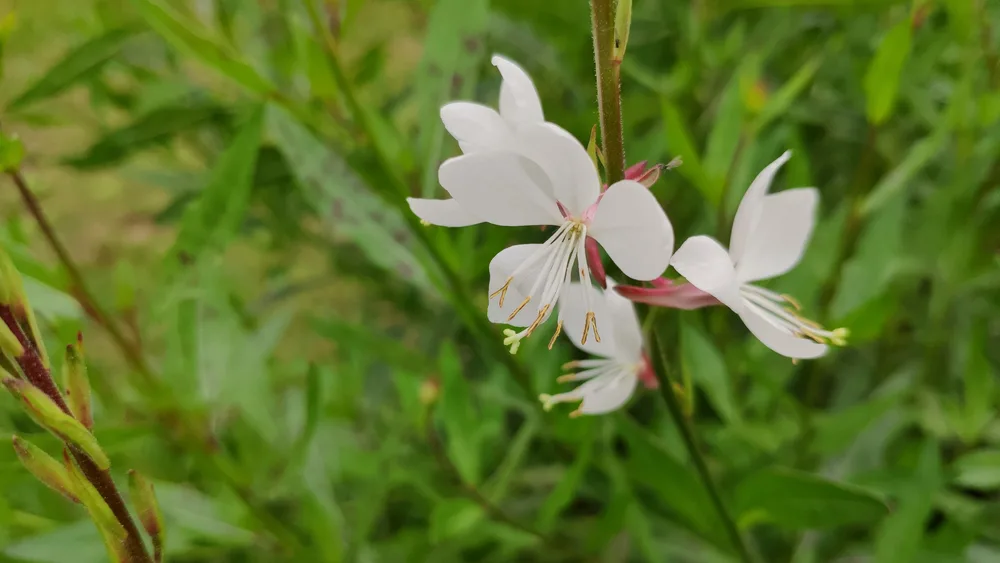
The name Gaura comes from the Greek word gauros, meaning “superb”—and indeed it is. A member of the evening primrose family (Onagraceae), gaura plants can range from 15 inches (dwarf) to 4 feet tall. Gaura’s small (1/2- to 1-inch-diameter), four-petal, pink, white, or bicolor flowers appear on wiry stems (aka “wands”) beginning in early summer and continue to do so if stems are cut back to allow for new growth, until the first hard frost. See your personalized frost dates.
The flowers attract bees and sometimes butterflies, and the plant is a host to the white-lined sphinx moth, a beneficial species. Gauras are tolerant of both drought and high temperatures. When they are planted in-ground, their long taproot goes deep for moisture; container plantings, though, need water—provided sparingly—for best flowering.
Gaura is an herbaceous, clump-forming perennial native to Texas, Louisiana, and Mexico. It is hardy in Zones 5 to 9, but in cold zones, it is often treated as or performs like an annual. The plant is also suitable for naturalizing in a mixed border or in wildflower or native plant gardens.
The plant is considered an easy-to-grow perennial, but it is not necessarily long-lived outside of its native areas, where cold temperatures and/or persistently wet soil can affect its survival. It is also suitable for naturalizing (in-ground) in a mixed border or in wildflower or native plant gardens. Check out more popular plants for naturalizing.
Planting
Purchasing plants is recommended, at least initially. Gaura may self-seed (naturalize) if flower stems are not pruned out in fall (to minimize seeding, remove them when flowers fade); alternatively, seeds (reddish brown, inside nutlike capsules) may be saved for sowing in spring. The large root makes propagation by division a challenge, so this is seldom advised.
Where to Grow Gaura
Gaura does well in sandy, loamy, well-draining soil, but it will tolerate poor soil as well. Avoid excessive aged manure and minimize fertilizer, as these can cause plants to flop over. Poor drainage can result in root rot; the plant may not survive wet soil in winter.
Provide full sun. Some afternoon shade is tolerated, but too much shade can cause flopping.
Growing
Water occasionally but deeply, especially if you are growing your gaura in containers.
Fertilizer is not necessary.
If plants become leggy and/or flop over, provide artificial support, plant closer together, or introduce other plants to provide support.
Prune out spent flower spikes for additional blooms. Cut back tall plants by half in late spring to maintain form.
Remove flower stems in fall and eliminate dead foliage in spring.
Pests and Problems
Diseases: cotton root rot, powdery mildew, and rust.
Pests: aphids, flea beetles, and whiteflies.
Types
- Oenothera Ballerina series: white, pink, or rose blooms; does not self-seed; compact, 1-1/2 to 2 feet tall.
- O. ‘Dauphine’: white-to-pink blooms; 4 to 5 feet tall.
- O. ‘Siskiyou Pink’: maroon flower buds, pink blooms; 2-1/2 to 3 feet tall
- O. ‘Snowstorm’: pink and white flowers; 2 to 3 feet tall.
- O. ‘Star Pink,’ aka ‘Karalee Petite Pink’: deep pink flowers; 2 feet tall.
- O. ‘Whirling Butterflies’: heavy-blooming; red stems, pink flower buds, white blooms; 2 to 3 feet tall.
Wit and Wisdom
- Ferdinand Jacob Lindheimer, after whom more than 20 plant species (and one genus) were named, is known as the “Father of Texas Botany.” The Texas rat snake (Pantherophis obsoletus lindheimeri) is also named in his honor.
- Lindheimer cofounded the city of New Braunfels, Texas, where his house (which was added to the National Register of Historic Places in 1970) is preserved as a museum. He was the first editor of the newspaper in that city, which is today called the Herald-Zeitung.
- Lindheimer’s plant essays and articles were published in German in 1879 and translated by John E. Williams for publication by Texas A&M University Press.