



Planting and Growing carrot 'Maestro'

| Care difficulty | 2 / 5 |
|---|---|
| Watering schedule | Moderate regular watering, allowing brief slight drying between soakings |
| Sunlight requirements | Full sun |
| Ideal temperature | Information to be completed |
| Soil type | Clay · Loam · Sand |
| Soil pH | Acid · Alkaline · Neutral |
| Soil moisture | Moist but well drained · Well drained |
| Fertilizing | Balanced perennial feed every four weeks from spring through summer |
| Toxicity | Information to be completed |
How to Water carrot 'Maestro'?
Moderate regular watering, allowing brief slight drying between soakings
Learn more →What Are the Sunlight Requirements for carrot 'Maestro'?
Full sun
Learn more →What Soil Is Best for carrot 'Maestro'?
- Soil type
- Clay · Loam · Sand
- Soil pH
- Acid · Alkaline · Neutral
What Are the Moisture Requirements for carrot 'Maestro'?
Moist but well drained · Well drained
Learn more →How to Fertilize carrot 'Maestro'?

Balanced perennial feed every four weeks from spring through summer
Learn more →How to Prune carrot 'Maestro'?

No pruning required
Learn more →How to Propagate carrot 'Maestro'?

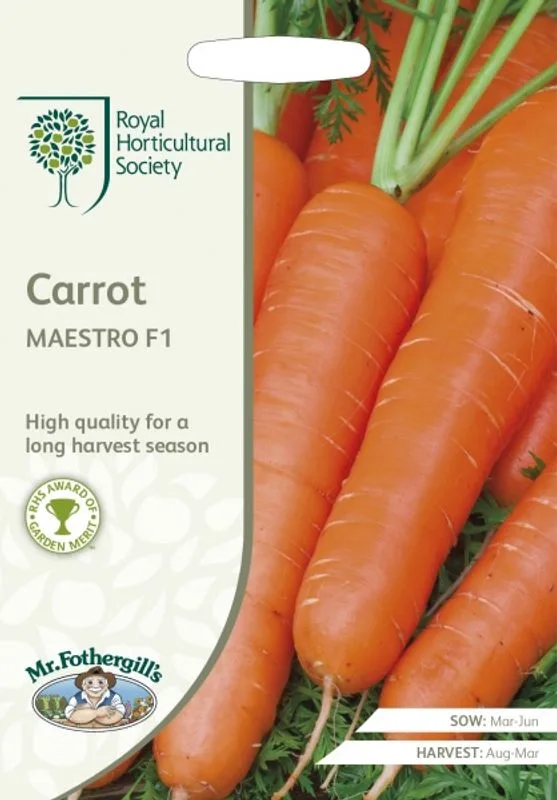
Propagate by seed. Seeds can be sown from March until June. To sow directly into the ground, dig over the soil to remove weeds and large stones, firm it and then rake it level. Make drills with a hoe, water the base and sow the seed. It is best to sow sparingly so you don’t have to thin the carrots too much later on as this can attract carrot fly. Cover with soil and water in.
Learn more →How to Plant carrot 'Maestro'?
Grow in an open, sunny position with deeply cultivated, well-drained soil; heavy clay or stony soils may cause carrots to fork so it is best to make sure you have removed as many stones as possible and for clay soils add plenty of organic matter, such as well rotted manure. To reduce chances of harvesting forked carrots in clay soil choose a short-rooted cultivar. Keep seeds well-watered until your seedlings have emerged. You can also sow seeds in containers, especially if you select a cultivar with a shorter root. Harvest carrots from August through the winter March. For more advice, see carrots cultivation.
Learn more →Common Pests & Diseases

Diseases
May be susceptible to types of carrot leaf blight in wet conditions during the growing season but shows good resistance to Alternaria and carrot spot. Generally disease-free
Pests
May be susceptible to wireworm, slugs and rodents; foliage may be affected by aphids but shows good resistance to carrot fly larvae A barrier of fine insect mesh at least 60cm high around the beds can help prevent carrot fly laying eggs.
Explore the plant health library →