



Planting and Growing Pak choi

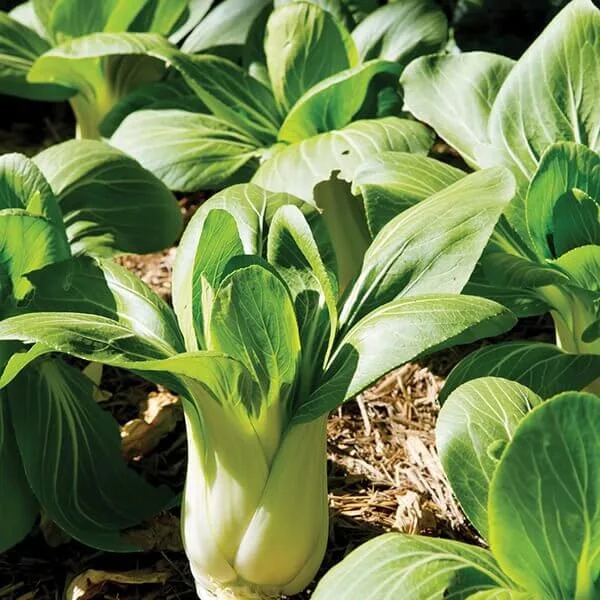
| Care difficulty | 2 / 5 |
|---|---|
| Watering schedule | Keep soil consistently moist |
| Sunlight requirements | Full sun |
| Ideal temperature | 15 – 20 °C |
| Soil type | Loam |
| Soil pH | Neutral |
| Soil moisture | Moist but well drained |
| Fertilizing | Every 2-3 weeks during growing season with a balanced liquid fertilizer |
| Toxicity | Non-toxic to humans and pets. |
How to Water Pak choi?
Originating from the lush regions of Asia, bok choi thrives in moist environments and exhibits a preference for consistent soil moisture. This species is moderately drought-tolerant but performs best when the soil doesn't dry out completely. Watering should be done twice a week to maintain optimal hydration levels. Bok choi is typically cultivated outdoors where it can benefit from natural rainfall patterns, especially during its active growing season which relies on adequate water to produce crisp, succulent leaves.
Learn more →What Are the Sunlight Requirements for Pak choi?
Like most plants, bok choi must be spaced adequately to ensure each plant receives enough sunlight on all above ground plant plants and to ensure that disease is unable to take hold. The majority of Brassicaceae will thrive in around 6 hours of direct sunlight each day. The plants should be positioned in full sun though care should be taken to ensure that they are protected from wind.
Learn more →What Is the Ideal Temperature Range for Pak choi?

Bok choi prefers to germinate and grow at relatively low temperatures. The biology of bok choi likes temperatures between approximately 20 to 25 ℃, but will also sprout at temperatures as low as 10 ℃. If temperatures are very low, planted seeds can be started on a heat mat and removed as soon as they have germinated. Brassica is one genus of vegetable with several well-known families which actually taste better after a frost; temperatures can drop below zero during the season. Temperature is very important for the transition of bok choi from the vegetative to the reproductive phase. Whether growing these plants for leafy vegetables as a source of seeds or for breeding, temperature and timing should be carefully considered to achieve the desired result. Plants of genus Brassica is sensitive to moisture regardless of family. The large leaves of bok choi require considerable amounts of water, however equally the roots require ample drainage. Sandy soils tend to lose moisture too quickly for this genus, whilst clay holds too much. Growing of bok choi therefore calls for use of organic matter to ensure an adequate balance of moisture. The organic matter will also hold and supply trace elements, buffer pH and support beneficial organisms.
Learn more →What Soil Is Best for Pak choi?
Native to East Asia, bok choi thrives in slightly acidic to neutral soils (pH 6.0-7.5). Typically found in fertile, well-drained loamy soils with organic matter. A suitable mix includes 40% loam, 30% compost, and 30% sand to ensure good drainage. To enhance growth, add balanced organic fertilizers like compost or well-rotted manure. Avoid water-logging by amending the soil with perlite or coarse sand if necessary. Regular pH checks and adjustments with lime (to raise pH) or sulfur (to lower pH) can optimize nutrient absorption.
- Soil type
- Loam
- Soil pH
- Neutral
What Are the Moisture Requirements for Pak choi?
Moist but well drained
Learn more →How to Fertilize Pak choi?

Fertilize bok choi with a high nitrogen fertilizer every 2-3 weeks during active growth, applying it at the manufacturer's recommended rate to avoid burning the leaves. Nitrogen supports lush leaf development, essential for leafy greens. Seasonally, reduce fertilization in cooler months when growth slows. Use a water-soluble formula for even distribution and absorption. Apply early morning or late afternoon to prevent plant stress. Always water bok choi before and after applying fertilizer to ensure the roots are not damaged.
Learn more →How to Prune Pak choi?

Bok choi, known for its leafy greens and robust growth, requires minimal pruning. Trim damaged or yellow leaves regularly to boost plant health and productivity. The optimal pruning period is from early to later spring, aligning with its active growth phase. Pruning promotes airflow and reduces disease, enhancing yield. Always use clean, sharp tools to avoid infection. This ensures bok choi remains vigorous and productive throughout its growing cycle.
Learn more →How to Propagate Pak choi?

Bok choi is a popular leafy green vegetable with a distinctive flavor, known for its smooth green leaves and clustered white stems. To propagate, use fresh seeds and plant them directly into well-prepared, fertile, and moist soil. Thin the seedlings to avoid overcrowding and promote robust growth. It is crucial to maintain consistent irrigation, as bok choi prefers a steady supply of water. Gentle handling is imperative as bok choi's roots are usually delicate. It is recommended to apply a balanced fertilizer to support healthy foliage development.
Learn more →How to Transplant Pak choi?
The prime time to transplant bok choi is in the balmy days of late spring to early summer, ensuring milder temperatures for root establishment. Choose a sunny spot with rich, well-draining soil and space plants for ample growth. A gentle touch is key when moving bok choi.
Learn more →How to Plant Pak choi?
Propagation of bok choi seedlings is best started indoors with seeds planted six to four weeks before the last frost in spring or, for a winter crop ten to twelve weeks before the first frost in the fall. The seeds should be sown to a depth of a 1.3 cm. Once germinated, seedlings can be thinned to 8 cm between each plant. They can be transplanted once a height of 6 cm has been reached; for Brussels sprouts and kale, the height should be about double this. Spacing then depends on Brassicaceae but ranges from 30 to 76 cm.
Learn more →How to Harvest Pak choi?

Harvesting of brassicas depends on family and variety. Summer cabbages cauliflower kohl and common broccoli can all be harvested from the end of summer whilst many others are good for picking in the fall or winter. Low growing brassicas such as cabbages should be harvested by cutting close to the ground level using a sharp knife. When harvesting cabbages the whole plant should be lifted to reduce the risk of club root. Broccoli should be harvested when flower shoots are well formed. Kale on the other hand can be harvested throughout the season on a frequent basis.
Learn more →Common Pests & Diseases

Diseases
Susceptible to clubroot and downy mildew in poorly drained soils. Avoid overwatering and rotate crops.
Pests
Common pests include aphids, flea beetles, and cabbage white caterpillars. Use row covers or insecticidal soap as needed.
Explore the plant health library →Troubleshooting
Early Bolting, Poor Harvest Quality, or Root Rot
Pak choi (Brassica rapa subsp. chinensis) requires steady soil moisture, well-drained fertile ground, and timely seasonal sowing/harvesting; heat waves, drought stress, or waterlogged soil quickly reduce quality.
| What you notice | Possible explanation | What to check next |
|---|---|---|
| Plant sends up a tall flower stalk prematurely (bolting) and leaves turn tough or bitter | High temperatures, long summer days, or irregular drought stress (especially in cool-season crops like Pak choi, Dill, Parsley, and Leeks) | Check recent daytime temperatures and soil moisture consistency |
| Lower leaves yellow and plants wilt or collapse at the base in wet soil | Waterlogged soil or soil-borne disease (Susceptible to clubroot and downy mildew in poorly drained soils. Avoid overwatering and rotate crops.) | Inspect soil drainage and lift a struggling plant to examine roots/bulbs |
- Grow in fertile, well-drained soil in full sun, spacing plants properly for good air circulation.
- Maintain even moisture without waterlogging: Keep soil consistently moist.
- Harvest promptly at peak size/maturity, rotate crops annually in garden beds, and discard diseased plants rather than composting them.
For sweet corn (Zea mays), plant in a multi-row block/grid rather than a single row so wind pollination fills out the ears.
Leaf-Eating Caterpillars, Aphids, Leaf Miners, or Slugs
Tender foliage and developing bulbs or cobs of Pak choi (Brassica rapa subsp. chinensis) attract garden pests such as Common pests include aphids, flea beetles, and cabbage white caterpillars. Use row covers or insecticidal soap as needed..
| What you notice | Possible explanation | What to check next |
|---|---|---|
| Holes in leaves, winding pale tunnels inside leaves, or sticky clusters of aphids on tender shoots | Common pests (Common pests include aphids, flea beetles, and cabbage white caterpillars. Use row covers or insecticidal soap as needed.) | Inspect leaf undersides, inner crowns, and soil surface early in the morning |
| Powdery white coating or rusty/dark leaf spots in humid crowded beds | Fungal disease (Susceptible to clubroot and downy mildew in poorly drained soils. Avoid overwatering and rotate crops.) | Check plant spacing and whether overhead watering wets foliage late in the day |
- Protect young seedlings with fine insect mesh / floating row covers and remove slugs or caterpillars by hand.
- Water at the soil base in the morning so foliage dries quickly, and thin crowded seedlings to improve airflow.
- If using insecticidal soap or organic controls, follow label directions and pre-harvest intervals strictly.
Wash harvested greens, herbs, and vegetables thoroughly in clean water before kitchen use.
The Toxicity of Pak choi
Non-toxic to humans and pets.