



Planting and Growing Burmann's Sundew

| Care difficulty | 3 / 5 |
|---|---|
| Watering schedule | Keep soil constantly moist with distilled or rainwater; use tray method if possible. |
| Sunlight requirements | Full sun |
| Ideal temperature | 15 – 25 °C |
| Soil type | Peat · Sand |
| Soil pH | Acid |
| Soil moisture | Moist |
| Fertilizing | No fertilizer required; plant obtains nutrients from captured insects. |
| Toxicity | Non-toxic to humans and pets, but the sticky secretions can cause minor skin irritation in sensitive individuals. |
How to Water Burmann's Sundew?
Keep soil constantly moist with distilled or rainwater; use tray method if possible.
Learn more →What Are the Sunlight Requirements for Burmann's Sundew?
Full sun
Learn more →What Is the Ideal Temperature Range for Burmann's Sundew?

15 – 25 °C
Learn more →What Soil Is Best for Burmann's Sundew?
- Soil type
- Peat · Sand
- Soil pH
- Acid
What Are the Moisture Requirements for Burmann's Sundew?
Moist
Learn more →How to Fertilize Burmann's Sundew?

No fertilizer required; plant obtains nutrients from captured insects.
Learn more →How to Prune Burmann's Sundew?

Remove dead or withered leaves and spent flower stalks as needed to maintain a tidy appearance.
Learn more →How to Propagate Burmann's Sundew?

Propagate by seed sown on damp sphagnum or peat in spring; keep at 20-25°C with high humidity. Leaf cuttings can also be rooted in moist sphagnum under high humidity.
Learn more →How to Plant Burmann's Sundew?
Grow in a sunny or bright location, ideally a south-facing windowsill or a greenhouse. Use a mix of peat and sand (or sphagnum moss) and keep the soil constantly moist with distilled or rainwater—never allow it to dry out. Avoid fertilizers; the plant derives nutrients from insects. In winter, reduce watering slightly but never let the soil become completely dry. Maintain high humidity by placing the pot on a tray of water. This species is not frost-tolerant and should be kept above 10°C year-round.
Learn more →Common Pests & Diseases

Diseases
Susceptible to root rot if overwatered or kept in stagnant, waterlogged soil. Good air circulation helps prevent fungal issues.
Pests
Aphids and fungus gnats may occasionally infest the plant, especially in stagnant conditions.
Explore the plant health library →Troubleshooting
Loss of Sticky Dewdrops or Rapid Blackening from Tap Water/Fertilizer
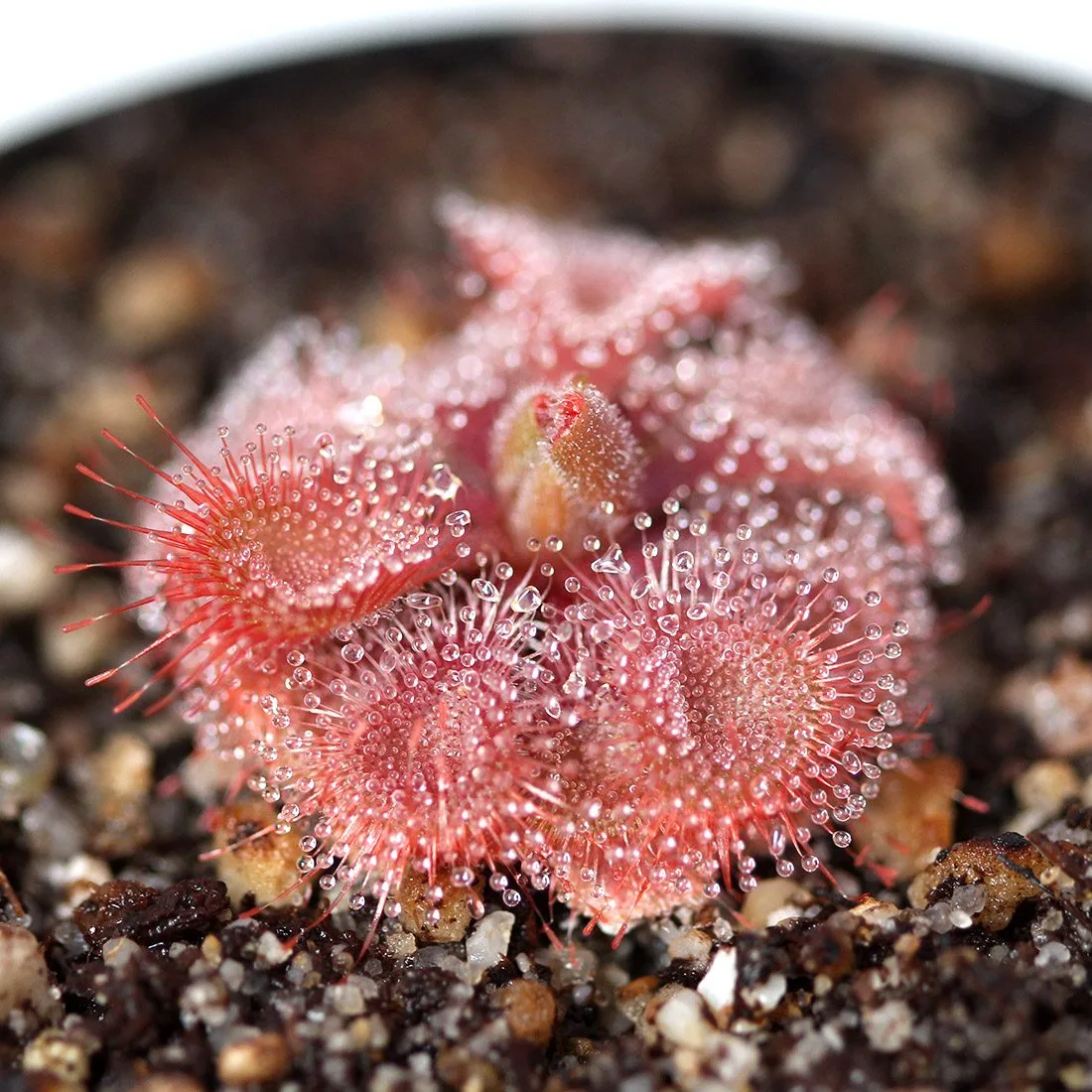
Burmann's sundew (Drosera burmannii) is a fast-growing annual/short-lived carnivorous bog plant adapted to nutrient-poor acidic wetlands; tap-water minerals, soil drying, or fertilizer rapidly burn its roots and leaves.
| What you notice | Possible explanation | What to check next |
|---|---|---|
| Tentacle tips lose their glistening sticky mucilage droplets and leaves curl inward dryly | Low ambient humidity, dry potting medium, or insufficient bright light | Check whether the pot stands in a shallow tray of rainwater/distilled water and evaluate sunlight |
| Rosette turns black and collapses rapidly after repotting or watering | Mineral toxicity from tap water, regular potting soil, or fertilizer | Verify water source (must be rainwater, distilled, or reverse-osmosis water <50 ppm) and substrate |
- Grow in pure, nutrient-free acidic sphagnum peat moss mixed with horticultural silica sand or perlite (1:1)—never use standard potting compost or fertilizer.
- Stand the pot in a shallow tray containing 1–2 cm of rainwater, distilled water, or reverse-osmosis water so the medium stays constantly wet.
- Provide full sun or very bright light (at least 4–6 hours of direct sun) and warm temperatures (18–30°C).
Drosera burmannii often behaves as an annual and may decline after heavy flowering; collect and sow its tiny dust-like seeds on damp peat to perpetuate your colony.
Aphids, Fungus Gnats, or Mold on Uneaten Prey
Aphids can distort young sundew rosettes, while large dead insects placed on leaves in stagnant air can grow grey mold.
| What you notice | Possible explanation | What to check next |
|---|---|---|
| Curled, distorted central leaves with small green or pale insects | Aphids feeding on tender non-sticky crown tissues | Inspect the center of the rosette and flower stalks closely |
| White or grey fuzz growing around a large dead insect on a leaf blade | Saprophytic mold growing on oversized prey in stagnant air | Check airflow and remove any moldy insect remains with clean tweezers |
- Remove moldy prey debris with clean tweezers and improve gentle air movement.
- For aphids, submerge the entire pot completely in clean rainwater/distilled water for 24–48 hours to drown pests safely without chemical burns, then drain.
- Allow the plant to catch tiny gnats or fruit flies naturally rather than overfeeding.
Never use standard chemical insecticides or foliar fertilizers on Drosera leaves, as they destroy the mucilage glands.
The Toxicity of Burmann's Sundew
Non-toxic to humans and pets, but the sticky secretions can cause minor skin irritation in sensitive individuals.