
Burmann's Sundew
Also known as: Burmann's Sundew, Tropical Sundew
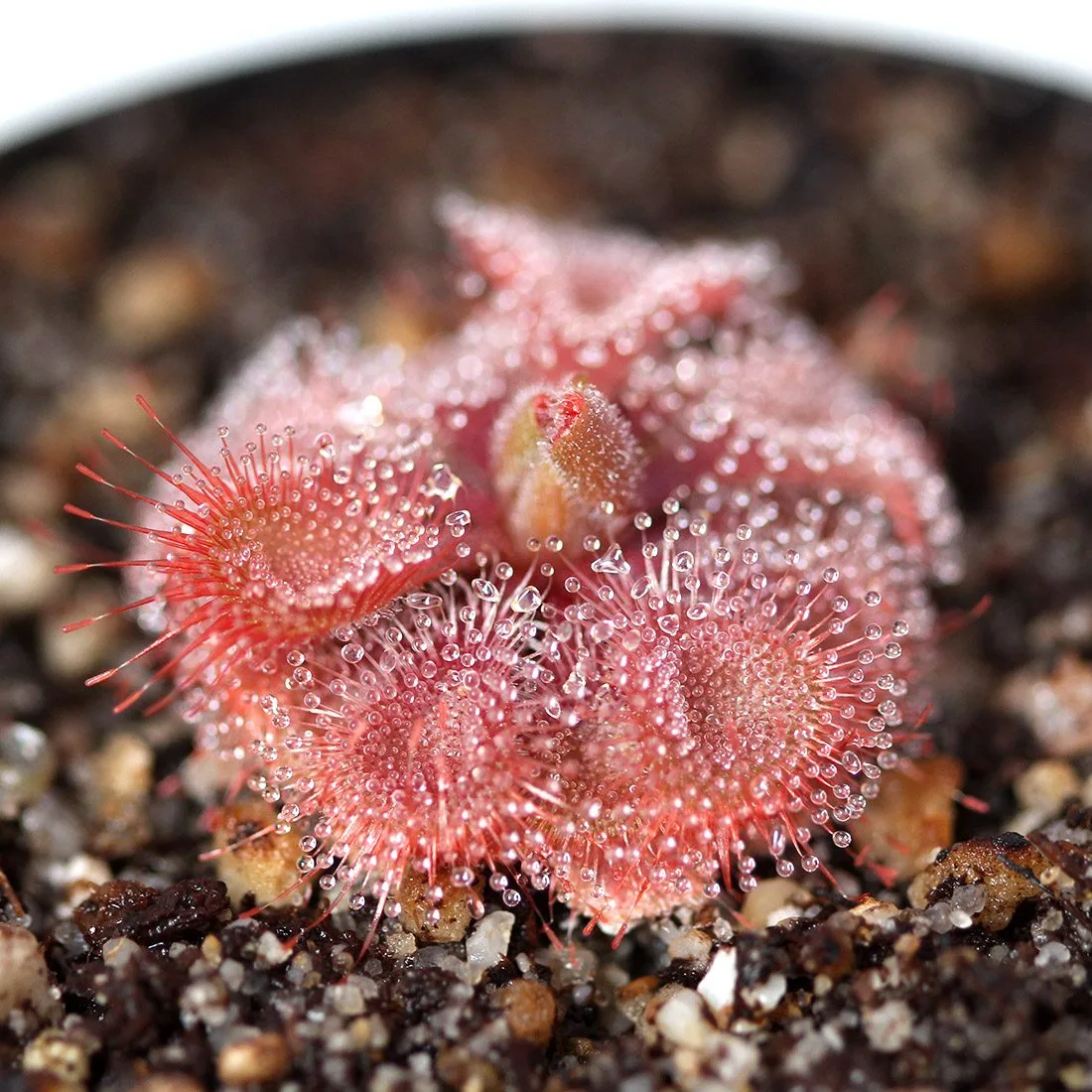
Drosera burmannii is a small, rosette-forming carnivorous plant. It produces tiny, spoon-shaped leaves covered in sticky glandular hairs that trap insects. The leaves are green to reddish, depending on light intensity. In spring and summer, slender stalks rise above the rosette bearing small white to pale pink flowers. Its compact size and glistening dew-like droplets make it a fascinating specimen for indoor cultivation.
Scientific classification
- Species
- Burmann's Sundew (Drosera burmannii)
- Genus
- Information to be completed
- Family
- Droseraceae
- Non-toxic to humans and pets, but the sticky secretions can cause minor skin irritation in sensitive individuals.
- Toxicity
- Bogs · Conservatory Greenhouse
- Plant type
- 0.05 - 0.1 metres
- Height
- 0.05 - 0.15 metres
- Spread
- Evergreen
- Foliage
- Matforming · Clump forming
- Habit
- Spring · Summer
- Season of interest
- Full sun
- Sunlight
- 15 – 25 °C
- Ideal temperature









Burmann's Sundew pictures
Distribution of Burmann's Sundew
Distribution map
Tropical Asia (India, Southeast Asia, southern China, Philippines) to northern Australia
Information to be completed
Culture
Information to be completed
Toxicity
Non-toxic to humans and pets, but the sticky secretions can cause minor skin irritation in sensitive individuals.
Quick identification of Burmann's Sundew
Information to be completed
Burmann's Sundew care guide
- Keep soil constantly moist with distilled or rainwater; use tray method if possible.
- Watering
- Full sun
- Sunlight
- 15 – 25 °C
- Ideal temperature

Watering
Keep soil constantly moist with distilled or rainwater; use tray method if possible.
Fertilizing
 Fertilizing
No fertilizer required; plant obtains nutrients from captured insects.
Pruning
 Pruning
Remove dead or withered leaves and spent flower stalks as needed to maintain a tidy appearance.
Propagation
 Propagation
Propagate by seed sown on damp sphagnum or peat in spring; keep at 20-25°C with high humidity. Leaf cuttings can also be rooted in moist sphagnum under high humidity.
Growing
 Growing
Grow in a sunny or bright location, ideally a south-facing windowsill or a greenhouse. Use a mix of peat and sand (or sphagnum moss) and keep the soil constantly moist with distilled or rainwater—never allow it to dry out. Avoid fertilizers; the plant derives nutrients from insects. In winter, reduce watering slightly but never let the soil become completely dry. Maintain high humidity by placing the pot on a tray of water. This species is not frost-tolerant and should be kept above 10°C year-round.
People also ask
Information to be completed
Common pests and diseases
Diseases
Susceptible to root rot if overwatered or kept in stagnant, waterlogged soil. Good air circulation helps prevent fungal issues.
Pests
Aphids and fungus gnats may occasionally infest the plant, especially in stagnant conditions.
Explore the plant health library →




