



Planting and Growing Japanese quince [Mango Storm]

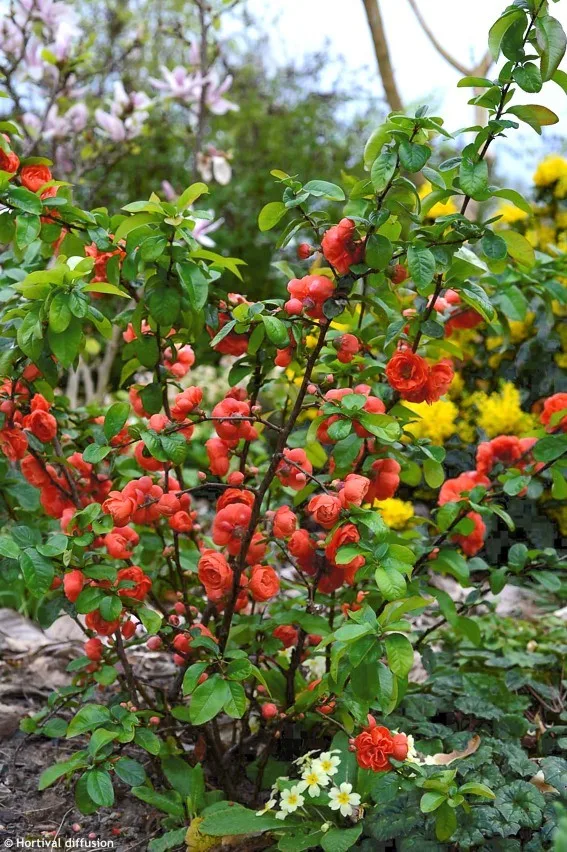
| Care difficulty | 2 / 5 |
|---|---|
| Watering schedule | Moderate regular watering, allowing brief slight drying between soakings |
| Sunlight requirements | Full sun · Partial shade |
| Ideal temperature | Information to be completed |
| Soil type | Chalk · Clay · Loam · Sand |
| Soil pH | Acid · Alkaline · Neutral |
| Soil moisture | Moist but well drained · Well drained |
| Fertilizing | Balanced perennial feed every four weeks from spring through summer |
| Toxicity | Fruit are ornamental - not to be eaten. Wear gloves and other protective equipment when handling |
How to Water Japanese quince [Mango Storm]?
Moderate regular watering, allowing brief slight drying between soakings
Learn more →What Are the Sunlight Requirements for Japanese quince [Mango Storm]?
Full sun · Partial shade
Learn more →What Soil Is Best for Japanese quince [Mango Storm]?
- Soil type
- Chalk · Clay · Loam · Sand
- Soil pH
- Acid · Alkaline · Neutral
What Are the Moisture Requirements for Japanese quince [Mango Storm]?
Moist but well drained · Well drained
Learn more →How to Fertilize Japanese quince [Mango Storm]?

Balanced perennial feed every four weeks from spring through summer
Learn more →How to Prune Japanese quince [Mango Storm]?

If growing against a wall cut back flowered shoots to within 2/4 buds of the permanent framework. If growing as a shrub, prune after flowering to strong buds or basal growth.Take out one-fifth of old shoot to the base.
Learn more →How to Propagate Japanese quince [Mango Storm]?

Root semi-ripe cuttings in summer. Layer in Autumn. Sow seed in an open frame or seedbed in Autumn.
Learn more →How to Plant Japanese quince [Mango Storm]?
Grow in well-drained soil in sun or partial shade. Grow in full sun for the best flowering and fruiting. See quince cultivation for further advice
Learn more →Common Pests & Diseases

Diseases
May be susceptible to fireblight, blossom wilt, brown rot and honey fungus (rarely)
Pests
May be susceptible to scale insects, brown scale and aphids
Explore the plant health library →The Toxicity of Japanese quince [Mango Storm]
Fruit are ornamental - not to be eaten. Wear gloves and other protective equipment when handling