



Planting and Growing Dendrobium Enobi Purple gx 'Splash'

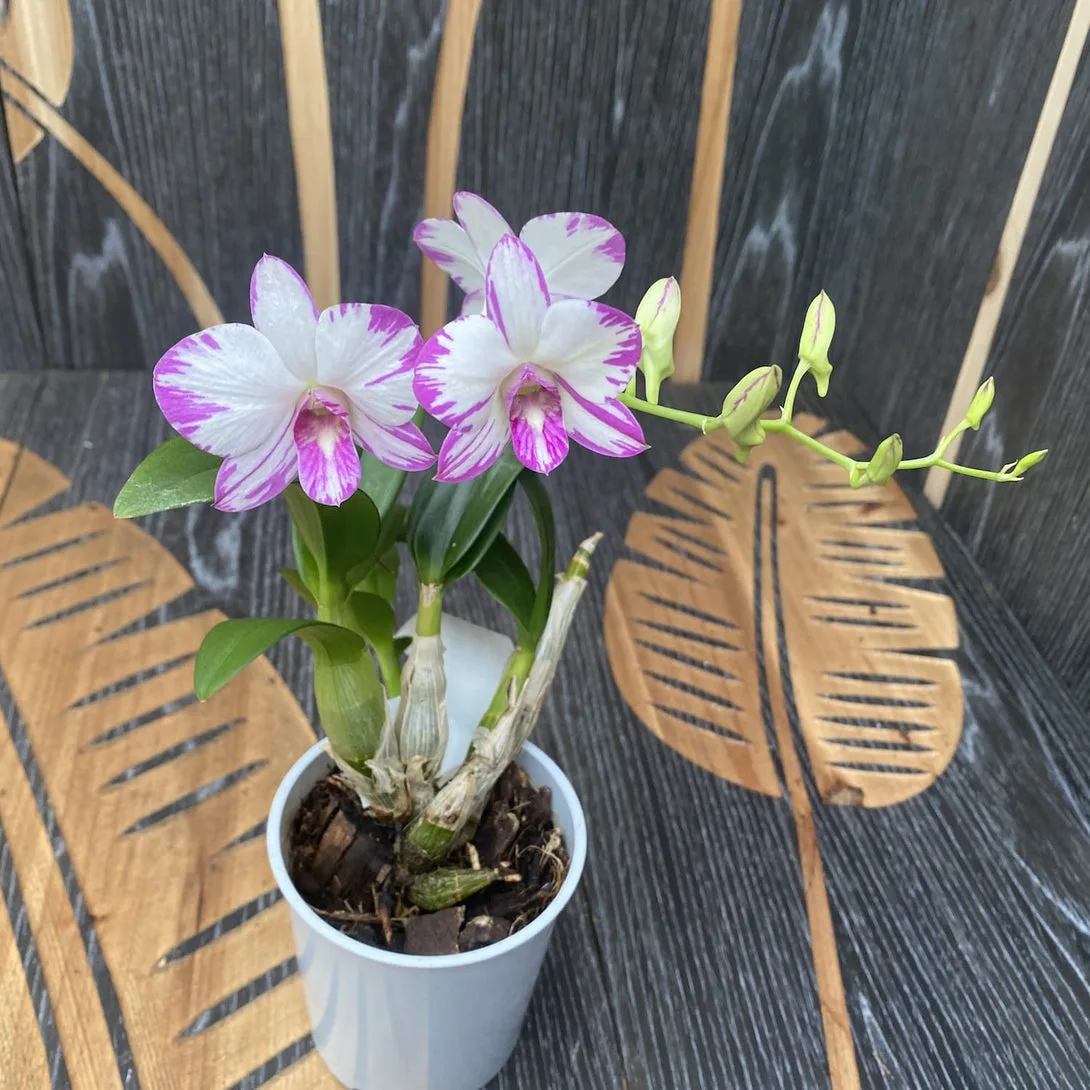
| Care difficulty | 3 / 5 |
|---|---|
| Watering schedule | Keep potting medium lightly moist, airy, and never stagnant |
| Sunlight requirements | Partial shade · Full sun |
| Ideal temperature | Information to be completed |
| Soil type | Information to be completed |
| Soil pH | Neutral |
| Soil moisture | Well drained |
| Fertilizing | Half-strength orchid feed every two to three weeks in active growth |
| Toxicity | Information to be completed |
How to Water Dendrobium Enobi Purple gx 'Splash'?
Keep potting medium lightly moist, airy, and never stagnant
Learn more →What Are the Sunlight Requirements for Dendrobium Enobi Purple gx 'Splash'?
Partial shade · Full sun
Learn more →What Soil Is Best for Dendrobium Enobi Purple gx 'Splash'?
- Soil type
- Information to be completed
- Soil pH
- Neutral
What Are the Moisture Requirements for Dendrobium Enobi Purple gx 'Splash'?
Well drained
Learn more →How to Fertilize Dendrobium Enobi Purple gx 'Splash'?

Half-strength orchid feed every two to three weeks in active growth
Learn more →How to Prune Dendrobium Enobi Purple gx 'Splash'?

No pruning required. Remove spent flowers as necessary, but do not cut the whole cane unless completely shrivelled. Oldest canes may be removed as long as there are at least three, younger, thick, leaf-bearing canes on the plant.
Learn more →How to Propagate Dendrobium Enobi Purple gx 'Splash'?

Propagation by seed is only possible in controlled laboratory environment. Mature plants may be divided when the plant overgrows the pot. Sideshoots (keiki) may develop on older canes -remove and pot them into sphagnum moss when the new roots are at least 2cm long.
Learn more →How to Plant Dendrobium Enobi Purple gx 'Splash'?
Plants are best grown in a pot in an epiphytic, medium grade, bark-based potting mix with added perlite, moss, or coir. As with many orchids, they grow best when the roots are slightly restricted. Therefore, avoid over-potting or frequent root disturbance. It is a warm-growing orchid and the temperatures should not drop below 16°C. It can be grown similarly to Moth Orchid (Phalaenopsis) but requires much brighter conditions. Provide indirect light and higher humidity by misting regularly in spring and summer, then move the plant to a bright, room in autumn and winter. Water approximately once per week, ensure that roots dry-out between the waterings, especially in winter. See indoor orchid cultivation
Learn more →Common Pests & Diseases

Diseases
Generally disease-free.
Pests
May be susceptible to scale insects, aphids, mealybugs and red spider mite.
Explore the plant health library →