
spiderwort 'Tricolor Minima'
Also known as: Information to be completed
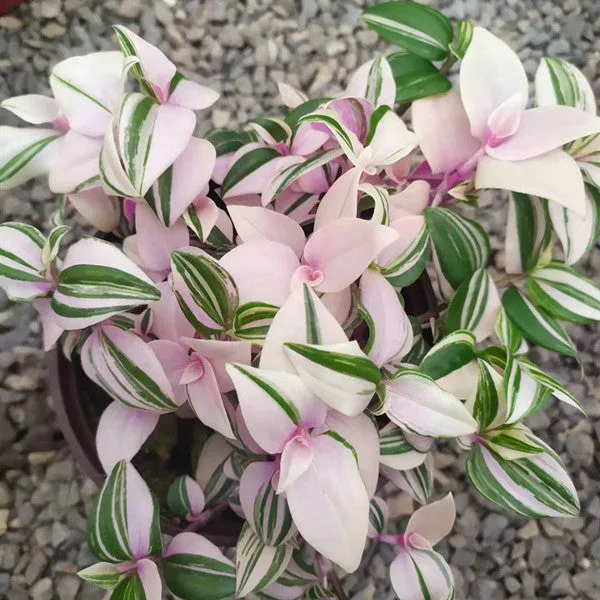
A trailing, evergreen perennial houseplant, with fleshy dark green leaves that are striped light pink and cream with a pink underside. Tiny white flowers are produced intermittently throughout the year
Scientific classification
- Species
- spiderwort 'Tricolor Minima' (Tradescantia fluminensis 'Tricolor Minima')
- Genus
- Tradescantia
- Family
- Commelinaceae
- Order
- Commelinales
- Class
- Liliopsida
- Phylum
- Magnoliophyta
- Skin allergen. Wear gloves and other protective equipment when handling
- Toxicity
- Houseplants
- Plant type
- Up to 10 cm
- Height
- 0.1-0.5 metres
- Spread
- Evergreen
- Foliage
- Trailing
- Habit
- Spring · Summer · Autumn · Winter
- Season of interest
- Partial shade
- Sunlight
- Information to be completed
- Ideal temperature









spiderwort 'Tricolor Minima' pictures
Distribution of spiderwort 'Tricolor Minima'
Distribution map
- Native
- Introduced
- Cultivated
Source:WCVP v16 · Royal Botanic Gardens, Kew · CC BY 3.0 · Boundaries:WGSRPD / TDWG
Toxicity
Skin allergen. Wear gloves and other protective equipment when handling
spiderwort 'Tricolor Minima' care guide
- Moderate regular watering, avoid prolonged drought and stagnant waterlogging
- Watering
- Partial shade
- Sunlight

Watering
Moderate regular watering, avoid prolonged drought and stagnant waterlogging
Fertilizing
 Fertilizing
Balanced perennial feed every four weeks spring through summer growth
Pruning
 Pruning
Pinch growth tips to encorage bushiness and remove plain green shoots from variegated cultivars, to stop reversion
Propagation
 Propagation
Propagate by softwood cuttings using stem tips in spring and summer
Growing
 Growing
Grow in a loamless peat free compost or John Innes No 2 which is loam based. Place in bright, filtered light but not direct sunlight. Pinch the growing tips to keep bushy and pinch out any plain green shoots of variegated cultivars. Plain green reverted shoots, if left, will take over the variegated growths.
Common pests and diseases
Diseases
Generally disease-free
Pests
May be susceptible to red spider mite, mealybugs, aphids, vine weevil and thrips
Explore the plant health library →




