
sumac 'Red Autumn Lace'
Also known as: Information to be completed
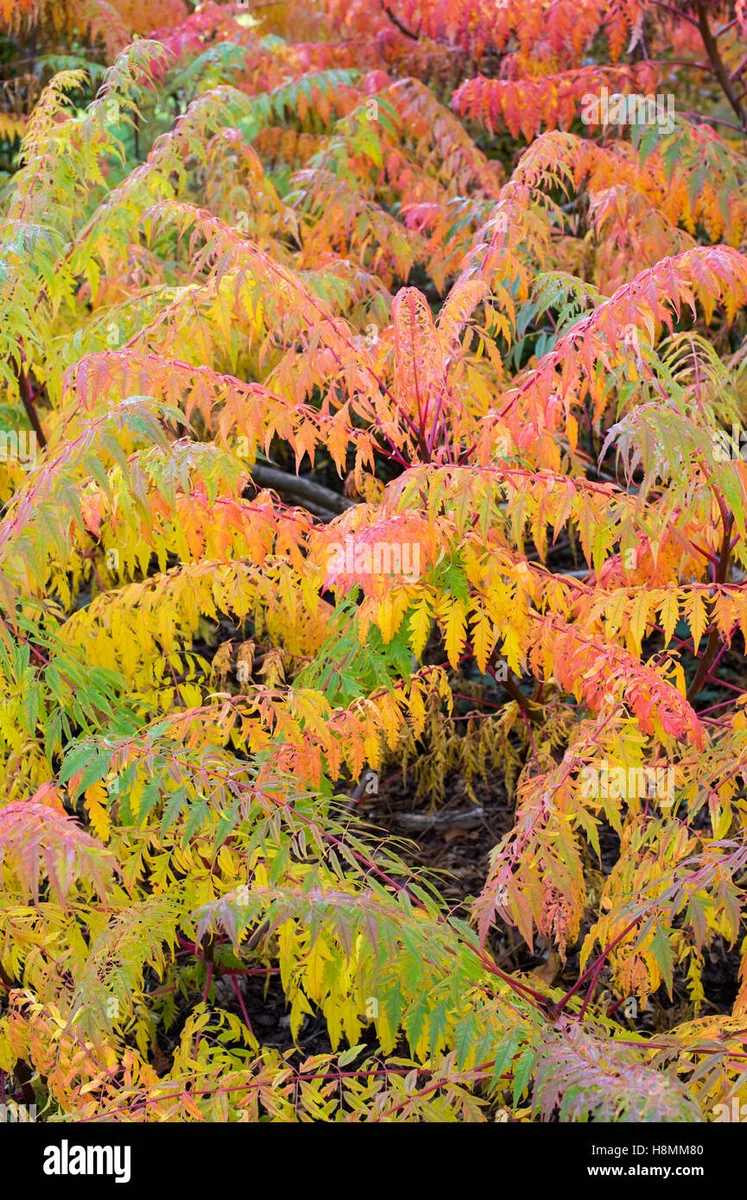
A spreading, suckering, deciduous shrub with pinnate leaves composed of 11-13 leaflets. In summer, yellow-green flowers are borne in erect, conical clusters, followed by spherical, bristly red fruit. The foliage takes on bright red and orange colouration in autumn
Scientific classification
- Species
- sumac 'Red Autumn Lace' (Rhus × pulvinata 'Red Autumn Lace')
- Genus
- Rhus
- Family
- Anacardiaceae
- Order
- Sapindales
- Class
- Magnoliopsida
- Phylum
- Magnoliophyta
- Information to be completed
- Toxicity
- Shrubs
- Plant type
- 1.5-2.5 metres
- Height
- 1.5-2.5 metres
- Spread
- Deciduous
- Foliage
- Suckering
- Habit
- Autumn · Spring · Summer
- Season of interest
- Full sun
- Sunlight
- Information to be completed
- Ideal temperature









sumac 'Red Autumn Lace' pictures
Distribution of sumac 'Red Autumn Lace'
Distribution map
- Native
- Introduced
- Cultivated
Source:WCVP v16 · Royal Botanic Gardens, Kew · CC BY 3.0 · Boundaries:WGSRPD / TDWG
sumac 'Red Autumn Lace' care guide
- Moderate regular watering, avoid prolonged drought or waterlogging
- Watering
- Full sun
- Sunlight

Watering
Moderate regular watering, avoid prolonged drought or waterlogging
Fertilizing
 Fertilizing
Balanced feed in spring and light repeat in growth season
Pruning
 Pruning
For colourful stems or large foliage, prune hard to a low framework. Let young plants establish for one to two years first. Prune in late winter or spring, before or as new growth starts.
Propagation
 Propagation
Propagate by seed, semi-ripe cuttings, or by separating suckers while the plant is dormant
Growing
 Growing
Grow in moist but well-drained soil in full sun to obtain best autumn colour. This variety is less vigorous than Rhus typhina but its suckering habit may make it a potential nusiance plant
Common pests and diseases
Diseases
May be susceptible to honey fungus, coral spot and Verticillium wilt
Pests
Generally pest-free
Explore the plant health library →




