
catkin yew
Also known as: Information to be completed
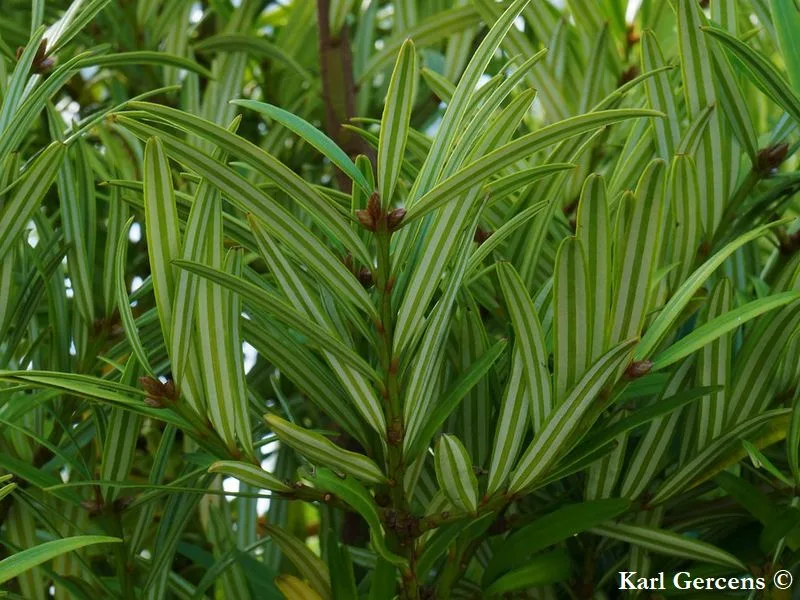
A slow-growing evergreen conifer, up to around 8m high, with ascending branches and reddish young bark fading to grey-brown. Leaves are linear, to around 10cm long, dark green and leathery, with bands of silvery white along the undersides. Pollen cones are around 6cm long, and formed in groups of 1-3 at tips of the branches, seed cones are shorter and rounder, to around 2.5cm long. Seeds are small and covered with a long red aril (a fleshy outgrowth or appendage)
Scientific classification
- Species
- catkin yew (Amentotaxus argotaenia)
- Genus
- Amentotaxus
- Family
- Cephalotaxaceae
- Order
- Cupressales
- Class
- Pinopsida
- Phylum
- Coniferophyta
- Information to be completed
- Toxicity
- Conifers · Trees
- Plant type
- 4-8 metres
- Height
- 4-8 metres
- Spread
- Evergreen
- Foliage
- Columnar upright
- Habit
- Spring · Summer · Autumn · Winter
- Season of interest
- Partial shade
- Sunlight
- Information to be completed
- Ideal temperature









catkin yew pictures
Distribution of catkin yew
Distribution map
- Native
- Introduced
- Cultivated
Source:WCVP v16 · Royal Botanic Gardens, Kew · CC BY 3.0 · Boundaries:WGSRPD / TDWG
catkin yew care guide
- Moderate regular watering, allowing brief slight drying between soakings
- Watering
- Partial shade
- Sunlight

Watering
Moderate regular watering, allowing brief slight drying between soakings
Fertilizing
 Fertilizing
Balanced perennial feed every four weeks from spring through summer
Pruning
 Pruning
Little pruning is needed. Remove diseased, damaged, crowded or crossing shoots and unwanted growth. Timing depends on the plant: generally late winter or early spring; plants prone to bleeding and deciduous magnolias need different timing, and deciduous azaleas and lilacs are pruned after flowering.
Propagation
 Propagation
Propagate by semi-ripe cuttings or by sowing seed as soon as it is ripe, outdoors. For more advice see our information on how to propagate from seed (tree/shrub)
Growing
 Growing
Thrives in rocky, moist but well-drained soils, in part or full shade. In regions where temperatures don't fall below -5°C, this species is well suited to understory planting in moist woodland or along damp stream banks
Common pests and diseases
Diseases
May be susceptible to Phytophthora root rot
Pests
Generally pest-free, though seeds may be eaten by rodents
Explore the plant health library →




