
snowflake
Also known as: Information to be completed
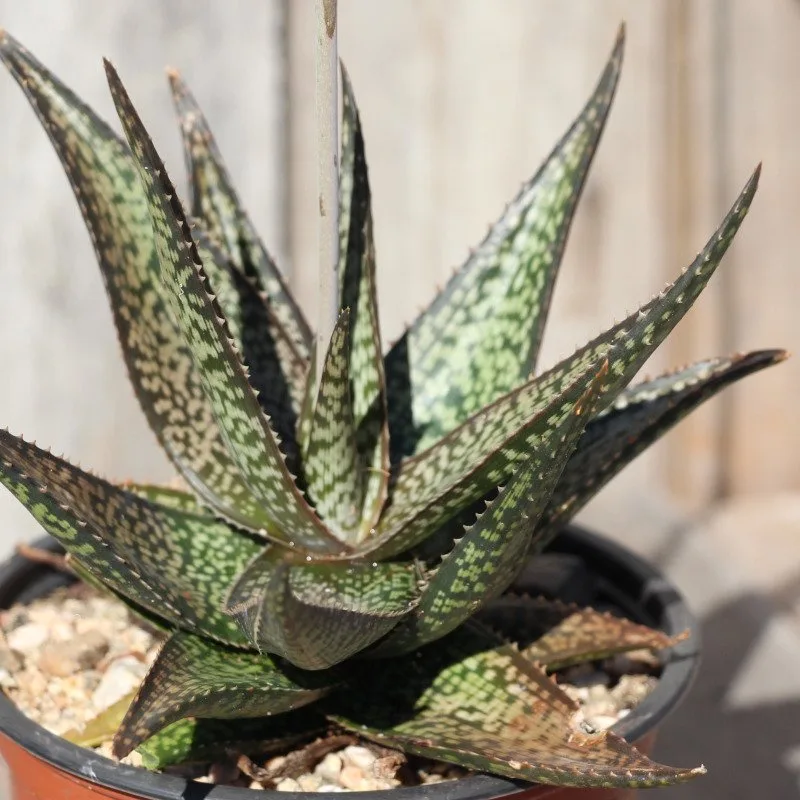
A stemless evergreen succulent with rosettes of lance-shaped, fleshy grey-green leaves, marked with patterns of paler green and with tiny white teeth on the margins. Leaves are sometimes flushed brown in strong sunlight. Flowers are small, pinkish-red and tubular, held on stalks up to 30cm high in summer
Scientific classification
- Species
- snowflake (Aloe rauhii)
- Genus
- Aloe
- Family
- Asphodelaceae
- Order
- Asparagales
- Class
- Liliopsida
- Phylum
- Magnoliophyta
- Harmful if eaten. Wear gloves and other protective equipment when handling
- Toxicity
- Cactus Succulent
- Plant type
- 0.1-0.5 metres
- Height
- 0.1-0.5 metres
- Spread
- Evergreen
- Foliage
- Clump forming
- Habit
- Spring · Summer · Autumn · Winter
- Season of interest
- Full sun
- Sunlight
- Information to be completed
- Ideal temperature









snowflake pictures
Distribution of snowflake
Distribution map
- Native
- Introduced
- Cultivated
Source:WCVP v16 · Royal Botanic Gardens, Kew · CC BY 3.0 · Boundaries:WGSRPD / TDWG
Toxicity
Harmful if eaten. Wear gloves and other protective equipment when handling
snowflake care guide
- Let gritty soil dry fully before each thorough watering cycle
- Watering
- Full sun
- Sunlight

Watering
Let gritty soil dry fully before each thorough watering cycle
Fertilizing
 Fertilizing
Very dilute low-nitrogen succulent feed monthly in warm growth
Pruning
 Pruning
Remove faded flower stems
Propagation
 Propagation
Propagate by seed sown at 21°C (70°F) as soon as ripe, or by division, separating offsets in late spring or early summer
Growing
 Growing
Grow in loam-based potting compost with added sharp sand or perlite, in full light with good ventilation. See houseplant cacti and succulent cultivation for more detailed advice
Common pests and diseases
Diseases
Generally disease-free
Pests
May be susceptible to scale insects and mealybugs
Explore the plant health library →




