
montbretia 'Red King'
Also known as: Information to be completed
A clump-forming perennial, to 70cm in height, with narrow, strap-like leaves and racemes of bright red, funnel shaped flowers with hints of yellow, to 10cm across, in late summer. Anthers are golden yellow as are the flower throats
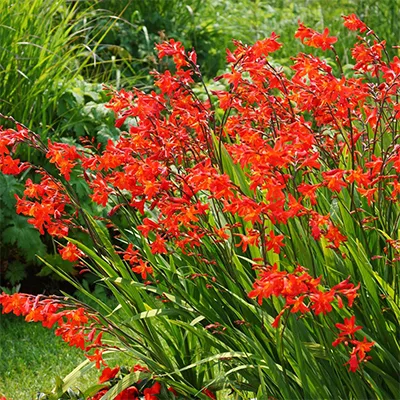
Scientific classification
- Species
- montbretia 'Red King' (Crocosmia × crocosmiiflora 'Red King')
- Genus
- Crocosmia
- Family
- Iridaceae
- Order
- Asparagales
- Class
- Liliopsida
- Phylum
- Tracheophyta
- Information to be completed
- Toxicity
- Herbaceous Perennial · Bulbs
- Plant type
- 0.5-1 metres
- Height
- 0.1-0.5 metres
- Spread
- Deciduous
- Foliage
- Clump forming
- Habit
- Spring · Summer · Autumn
- Season of interest
- Full sun · Partial shade
- Sunlight
- Information to be completed
- Ideal temperature









montbretia 'Red King' pictures
Distribution of montbretia 'Red King'
Distribution map
- Native
- Introduced
- Cultivated
Source:WCVP v16 · Royal Botanic Gardens, Kew · CC BY 3.0 · Boundaries:WGSRPD / TDWG
montbretia 'Red King' care guide
- Keep soil evenly moist during active growth, drier once winter dormancy arrives
- Watering
- Full sun · Partial shade
- Sunlight

Watering
Keep soil evenly moist during active growth, drier once winter dormancy arrives
Fertilizing
 Fertilizing
Balanced crocosmia feed every three weeks from spring into midsummer
Pruning
 Pruning
No pruning required, except removal of dead leaves and flower stems before new growth starts in spring
Propagation
 Propagation
Propagate by division in spring just before growth starts
Growing
 Growing
This species is listed on Schedule 9 of the UK Wildlife and Countryside Act as an invasive non-native species. While this does not prevent it from being sold in the UK, or from being grown in gardens, the RHS encourages those that do grow it to take great care with managing it and with disposing of unwanted material. The RHS also encourages gardeners to find alternative plants to grow to those listed on Schedule 9. For suggested alternative plants see the Plantlife/RHS guide: Gardening without harmful invasive plants
Common pests and diseases
Diseases
Generally disease-free
Pests
May be susceptible to glasshouse red spider mite
Explore the plant health library →




