
Diascia rigescens 'Anne Rennie'
Also known as: Information to be completed
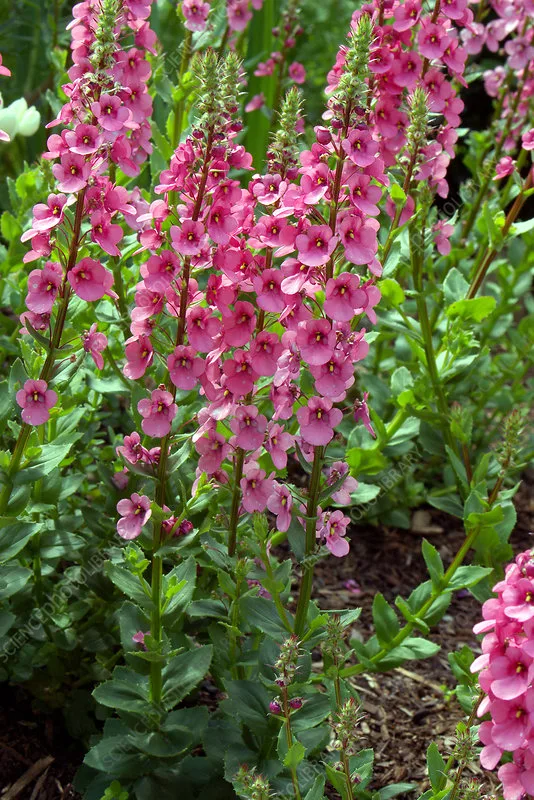
A trailing perennial with erect and semi-erect, branching stems and heart-shaped, deeply toothed, stalkless, semi-evergreen leaves. In summer it bears tall, dense spires of rose-pink flowers with characteristic small round 'windows' and short, incurved spurs. Height around 30cm (12in).
Scientific classification
- Species
- Diascia rigescens 'Anne Rennie' (Diascia rigescens 'Anne Rennie')
- Genus
- Diascia
- Family
- Scrophulariaceae
- Order
- Lamiales
- Class
- Magnoliopsida
- Phylum
- Magnoliophyta
- Information to be completed
- Toxicity
- Bedding · Herbaceous Perennial
- Plant type
- 0.1-0.5 metres
- Height
- 0.1-0.5 metres
- Spread
- Semi evergreen
- Foliage
- Trailing · Clump forming
- Habit
- Spring · Summer · Autumn · Winter
- Season of interest
- Full sun · Partial shade
- Sunlight
- Information to be completed
- Ideal temperature









Diascia rigescens 'Anne Rennie' pictures
Distribution of Diascia rigescens 'Anne Rennie'
Distribution map
- Native
- Introduced
- Cultivated
Source:WCVP v16 · Royal Botanic Gardens, Kew · CC BY 3.0 · Boundaries:WGSRPD / TDWG
Diascia rigescens 'Anne Rennie' care guide
- Even mild substrate dampness, cut back water volume late autumn season
- Watering
- Full sun · Partial shade
- Sunlight

Watering
Even mild substrate dampness, cut back water volume late autumn season
Fertilizing
 Fertilizing
Diluted diascia blooming feed biweekly spring through mid summer months
Pruning
 Pruning
No pruning required. Cut back old stems to ground level in spring.
Propagation
 Propagation
Propagate by softwood cuttings in spring, or semi-ripe cuttings in summer.
Growing
 Growing
Grow in fertile, moist but well-drained soil in full sun or partial shade. Water in dry periods. Provide protection from frosts.
Common pests and diseases
Diseases
Generally disease-free
Pests
May be susceptible to slugs and snails
Explore the plant health library →




