
Allium paradoxum var. normale
Also known as: Information to be completed
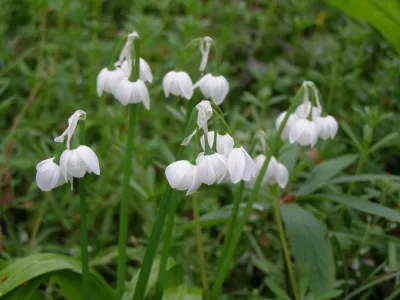
Bulbous perennial to about 30-50cm in height, with garlic scented, bright green, long, thin leaves to 40cm. Small, bell-shaped, white flowers are produced in clusters during early to late spring on upright stems are quickly replaced by clusters of small bulbils; quickly spreading, it may become a nuisance if conditions are favourable
Scientific classification
- Species
- Allium paradoxum var. normale (Allium paradoxum var. normale)
- Genus
- Allium
- Family
- Amaryllidaceae
- Order
- Asparagales
- Class
- Liliopsida
- Phylum
- Magnoliophyta
- Information to be completed
- Toxicity
- Bulbs
- Plant type
- 0.1-0.5 metres
- Height
- 0.5-1 metres
- Spread
- Deciduous
- Foliage
- Clump forming
- Habit
- Spring · Summer
- Season of interest
- Full sun · Partial shade
- Sunlight
- Information to be completed
- Ideal temperature









Allium paradoxum var. normale pictures
Distribution of Allium paradoxum var. normale
Distribution map
- Native
- Introduced
- Cultivated
Source:WCVP v16 · Royal Botanic Gardens, Kew · CC BY 3.0 · Boundaries:WGSRPD / TDWG
Allium paradoxum var. normale care guide
- Regular watering spring growth, reduce irrigation autumn leaf dieback
- Watering
- Full sun · Partial shade
- Sunlight

Watering
Regular watering spring growth, reduce irrigation autumn leaf dieback
Fertilizing
 Fertilizing
Weak bulb liquid feed applied once before spring leaf emergence phase
Pruning
 Pruning
No pruning required
Propagation
 Propagation
Please see cultivation notes
Growing
 Growing
This plant is listed on Schedule 9 of the UK Wildlife & Countryside Act as an invasive non-native species. Although not banned from sale, it is an offence to plant or cause these to grow in the wild IN ENGLAND WALES, NORTHERN IRELAND and the REPUBLIC OF IRELAND. Gardeners possessing them should undertake measures to control them. See RHS advice on invasive non-native species for further information
Common pests and diseases
Diseases
May be susceptible to onion white rot and onion downy mildew
Pests
May be susceptible to allium leaf miner and onion fly
Explore the plant health library →




