
bellflower 'Blue Bloomers'
Also known as: Information to be completed
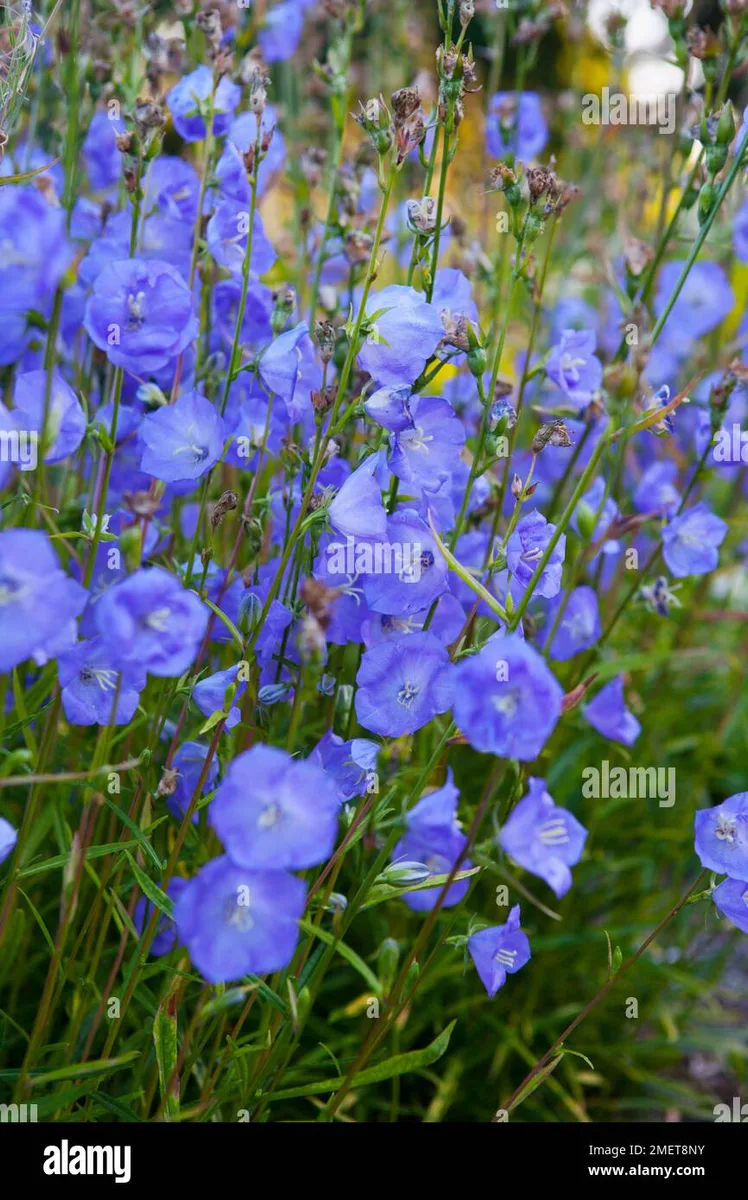
A deciduous perennial, to 75cm high, with narrowly-lance-shaped leaves. In summer, large, violet-blue, double flowers are held on the upper parts of upright stems arising from a basal rosette of foliage
Scientific classification
- Species
- bellflower 'Blue Bloomers' (Campanula persicifolia 'Blue Bloomers')
- Genus
- Campanula
- Family
- Campanulaceae
- Order
- Asterales
- Class
- Magnoliopsida
- Phylum
- Magnoliophyta
- Information to be completed
- Toxicity
- Herbaceous Perennial
- Plant type
- 0.1-0.5 metres
- Height
- 0.1-0.5 metres
- Spread
- Deciduous
- Foliage
- Columnar upright
- Habit
- Spring · Summer · Autumn
- Season of interest
- Full sun · Partial shade
- Sunlight
- Information to be completed
- Ideal temperature









bellflower 'Blue Bloomers' pictures
Distribution of bellflower 'Blue Bloomers'
Distribution map
- Native
- Introduced
- Cultivated
Source:WCVP v16 · Royal Botanic Gardens, Kew · CC BY 3.0 · Boundaries:WGSRPD / TDWG
bellflower 'Blue Bloomers' care guide
- Moderate regular watering, allowing brief slight drying between soakings
- Watering
- Full sun · Partial shade
- Sunlight

Watering
Moderate regular watering, allowing brief slight drying between soakings
Fertilizing
 Fertilizing
Balanced perennial feed every four weeks from spring through summer
Pruning
 Pruning
Cut back after flowering to encourage a second flush of flowers
Propagation
 Propagation
Propagate by division in spring or autumn or take basal cuttings in spring
Growing
 Growing
Best grown in fertile, neutral to alkaline soil that is moist but well-drained; in partial shade or sun
Common pests and diseases
Diseases
May be infected by a rust, powdery mildews and a leaf spot
Pests
May be damaged by slugs and snails
Explore the plant health library →




