
commonName:"false sunflower 'Sommersonne'"
Also known as: Information to be completed
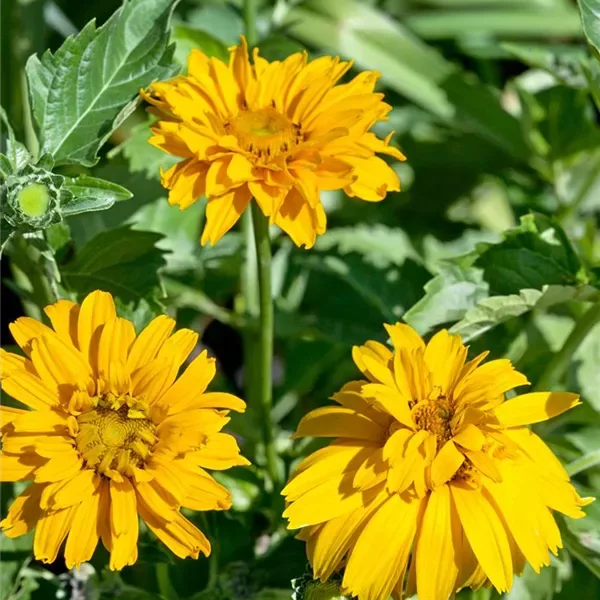
A clump-forming, herbaceous perennial to 1.2m tall, with ovate leaves. From late summer to early autumn it bears single, occasionally semi-double flowerheads, with deep golden yellow ray florets and brownish-yellow disc florets. A good plant to attract pollinating insects and also makes a long-lasting cut flower
Scientific classification
- Species
- commonName:"false sunflower 'Sommersonne'" (Heliopsis helianthoides var. scabra 'Sommersonne')
- Genus
- Heliopsis
- Family
- Asteraceae
- Order
- Asterales
- Class
- Magnoliopsida
- Phylum
- Magnoliophyta
- Information to be completed
- Toxicity
- Herbaceous Perennial
- Plant type
- 1-1.5 metres
- Height
- 0.5-1 metres
- Spread
- Deciduous
- Foliage
- Clump forming
- Habit
- Spring · Summer · Autumn
- Season of interest
- Full sun
- Sunlight
- Information to be completed
- Ideal temperature









commonName:"false sunflower 'Sommersonne'" pictures
Distribution of commonName:"false sunflower 'Sommersonne'"
Distribution map
- Native
- Introduced
- Cultivated
Source:WCVP v16 · Royal Botanic Gardens, Kew · CC BY 3.0 · Boundaries:WGSRPD / TDWG
commonName:"false sunflower 'Sommersonne'" care guide
- Moderate regular watering, allowing brief slight drying between soakings
- Watering
- Full sun
- Sunlight

Watering
Moderate regular watering, allowing brief slight drying between soakings
Fertilizing
 Fertilizing
Balanced perennial feed every four weeks from spring through summer
Pruning
 Pruning
Cut back stems to ground level in early winter
Propagation
 Propagation
Propagate by seed, division, or basal cuttings in spring
Growing
 Growing
Grow in moderately fertile, humus-rich, moist but well-drained soil in full sun. Divide every 2-3 years to maintain vigour. May require staking in exposed sites. See staking perennials
Common pests and diseases
Diseases
Generally disease-free
Pests
May be susceptible to slugs
Explore the plant health library →




