
Japanese black pine 'Thunderhead'
Also known as: Information to be completed
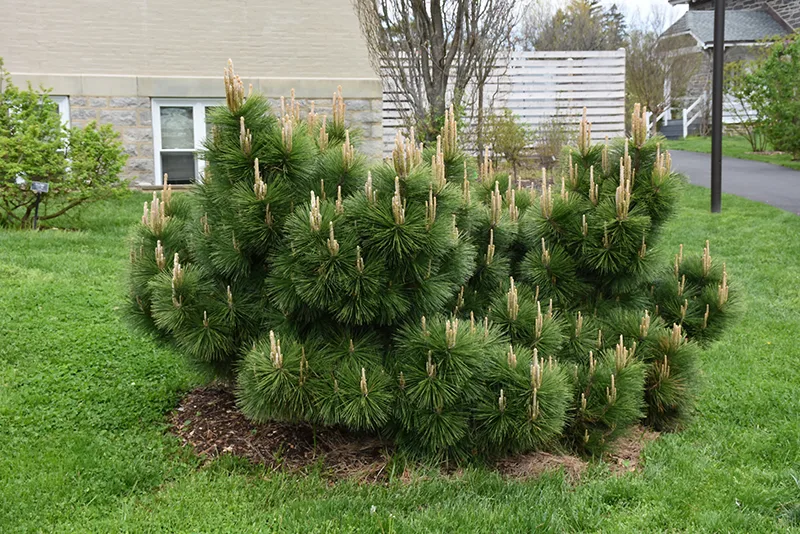
A compact, evergreen, coniferous tree, which produces an irregular, billowing, cloud-shaped canopy when mature, reaching about 3m (10ft) high and 1.5m (5ft) across after ten years. It has a open, branching habit. The needles are produced in bunches of two at the tips of the stems and are around 12cm (5in) long. They are glossy green in colour. It can produce oval-shaped, brown cones, that taper to a point at the tips and are up to 7cm (3in) long. The tree withstands exposed, coastal positions extremely well and its relatively small size, means it is an excellent choice for a small, city or courtyard garden, where an architectural, or evergreen focal point is needed
Scientific classification
- Species
- Japanese black pine 'Thunderhead' (Pinus thunbergii 'Thunderhead')
- Genus
- Pinus
- Family
- Pinaceae
- Information to be completed
- Toxicity
- Trees · Conifers
- Plant type
- 4-8 metres
- Height
- 1.5-2.5 metres
- Spread
- Evergreen
- Foliage
- Columnar upright
- Habit
- Spring · Summer · Autumn · Winter
- Season of interest
- Full sun
- Sunlight
- Information to be completed
- Ideal temperature









Japanese black pine 'Thunderhead' pictures
Distribution of Japanese black pine 'Thunderhead'
Distribution map
Information to be completed
Information to be completed
Culture
Information to be completed
Toxicity
Information to be completed
Quick identification of Japanese black pine 'Thunderhead'
Information to be completed
Japanese black pine 'Thunderhead' care guide
- Deep occasional watering with excellent drainage, less once established
- Watering
- Full sun
- Sunlight
- Information to be completed
- Ideal temperature

Watering
Deep occasional watering with excellent drainage, less once established
Fertilizing
 Fertilizing
Light conifer feed once yearly in early spring only
Pruning
 Pruning
No pruning required
Propagation
 Propagation
Propagate by grafting
Growing
 Growing
Grow in well-drained, preferably neutral to acidic soil in full sun
People also ask
Information to be completed
Common pests and diseases
Diseases
May be susceptible to honey fungus and needle cast diseases
Pests
May be susceptible to adelgids, conifer aphid, sawfly larvae, and pine shoot moth
Explore the plant health library →




