
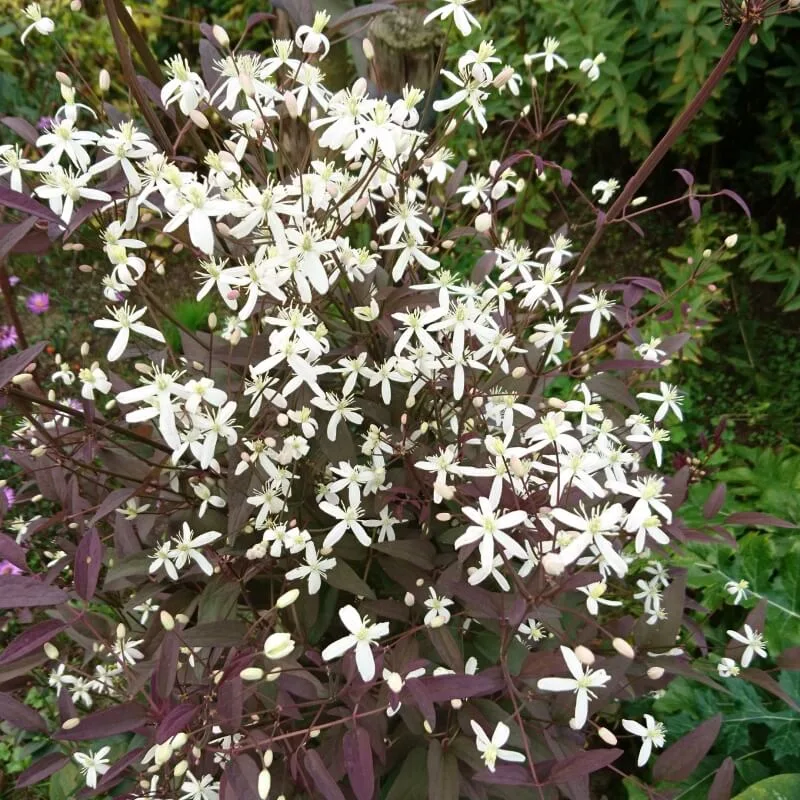
ground clematis 'Velvet Night'
Also known as: Information to be completed
A clump-forming, herbaceous perennial, to 2m high, with dark grey-green leaves that are flushed dark purple when young. Small, fragrant, starry white flowers are produced in mid to late summer
Scientific classification
- Species
- ground clematis 'Velvet Night' (Clematis recta 'Velvet Night')
- Genus
- Clematis
- Family
- Ranunculaceae
- Order
- Ranunculales
- Class
- Magnoliopsida
- Phylum
- Tracheophyta
- Skin irritant. Wear gloves and other protective equipment when handling
- Toxicity
- Herbaceous Perennial
- Plant type
- Information to be completed
- Height
- Information to be completed
- Spread
- Deciduous
- Foliage
- Clump forming
- Habit
- Autumn · Spring · Summer
- Season of interest
- Full sun · Partial shade
- Sunlight
- Information to be completed
- Ideal temperature









ground clematis 'Velvet Night' pictures
Distribution of ground clematis 'Velvet Night'
Distribution map
- Native
- Introduced
- Cultivated
Source:WCVP v16 · Royal Botanic Gardens, Kew · CC BY 3.0 · Boundaries:WGSRPD / TDWG
Toxicity
Skin irritant. Wear gloves and other protective equipment when handling
ground clematis 'Velvet Night' care guide
- Deep regular watering, keeping roots cool and never chronically dry
- Watering
- Full sun · Partial shade
- Sunlight

Watering
Deep regular watering, keeping roots cool and never chronically dry
Fertilizing
 Fertilizing
Balanced clematis feed monthly in spring, higher potash before bloom
Pruning
 Pruning
Prune as other herbaceous perennials, cutting back to ground level just before growth starts in spring. See clematis pruning: group three
Propagation
 Propagation
Propagate by division, or by basal softwood cuttings in spring or semi-ripe cuttings in early summer
Growing
 Growing
Plant in a moisture-retentive, well-drained soil; will tolerate part shade but leaf colour is best in full sun. Stems need support, see staking perennials. Ideal for a border where it can be supported by other plants. See clematis cultivation for more advice
Common pests and diseases
Diseases
May be susceptible to honey fungus (rarely), clematis wilt and clematis slime flux
Pests
May be susceptible to aphids. Cutworms and voles may cut young stems
Explore the plant health library →




