
houseleek tree 'Variegatum'
Also known as: Information to be completed
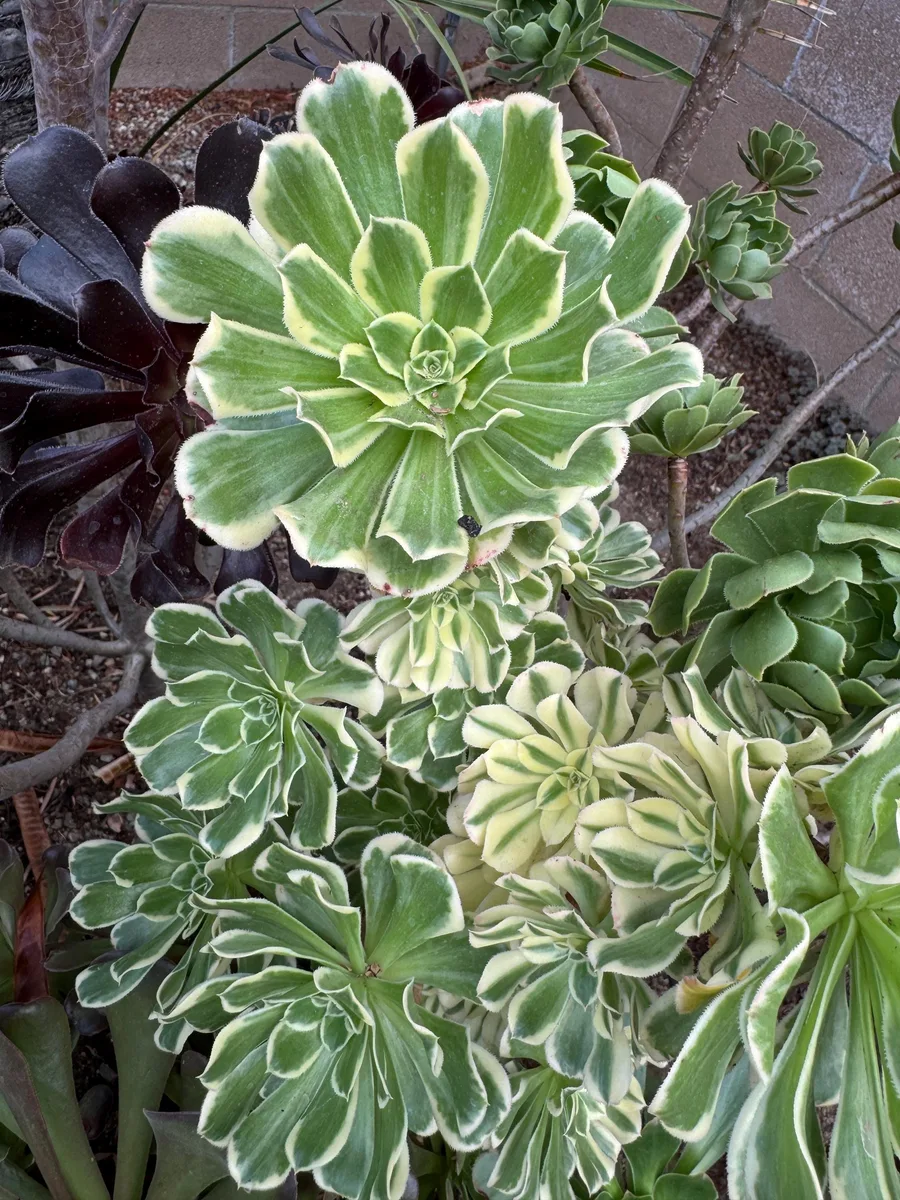
An upright, branching succulent to 60cm, with terminal rosettes of fleshy, spoon-shaped, pale greenleaves with broad cream margins. Sprays of small, cream flowers may appear in late spring
Scientific classification
- Species
- houseleek tree 'Variegatum' (Aeonium arboreum 'Variegatum')
- Genus
- Aeonium
- Family
- Crassulaceae
- Order
- Saxifragales
- Class
- Magnoliopsida
- Phylum
- Magnoliophyta
- Information to be completed
- Toxicity
- Cactus Succulent · Conservatory Greenhouse
- Plant type
- 0.5-1 metres
- Height
- 0.5-1 metres
- Spread
- Evergreen
- Foliage
- Bushy
- Habit
- Spring · Summer · Autumn · Winter
- Season of interest
- Full sun
- Sunlight
- Information to be completed
- Ideal temperature









houseleek tree 'Variegatum' pictures
Distribution of houseleek tree 'Variegatum'
Distribution map
- Native
- Introduced
- Cultivated
Source:WCVP v16 · Royal Botanic Gardens, Kew · CC BY 3.0 · Boundaries:WGSRPD / TDWG
houseleek tree 'Variegatum' care guide
- Fully dry soil between deep waterings, suspend water in winter cold
- Watering
- Full sun
- Sunlight

Watering
Fully dry soil between deep waterings, suspend water in winter cold
Fertilizing
 Fertilizing
Diluted low-nitrogen succulent feed monthly in warm growing season
Pruning
 Pruning
No pruning required
Propagation
 Propagation
Propagate by seed sown at 19-24°C in spring or by cuttings of rosettes kept at 18°C and barely moist until rooted
Growing
 Growing
Grow under glass in a loam-based potting compost with added grit. Water moderately when in growth, not at all when dormant. Apply a balanced liquid fertiliser two or three times in the growing season. See houseplant cacti and succulent cultivation
Common pests and diseases
Diseases
Generally disease-free
Pests
May be susceptible to aphids, mealybugs and vine weevil
Explore the plant health library →




