
elder 'Thundercloud'
Also known as: Information to be completed
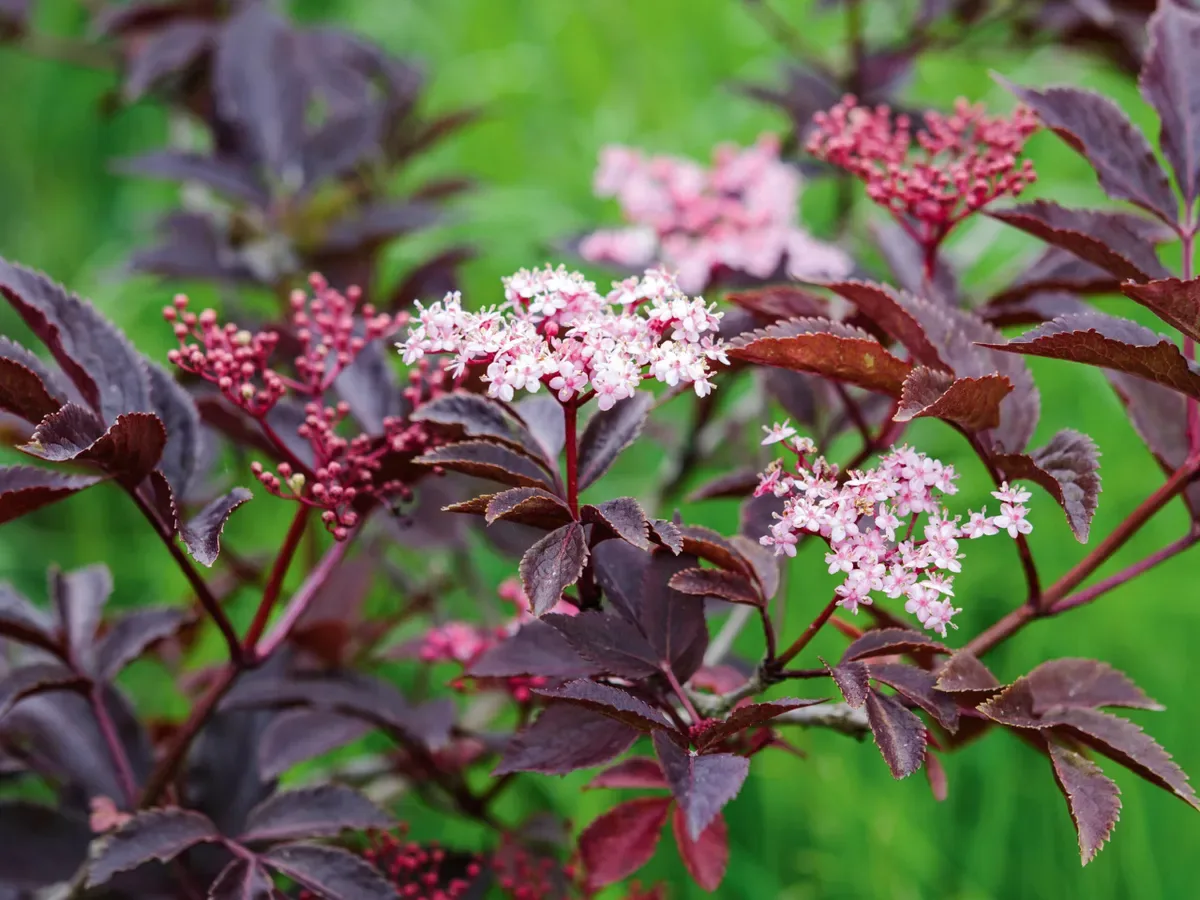
Decidous low maintenance shrub with a dense upright habit and finely-divided palmate leaves of almost black foliage. Red buds open in summer to flattened panicles of fragrant reddish-pink flowers that turn into glossy, dark purple fruit in autumn, a popular food source for wildlife.
Scientific classification
- Species
- elder 'Thundercloud' (Sambucus nigra f. porphyrophylla 'Thundercloud')
- Genus
- Sambucus
- Family
- Adoxaceae
- Order
- Dipsacales
- Class
- Magnoliopsida
- Phylum
- Tracheophyta
- Harmful if eaten, fruit/flowers edible if cooked. Wear gloves and other protective equipment when handling]
- Toxicity
- Shrubs
- Plant type
- 2.5-4 metres
- Height
- 1.5-2.5 metres
- Spread
- Deciduous
- Foliage
- Bushy
- Habit
- Autumn · Summer
- Season of interest
- Full sun · Partial shade
- Sunlight
- Information to be completed
- Ideal temperature









elder 'Thundercloud' pictures
Distribution of elder 'Thundercloud'
Distribution map
- Native
- Introduced
- Cultivated
Source:WCVP v16 · Royal Botanic Gardens, Kew · CC BY 3.0 · Boundaries:WGSRPD / TDWG
Toxicity
Harmful if eaten, fruit/flowers edible if cooked. Wear gloves and other protective equipment when handling]
elder 'Thundercloud' care guide
- Moderate regular watering, allowing brief slight drying between soakings
- Watering
- Full sun · Partial shade
- Sunlight

Watering
Moderate regular watering, allowing brief slight drying between soakings
Fertilizing
 Fertilizing
Balanced perennial feed every four weeks from spring through summer
Pruning
 Pruning
Minimal pruning in winter for general maintenance and to keep in shape. It will tolerate hard pruning to rejuvenate if required.
Propagation
 Propagation
Propagate from hard-wood or soft-wood cuttings.
Growing
 Growing
Will tolerate most soils in moderately fertile well-drained soil in full sun or partial-shade, prefering full sun to achieve the darkest leaf colour. Feed and water until well established, and lightly prune to keep in shape if necessary requiring little maintenance after that.
Common pests and diseases
Diseases
May be susceptible to verticillium wilt and honey fungus
Pests
May be susceptible to aphids and glasshouse red spider mite
Explore the plant health library →




