
clematis 'Alba'
Also known as: Information to be completed
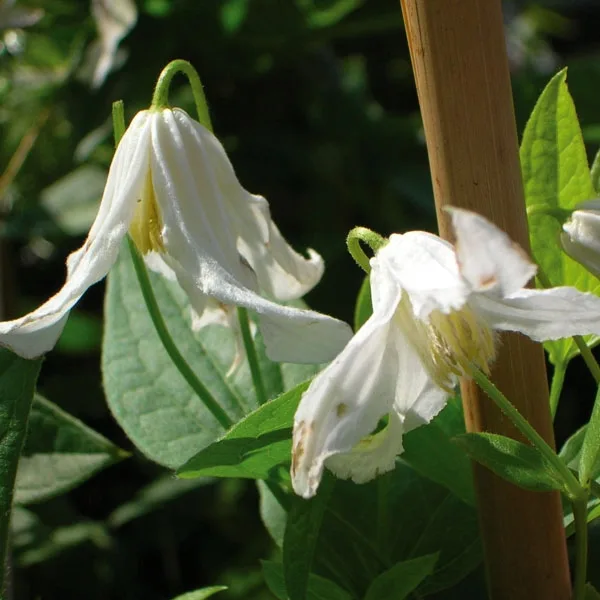
Deciduous, clump-forming herbaceous perennial to about 1m tall, with elliptical green leaves and stems topped by nodding, bell-shaped pure white flowers, occasionally tinted blue at the base, with slightly twisted outer sepals surrounding creamy-white anthers. Flowers from midsummer to early autumn, are followed by feathery, silvery seedheads
Scientific classification
- Species
- clematis 'Alba' (Clematis integrifolia 'Alba')
- Genus
- Clematis
- Family
- Ranunculaceae
- Order
- Ranunculales
- Class
- Magnoliopsida
- Phylum
- Tracheophyta
- Skin irritant. Wear gloves and other protective equipment when handling
- Toxicity
- Herbaceous Perennial
- Plant type
- 0.5-1 metres
- Height
- 0.5-1 metres
- Spread
- Deciduous
- Foliage
- Clump forming
- Habit
- Spring · Summer · Autumn
- Season of interest
- Full sun
- Sunlight
- Information to be completed
- Ideal temperature









clematis 'Alba' pictures
Distribution of clematis 'Alba'
Distribution map
- Native
- Introduced
- Cultivated
Locally extinct or doubtful records are excluded from native and introduced layers.
Source:WCVP v16 · Royal Botanic Gardens, Kew · CC BY 3.0 · Boundaries:WGSRPD / TDWG
Toxicity
Skin irritant. Wear gloves and other protective equipment when handling
clematis 'Alba' care guide
- Deep watering with cool roots, avoid soggy crown
- Watering
- Full sun
- Sunlight

Watering
Deep watering with cool roots, avoid soggy crown
Fertilizing
 Fertilizing
Low nitrogen feed in spring, higher potash before flowering
Pruning
 Pruning
 (clematis) group 3
Propagation
 Propagation
Propagate by division or take basal softwood cuttings of herbaceous clematis in spring
Growing
 Growing
Plant herbaceous (non-climbing) clematis at soil level in moisture-retentive, well-drained soil in full sun, with the roots and base of the plant in shade. See clematis cultivation
Common pests and diseases
Diseases
May be susceptible to honey fungus (rarely), clematis wilt and clematis slime flux
Pests
May be susceptible to aphids, snails and caterpillars; petals may be eaten by earwigs
Explore the plant health library →




