
Japanese cedar 'Barabits Gold'
Also known as: Information to be completed
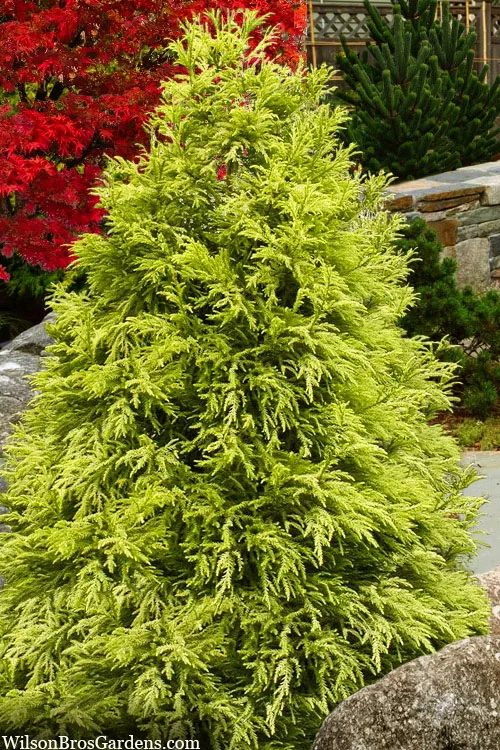
A vigorous evergreen conifer, to around 5m high in 10 years, with semi-pendent branches and fine, linear leaves arranged in spirals around the stems. New shoots are pale gold in spring and summer, and tinted bronze in late autumn and winter
Scientific classification
- Species
- Japanese cedar 'Barabits Gold' (Cryptomeria japonica 'Barabits Gold')
- Genus
- Cryptomeria
- Family
- Cupressaceae
- Order
- Cupressales
- Class
- Pinopsida
- Phylum
- Pinophyta
- Information to be completed
- Toxicity
- Conifers
- Plant type
- 4-8 metres
- Height
- 2.5-4 metres
- Spread
- Evergreen
- Foliage
- Bushy
- Habit
- Autumn · Winter · Spring · Summer
- Season of interest
- Full sun · Partial shade
- Sunlight
- Information to be completed
- Ideal temperature









Japanese cedar 'Barabits Gold' pictures
Distribution of Japanese cedar 'Barabits Gold'
Distribution map
- Native
- Introduced
- Cultivated
Source:WCVP v16 · Royal Botanic Gardens, Kew · CC BY 3.0 · Boundaries:WGSRPD / TDWG
Japanese cedar 'Barabits Gold' care guide
- Moderate regular watering, avoid prolonged drought or waterlogging
- Watering
- Full sun · Partial shade
- Sunlight

Watering
Moderate regular watering, avoid prolonged drought or waterlogging
Fertilizing
 Fertilizing
Balanced feed in spring and light repeat in growth season
Pruning
 Pruning
No pruning required
Propagation
 Propagation
Propagate by semi-hardwood cuttings in late summer or early autumn
Growing
 Growing
Tolerates most soils, but prefers a humus-rich, moist but well-drained soil in full sun or partial shade. Requires a sheltered site. Dislikes waterlogging
Common pests and diseases
Diseases
May be susceptible to phytophthora root rot and honey fungus (rarely)
Pests
Generally pest-free
Explore the plant health library →




