
radish 'Sparkler'
Also known as: Information to be completed
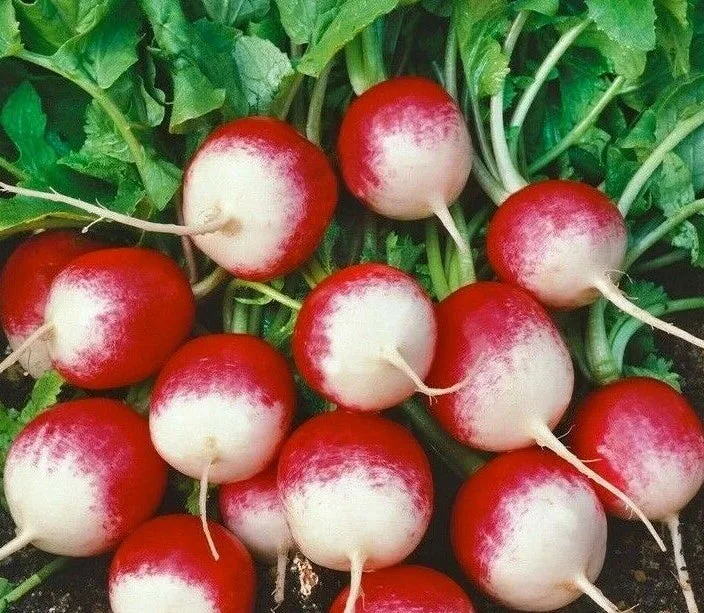
Has round roots which are bright red with a white tip, and crisp white flesh with a mild flavour. Radishes, Raphanus sativus, are annuals or biennials which germinate fast and grow fast, with lobed, dark green leaves to about 15-20cm high, and succulent, sharp-tasting edible enlarged taproots which can be harvested about four weeks after sowing, and can be round, tapering, or cylindrical, and have red, white, green, yellow, purple, or black skin, while the flesh is usually white but may be red or purple; if plants are left long enough, for example when grown as a cover crop or green manure, to grow to about 90cm then they can produce white or pale lilac flowers which provide both nectar and pollen for bees.
Scientific classification
- Species
- radish 'Sparkler' (Raphanus sativus 'Sparkler')
- Genus
- Raphanus
- Family
- Brassicaceae
- Information to be completed
- Toxicity
- Annual Biennial
- Plant type
- 0.1-0.5 metres
- Height
- 0.1-0.5 metres
- Spread
- Deciduous
- Foliage
- Bushy
- Habit
- Spring · Summer · Autumn · Winter
- Season of interest
- Full sun · Partial shade
- Sunlight
- Information to be completed
- Ideal temperature









radish 'Sparkler' pictures
Distribution of radish 'Sparkler'
Distribution map
Information to be completed
Information to be completed
Culture
Information to be completed
Toxicity
Information to be completed
Quick identification of radish 'Sparkler'
Information to be completed
radish 'Sparkler' care guide
- Moderate regular watering, allowing brief slight drying between soakings
- Watering
- Full sun · Partial shade
- Sunlight
- Information to be completed
- Ideal temperature

Watering
Moderate regular watering, allowing brief slight drying between soakings
Fertilizing
 Fertilizing
Balanced perennial feed every four weeks from spring through summer
Pruning
 Pruning
No pruning required
Propagation
 Propagation
Propagate by seed sown 1-2cm deep, from early spring to late summer
Growing
 Growing
Grow in full light or light shade, ideally in light, rich, near-neutral, and moist but well-drained soil; sow seed at frequent intervals from early spring to late summer, so that there is a succession of crops; sow in rows 15cm apart, at a depth of 1-2cm, and sow at or thin to a spacing of about 3 cm apart, and harvest them when young so that they do not become woody; for more advice, see radish cultivation
People also ask
Information to be completed
Common pests and diseases
Diseases
Radishes may be affected by brassica downy mildew, and by brassica white blister, club root, damping off, fungal leaf spot, and virus diseases
Pests
Radishes may be affected by flea beetles, slugs and snails, and cabbage root fly
Explore the plant health library →




