
broad-leaved thyme 'Foxley'
Also known as: Information to be completed
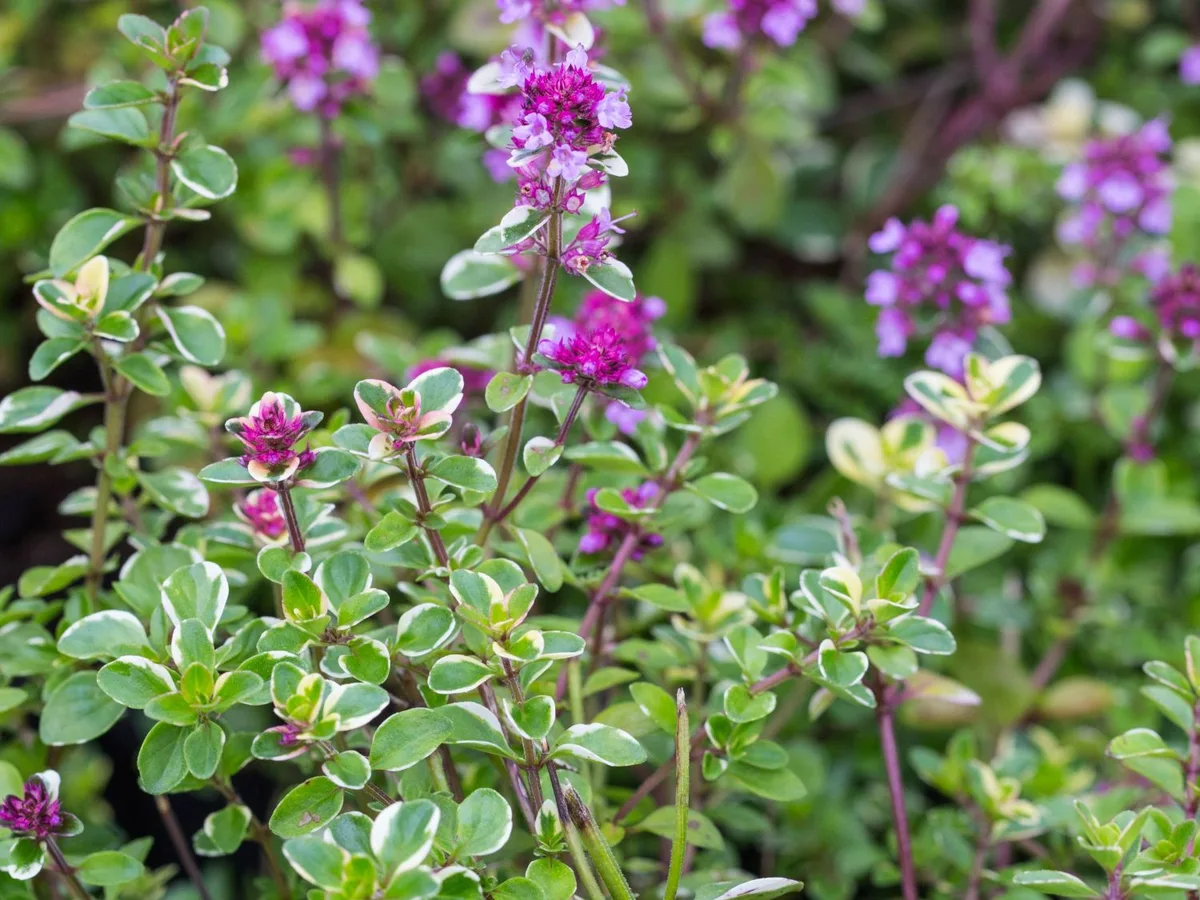
An evergreen, spreading sub-shrub, to 20cm high, with small, aromatic, green leaves irregularly-variegated with cream and short spikes of tiny purple-pink flowers in late spring and early summer
Scientific classification
- Species
- broad-leaved thyme 'Foxley' (Thymus pulegioides 'Foxley')
- Genus
- Thymus
- Family
- Lamiaceae
- Order
- Lamiales
- Class
- Magnoliopsida
- Phylum
- Magnoliophyta
- Information to be completed
- Toxicity
- Herbs - Culinary · Shrubs
- Plant type
- 0.1-0.5 metres
- Height
- 0.1-0.5 metres
- Spread
- Evergreen
- Foliage
- Matforming
- Habit
- Spring · Summer · Autumn · Winter
- Season of interest
- Full sun
- Sunlight
- Information to be completed
- Ideal temperature









broad-leaved thyme 'Foxley' pictures
Distribution of broad-leaved thyme 'Foxley'
Distribution map
- Native
- Introduced
- Cultivated
Source:WCVP v16 · Royal Botanic Gardens, Kew · CC BY 3.0 · Boundaries:WGSRPD / TDWG
broad-leaved thyme 'Foxley' care guide
- Moderate regular watering, allowing brief slight drying between soakings
- Watering
- Full sun
- Sunlight

Watering
Moderate regular watering, allowing brief slight drying between soakings
Fertilizing
 Fertilizing
Balanced perennial feed every four weeks from spring through summer
Pruning
 Pruning
Shorten flowered shoots to about 1.5–2.5 cm from the previous year's growth. If flowering is on last year's growth, prune after flowering; if on current-year growth, prune the following early to mid-spring.
Propagation
 Propagation
Propagate by division in spring. Semi-hardwood cuttings may be taken in mid- to late-summer although some bottom heat may be required
Growing
 Growing
Easy to grow in most well-drained, alkaline to neutral soils in full sun
Common pests and diseases
Diseases
Generally disease-free
Pests
Generally pest-free
Explore the plant health library →




