
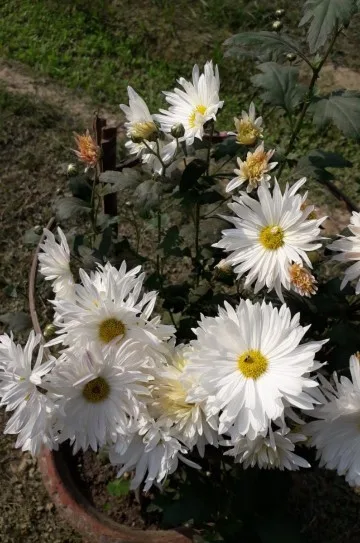
chrysanthemum 'Long Island Beauty'
Also known as: Information to be completed
Long Island Beauty' is a medium Anemone-centred chrysanthemum with sprays of white flower-heads
Scientific classification
- Species
- chrysanthemum 'Long Island Beauty' (Chrysanthemum 'Long Island Beauty')
- Genus
- Chrysanthemum
- Family
- Asteraceae
- Order
- Asterales
- Class
- Magnoliopsida
- Phylum
- Tracheophyta
- Skin allergen. Wear gloves and other protective equipment when handling
- Toxicity
- Conservatory Greenhouse
- Plant type
- 1-1.5 metres
- Height
- 0.5-1 metres
- Spread
- Deciduous
- Foliage
- Bushy
- Habit
- Spring · Summer · Autumn
- Season of interest
- Full sun
- Sunlight
- Information to be completed
- Ideal temperature









chrysanthemum 'Long Island Beauty' pictures
Toxicity
Skin allergen. Wear gloves and other protective equipment when handling
chrysanthemum 'Long Island Beauty' care guide
- Moderate regular watering, allowing brief slight drying between soakings
- Watering
- Full sun
- Sunlight

Watering
Moderate regular watering, allowing brief slight drying between soakings
Fertilizing
 Fertilizing
Balanced perennial feed every four weeks from spring through summer
Pruning
 Pruning
Cut back to near ground level in the autumn, before lifting and storing for the winter
Propagation
 Propagation
Propagate by rooting softwood cuttings in loam-less potting compost at 16°C in spring. Pot on rooted cuttings in late June to early July into 23cm pots and pinch out as soon as established
Growing
 Growing
Grow in a rich, fertile, moist but well-drained soil in sun in glasshouse border or containers of John Innes Number 3 compost. Plants can be grown outdoors in summer and brought into a cool greenhouse in early September. Blooms are produced in October to November, extending into December and so need protection from frosts in a temperate or warm greenhouse. They are grown either as disbudded or non-disbudded forms. Disbuds have all of the flower buds on each shoot removed except for the terminal bud so causing a much larger bloom to be produced than is usual. Up to 6 shoots are allowed to develop per plant, each bearing a single flower. Non-disbudded chrysanthemums are permitted to develop freely, with up to 6 stems per plant, each bearing 5 or more flower heads. The central bud of each spray is removed to give a more rounded outline
Common pests and diseases
Diseases
May be susceptible to glasshouse grey mould, powdery mildews and chrysanthemum white rust
Pests
May be susceptible to aphids and leaf miners which are common pests. Leaf and bud eelworms can damage stock that has not been heat-treated. Earwigs sometimes damage blooms. Capsid bug and glasshouse red spider mite are occasional pests
Explore the plant health library →




