
barrenwort 'Caramel'
Also known as: Information to be completed
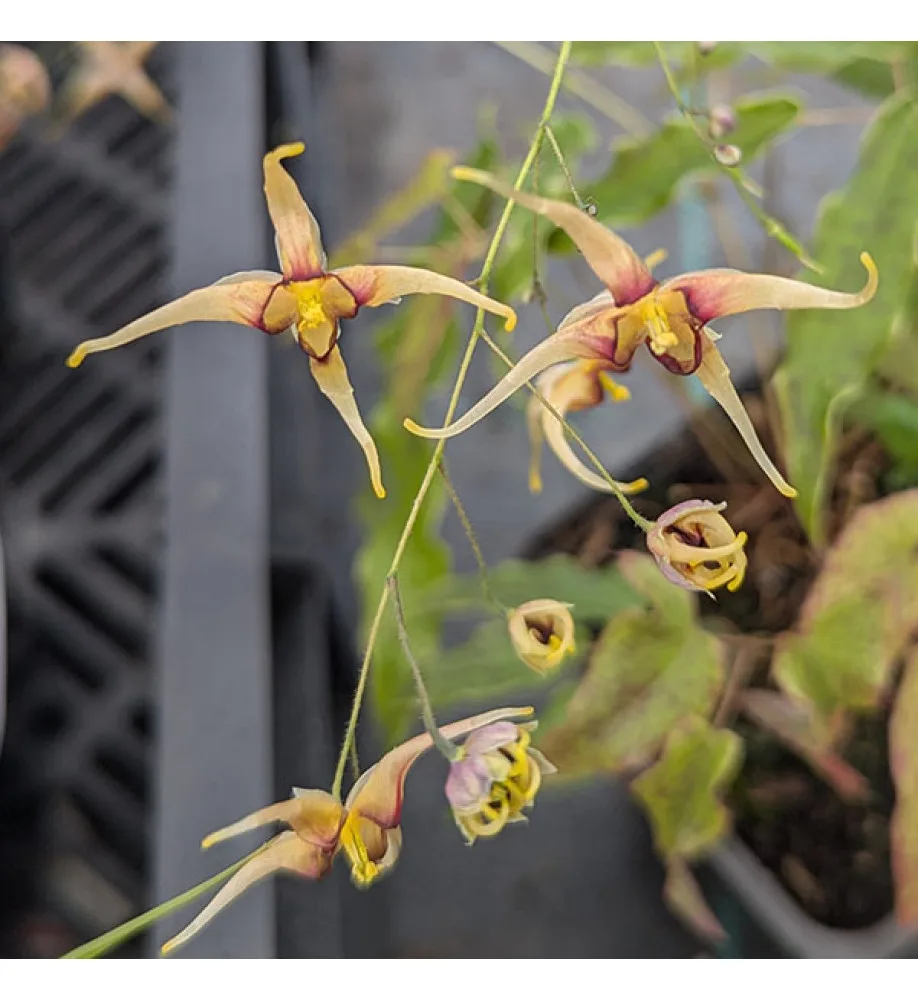
Caramel' is a clump-forming rhizomatous perennial 80-100cm high, with evergreen leaves divided into three long lance-shaped, glossy leaflets which are mid-green, splashed with brown when young, and have heart-shaped bases and wavy, spiny margins, and tall stems of spidery flowers of pale cream sepals suffused with light red and long-spurred, pale yellow petals suffused with orange, and dark purplish-brown mouths, from mid-spring to late spring; Epimedium leaves may be used for their nests by leaf-cutting bees
Scientific classification
- Species
- barrenwort 'Caramel' (Epimedium wushanense 'Caramel')
- Genus
- Epimedium
- Family
- Berberidaceae
- Order
- Ranunculales
- Class
- Magnoliopsida
- Phylum
- Magnoliophyta
- Information to be completed
- Toxicity
- Herbaceous Perennial
- Plant type
- 0.5-1 metres
- Height
- 0.1-0.5 metres
- Spread
- Evergreen
- Foliage
- Clump forming
- Habit
- Spring · Summer · Autumn · Winter
- Season of interest
- Partial shade
- Sunlight
- Information to be completed
- Ideal temperature









barrenwort 'Caramel' pictures
Distribution of barrenwort 'Caramel'
Distribution map
- Native
- Introduced
- Cultivated
Source:WCVP v16 · Royal Botanic Gardens, Kew · CC BY 3.0 · Boundaries:WGSRPD / TDWG
barrenwort 'Caramel' care guide
- Steady lightly damp shaded soil, avoid total root ball drying
- Watering
- Partial shade
- Sunlight

Watering
Steady lightly damp shaded soil, avoid total root ball drying
Fertilizing
 Fertilizing
Mild balanced woodland perennial feed every four warm weeks
Pruning
 Pruning
No pruning required, but cutting back in late winter or early spring, before flower spikes form, will improve appearance
Propagation
 Propagation
Propagate by division in autumn or after flowering; or by root cuttings of rhizomes, kept under glass in winter, and planted out after all danger of frost has passed
Growing
 Growing
Grow in fertile, humus-rich, moist but well-drained soil in partial shade, with shelter from cold, drying winds; where frosts are prolonged or severe, spread an organic mulch such as leaf mould or composted bark to protect plants over winter
Common pests and diseases
Diseases
May be susceptible to mosaic virus diseases and fungal leaf spots
Pests
May be susceptible to vine weevil
Explore the plant health library →




