
Japanese maple 'Peaches and Cream'
Also known as: Information to be completed
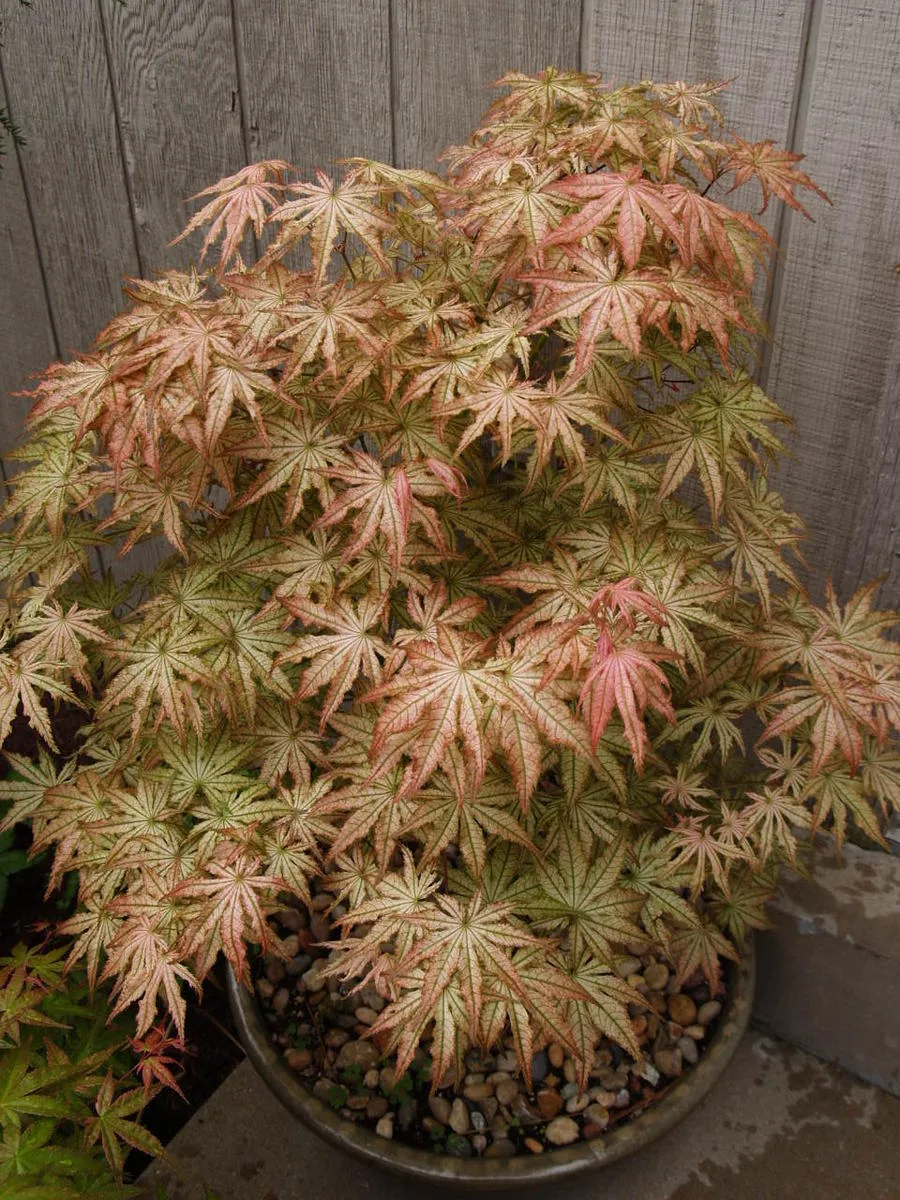
A deciduous, round-headed tree or shrub to 4m tall and wide. Its deeply-divided and lobed leaves emerge in spring creamy-white with green veins and the tips and margins tinged a pinkish-red. This pinkish-red colouring fades as the leaves mature in summer before turning yellow-orange in autumn. Small purple-red flowers may be followed by winged fruit in autumn
Scientific classification
- Species
- Japanese maple 'Peaches and Cream' (Acer palmatum 'Peaches and Cream')
- Genus
- Acer
- Family
- Sapindaceae
- Order
- Sapindales
- Class
- Magnoliopsida
- Phylum
- Magnoliophyta
- Information to be completed
- Toxicity
- Trees
- Plant type
- 2.5-4 metres
- Height
- 2.5-4 metres
- Spread
- Deciduous
- Foliage
- Bushy
- Habit
- Autumn · Spring · Summer
- Season of interest
- Full sun · Partial shade
- Sunlight
- Information to be completed
- Ideal temperature









Japanese maple 'Peaches and Cream' pictures
Japanese maple 'Peaches and Cream' care guide
- Keep soil evenly moist, sheltered from drying winds
- Watering
- Full sun · Partial shade
- Sunlight

Watering
Keep soil evenly moist, sheltered from drying winds
Fertilizing
 Fertilizing
Slow release tree feed in spring
Pruning
 Pruning
Little pruning is needed. Remove diseased, damaged, crowded or crossing shoots and unwanted growth. Timing depends on the plant: generally late winter or early spring; plants prone to bleeding and deciduous magnolias need different timing, and deciduous azaleas and lilacs are pruned after flowering.
Propagation
 Propagation
Propagate by grafting or by softwood cuttings
Growing
 Growing
Grow in a place sheltered from cold drying winds and from late frosts, in full sun where its colours will develop best or in light dappled shade, in moist but well-drained neutral or acidic soil that does not dry out in summer or become waterlogged in winter, and protect roots with an open-textured organic mulch such as coarse bark; for more advice, see Japanese maple cultivation
Common pests and diseases
Diseases
May be susceptible to Verticillium wilt, Acer leaf scorch and honey fungus
Pests
May be susceptible to Acer gall mite, aphids, caterpillars and horse chestnut scale
Explore the plant health library →




