
moss phlox 'Oakington Blue Eyes'
Also known as: Information to be completed
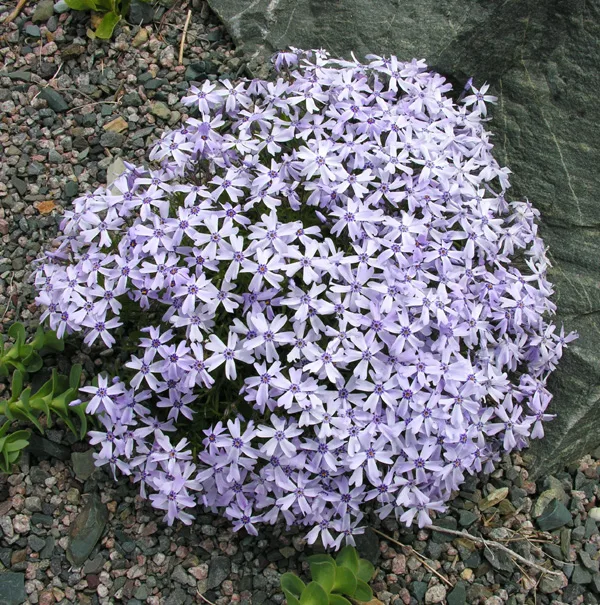
A prostrate, mat-forming evergreen alpine with fine, green needle-like leaves and star-shaped lavender-blue flowers and small dark blue markins in the centre in spring and summer
Scientific classification
- Species
- moss phlox 'Oakington Blue Eyes' (Phlox subulata 'Oakington Blue Eyes')
- Genus
- Phlox
- Family
- Polemoniaceae
- Order
- Ericales
- Class
- Magnoliopsida
- Phylum
- Magnoliophyta
- Information to be completed
- Toxicity
- Alpine Rockery
- Plant type
- 0.1-0.5 metres
- Height
- 0.1-0.5 metres
- Spread
- Evergreen
- Foliage
- Matforming
- Habit
- Spring · Summer · Autumn · Winter
- Season of interest
- Full sun · Partial shade
- Sunlight
- Information to be completed
- Ideal temperature









moss phlox 'Oakington Blue Eyes' pictures
Distribution of moss phlox 'Oakington Blue Eyes'
Distribution map
- Native
- Introduced
- Cultivated
Source:WCVP v16 · Royal Botanic Gardens, Kew · CC BY 3.0 · Boundaries:WGSRPD / TDWG
moss phlox 'Oakington Blue Eyes' care guide
- Minimal excess moisture, deep water after top soil dries out
- Watering
- Full sun · Partial shade
- Sunlight

Watering
Minimal excess moisture, deep water after top soil dries out
Fertilizing
 Fertilizing
Weak low-nitrogen rockery feed once monthly spring growth
Pruning
 Pruning
No pruning required
Propagation
 Propagation
Propagate by softwood cuttings in early spring
Growing
 Growing
Will perform best in well-drained fertile soil in a sunny or dappled shade positon, prefering full sun and avoiding waterlogging. Can be trimmed back in autumn to rejuvenate and shape.
Common pests and diseases
Diseases
May be susceptible to Powdery mildews and leaf spot
Pests
May be susceptible to stem and bulb eelworm
Explore the plant health library →




