
plantain lily 'Striptease'
Also known as: Information to be completed
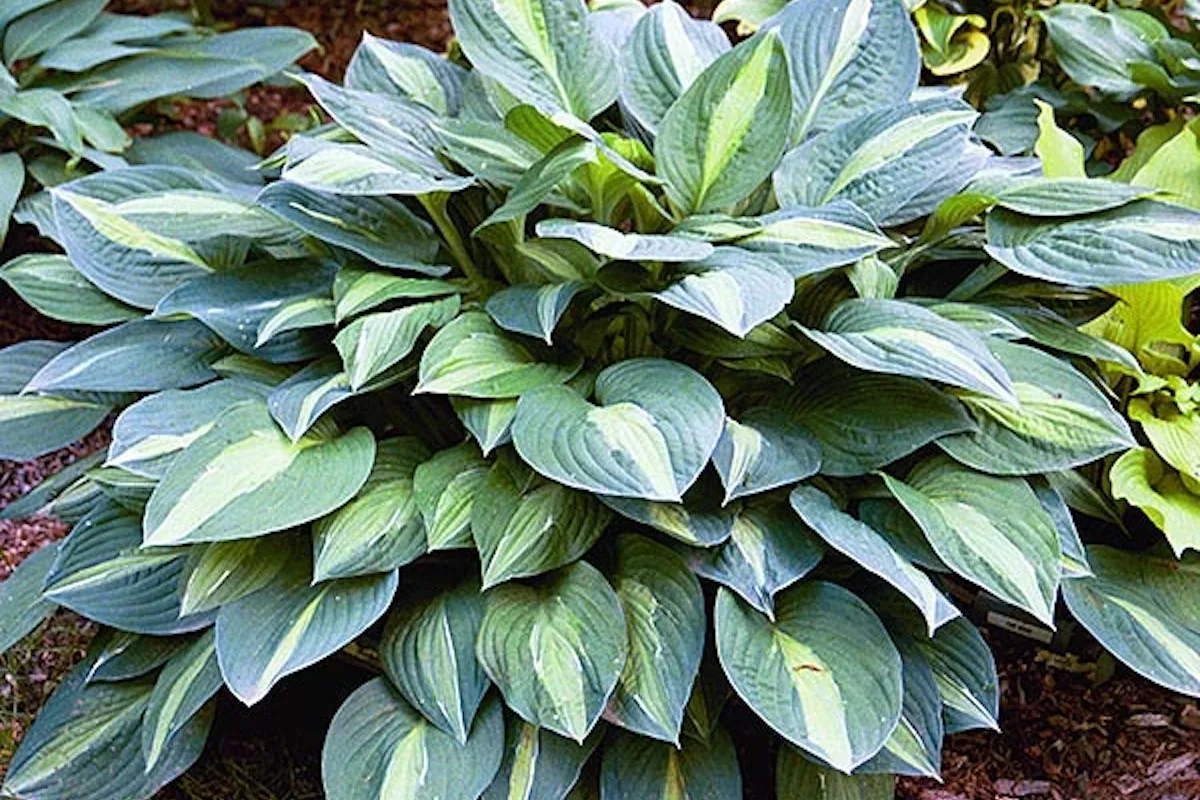
A herbaceous perennial forming a mound of foliage to 50cm high and 115cm wide. The oval leaves have a chartreuse centre, turning yellow to ivory, which is separated by a thin white line from a wide dark green margin. Pale purple flowers are held on stems aove the mounded foliage in summer
Scientific classification
- Species
- plantain lily 'Striptease' (Hosta 'Striptease')
- Genus
- Hosta
- Family
- Asparagaceae
- Information to be completed
- Toxicity
- Herbaceous Perennial
- Plant type
- 0.5-1 metres
- Height
- 1-1.5 metres
- Spread
- Deciduous
- Foliage
- Clump forming
- Habit
- Spring · Summer · Autumn
- Season of interest
- Full sun · Partial shade
- Sunlight
- Information to be completed
- Ideal temperature









plantain lily 'Striptease' pictures
Distribution of plantain lily 'Striptease'
Distribution map
Information to be completed
Information to be completed
Culture
Information to be completed
Toxicity
Information to be completed
Quick identification of plantain lily 'Striptease'
Information to be completed
plantain lily 'Striptease' care guide
- Keep humus-rich soil evenly moist, especially during warm weather
- Watering
- Full sun · Partial shade
- Sunlight
- Information to be completed
- Ideal temperature

Watering
Keep humus-rich soil evenly moist, especially during warm weather
Fertilizing
 Fertilizing
Balanced shade-perennial feed monthly in spring and early summer
Pruning
 Pruning
Remove spent foliage as required and clear up dead foliage when it dies back at the end of the growing season
Propagation
 Propagation
Propagate by division in late summer or early spring
Growing
 Growing
Grow in fertile, moist but well-drained soil with shelter from cold, dry winds. Best in slightly acid or neutral soils; it will grow in alkaline soils if enriched but shallow, chalky soils can cause leaves to yellow. Partial shade is best but it can tolerate some sun if the soil is kept moist. Mulch in spring. See hosta cultivation
People also ask
Information to be completed
Common pests and diseases
Diseases
May be subject to a virus
Pests
May be attacked by slugs, snails and vine weevil
Explore the plant health library →




