
winter aconite 'Orange Glow'
Also known as: Information to be completed
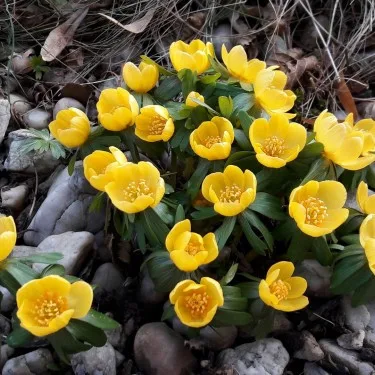
Orange Glow' forms a small clump of rounded, palmately lobed basal leaves, with deep yellow flowers 2-3cm wide, sitting above deeply divided green bracts and opening in late winter and early spring
Scientific classification
- Species
- winter aconite 'Orange Glow' (Eranthis hyemalis 'Orange Glow')
- Genus
- Eranthis
- Family
- Ranunculaceae
- Order
- Ranunculales
- Class
- Magnoliopsida
- Phylum
- Magnoliophyta
- Harmful if eaten, skin/eye irritant. Wear gloves and other protective equipment when handling]
- Toxicity
- Bulbs
- Plant type
- Up to 10 cm
- Height
- 0-0.1 metre
- Spread
- Deciduous
- Foliage
- Bushy
- Habit
- Spring · Winter
- Season of interest
- Full sun · Partial shade
- Sunlight
- Information to be completed
- Ideal temperature









winter aconite 'Orange Glow' pictures
Distribution of winter aconite 'Orange Glow'
Distribution map
- Native
- Introduced
- Cultivated
Source:WCVP v16 · Royal Botanic Gardens, Kew · CC BY 3.0 · Boundaries:WGSRPD / TDWG
Toxicity
Harmful if eaten, skin/eye irritant. Wear gloves and other protective equipment when handling]
winter aconite 'Orange Glow' care guide
- Moderate regular watering, allowing brief slight drying between soakings
- Watering
- Full sun · Partial shade
- Sunlight

Watering
Moderate regular watering, allowing brief slight drying between soakings
Fertilizing
 Fertilizing
Balanced perennial feed every four weeks from spring through summer
Pruning
 Pruning
No pruning required
Propagation
 Propagation
Propagate by separating tubers in late spring after flowering. Dry tubers may not establish well
Growing
 Growing
Grow in humus-rich, moderately fertile soil that doesn't dry out. Tolerates most soil types but does best in alkaline soils
Common pests and diseases
Diseases
May be susceptible to smut
Pests
May be susceptible to slugs
Explore the plant health library →




