
variegated giant taro
Also known as: Information to be completed
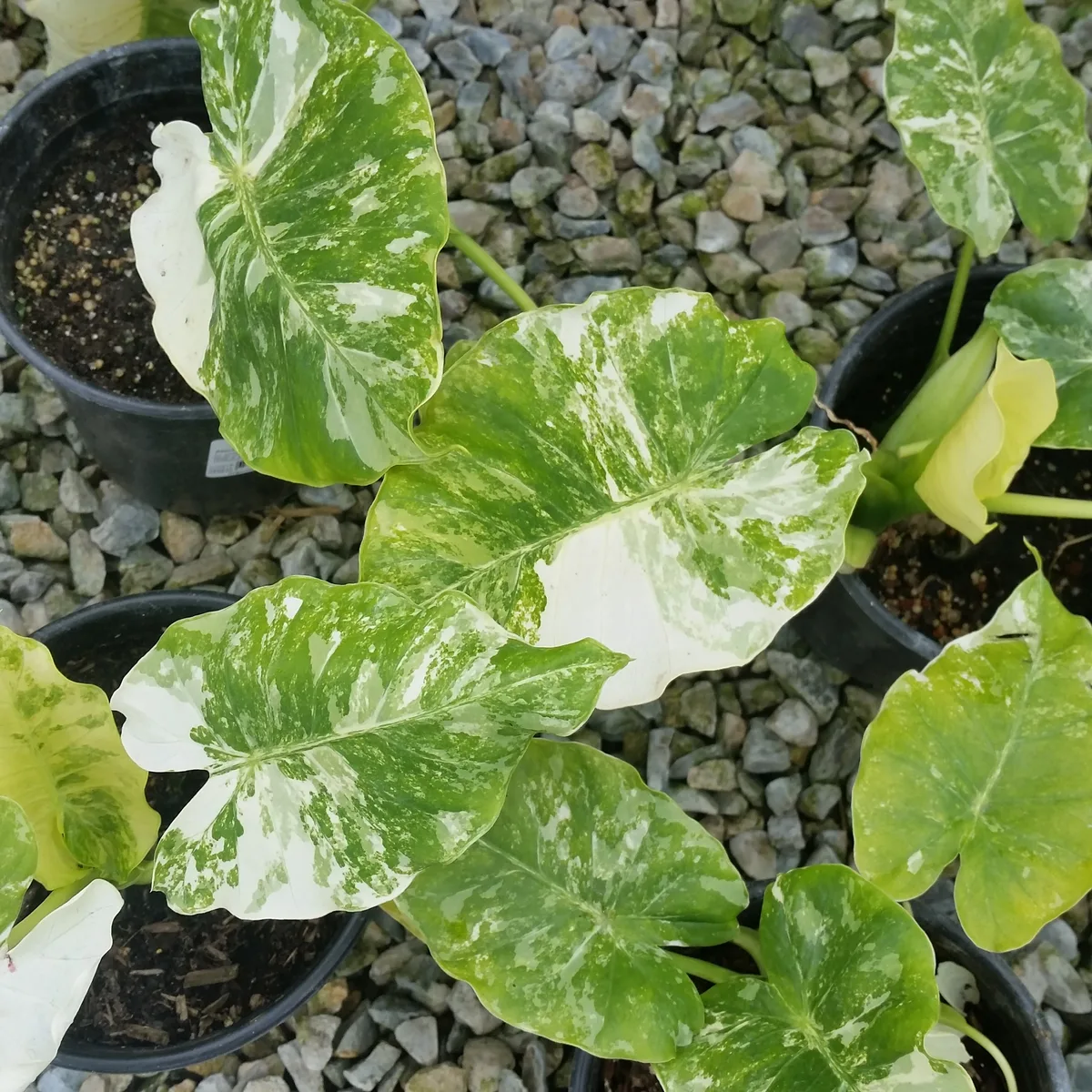
Robust, evergreen rhizomatous perennial to 4m tall, with stout upright stems and narrowly arrow-shaped, wavy-edged leaves, dark green with pale green veins and marked ivory and grey-green. Leaf blades to 1.2m long are held on leaf stalks 1.2m long. Yellow-green flower bracts to 35cm long are borne at any time of year
Scientific classification
- Species
- variegated giant taro (Alocasia macrorrhizos 'Variegata')
- Genus
- Alocasia
- Family
- Araceae
- Order
- Alismatales
- Class
- Liliopsida
- Phylum
- Magnoliophyta
- TOXIC if eaten, skin/eye irritant. Wear gloves and other protective equipment when handling]
- Toxicity
- Herbaceous Perennial
- Plant type
- 4-8 metres
- Height
- 2.5-4 metres
- Spread
- Evergreen
- Foliage
- Clump forming
- Habit
- Spring · Summer · Autumn · Winter
- Season of interest
- Partial shade
- Sunlight
- Information to be completed
- Ideal temperature









variegated giant taro pictures
Distribution of variegated giant taro
Distribution map
- Native
- Introduced
- Cultivated
Source:WCVP v16 · Royal Botanic Gardens, Kew · CC BY 3.0 · Boundaries:WGSRPD / TDWG
Toxicity
TOXIC if eaten, skin/eye irritant. Wear gloves and other protective equipment when handling]
variegated giant taro care guide
- Keep soil evenly moist with warmth and humidity
- Watering
- Partial shade
- Sunlight

Watering
Keep soil evenly moist with warmth and humidity
Fertilizing
 Fertilizing
Balanced feed every few weeks in active growth
Pruning
 Pruning
No pruning required
Propagation
 Propagation
Propagate by division in spring or summer. Propagate by stem cuttings in spring
Growing
 Growing
Grow indoors in a potting mixture of equal parts of composted bark, loam and sand, in filtered light. Water freely in the growing season, provide high humidity by placing container on a tray of moist gravel or pebbles and apply a balanced liquid fertiliser every 2-3 weeks. Water moderately in winter. Requires a minimum temperature of 15-18°C. Can be planted outside after frost, or started off in pots under glass in late winter to early spring. Plant bulbs so their growing tip is just above the soil surface, water sparingly initially then keep moist during the growing season and lift bulbs in autumn before the first frosts; keep tubers dry and frost free throughout winter
Common pests and diseases
Diseases
Generally disease-free
Pests
May be susceptible to glasshouse red spider mite and mealybugs
Explore the plant health library →




