
leucadendron 'Fireglow'
Also known as: Information to be completed
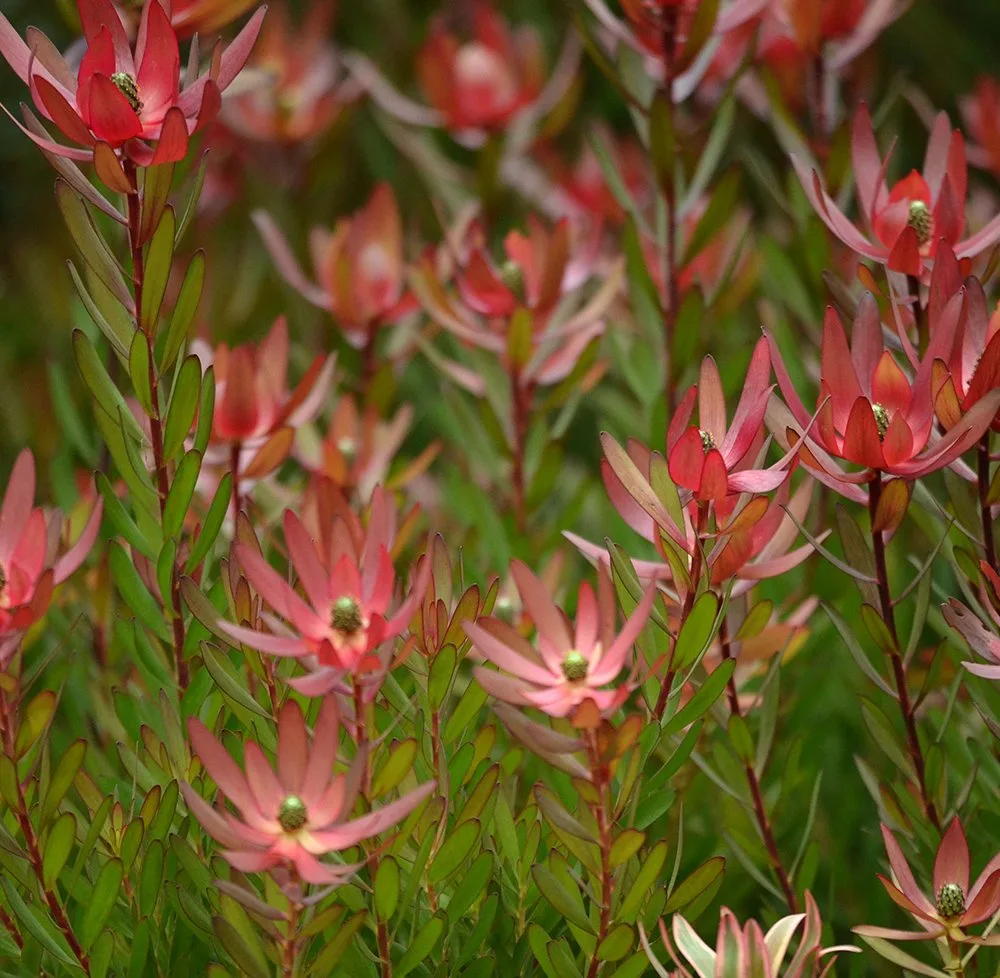
Compact, bushy, evergreen shrub about 1m high with narrow green leaves tipped red, and flowerheads with red floral bracts from autumn to spring
Scientific classification
- Species
- leucadendron 'Fireglow' (Leucadendron salignum 'Fireglow')
- Genus
- Leucadendron
- Family
- Proteaceae
- Order
- Proteales
- Class
- Magnoliopsida
- Phylum
- Magnoliophyta
- Information to be completed
- Toxicity
- Shrubs
- Plant type
- 0.5-1 metres
- Height
- 0.5-1 metres
- Spread
- Evergreen
- Foliage
- Bushy
- Habit
- Spring · Summer · Autumn · Winter
- Season of interest
- Full sun
- Sunlight
- Information to be completed
- Ideal temperature









leucadendron 'Fireglow' pictures
leucadendron 'Fireglow' care guide
- Minimal watering, allow soil to dry thoroughly between irrigation cycles
- Watering
- Full sun
- Sunlight

Watering
Minimal watering, allow soil to dry thoroughly between irrigation cycles
Fertilizing
 Fertilizing
Very weak low-nitrogen protea feed once monthly warm growth months
Pruning
 Pruning
Little pruning is needed. Remove diseased, damaged, crowded or crossing shoots and unwanted growth. Timing depends on the plant: generally late winter or early spring; plants prone to bleeding and deciduous magnolias need different timing, and deciduous azaleas and lilacs are pruned after flowering.
Propagation
 Propagation
Propagate by semi-ripe cuttings with bottom heat in summer
Growing
 Growing
In milder areas, grow outside in poor, well-drained, neutral to acidic soil, in full sun in a warm, dry position such as a courtyard or against a south-facing or west-facing wall; in frost-prone areas, grow in a cool or temperate greenhouse, in a mix of lime-free potting compost and grit, in full light and low humidity, and water moderately during the growing season and sparingly in winter
Common pests and diseases
Diseases
Generally disease-free
Pests
May be susceptible to glasshouse red spider mite under glass
Explore the plant health library →




