
nodding conehead
Also known as: Information to be completed
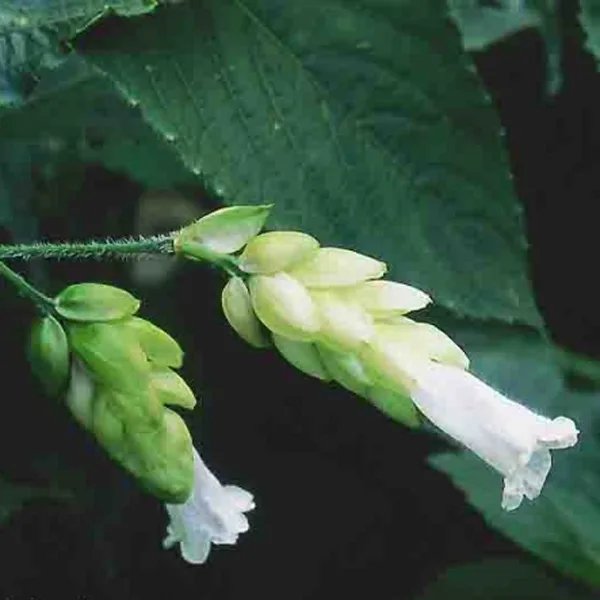
A spreading perennial to around 30cm high, with trailing to ascending, hairy stems that root at the nodes, and oval-shaped, hairy green leaves with serrated edges. Pendent clusters of white flowers are produced in late summer and early autumn, initially overlapping like a pine cone before opening to long tubular flowers flared at the tips
Scientific classification
- Species
- nodding conehead (Strobilanthes nutans)
- Genus
- Strobilanthes
- Family
- Acanthaceae
- Information to be completed
- Toxicity
- Herbaceous Perennial
- Plant type
- 0.1-0.5 metres
- Height
- 0.5-1 metres
- Spread
- Deciduous
- Foliage
- Trailing
- Habit
- Spring · Summer · Autumn
- Season of interest
- Partial shade · Full shade
- Sunlight
- Information to be completed
- Ideal temperature









nodding conehead pictures
Distribution of nodding conehead
Distribution map
Nepal
Information to be completed
Culture
Information to be completed
Toxicity
Information to be completed
Quick identification of nodding conehead
Information to be completed
nodding conehead care guide
- Moderate regular watering, avoid prolonged drought and stagnant waterlogging
- Watering
- Partial shade · Full shade
- Sunlight
- Information to be completed
- Ideal temperature

Watering
Moderate regular watering, avoid prolonged drought and stagnant waterlogging
Fertilizing
 Fertilizing
Balanced perennial feed every four weeks spring through summer growth
Pruning
 Pruning
No pruning required
Propagation
 Propagation
Propagate by seed, sown at 13-18°C in spring, or by softwood cuttings in late spring or early summer
Growing
 Growing
In mild, frost free areas, grow outside in fertile, well-drained soil that does not dry out in summer, in part or full shade. In colder areas, grow in loam-based compost in a cool greenhouse or conservatory, or in containers that can be moved indoors over winter
People also ask
Information to be completed
Common pests and diseases
Diseases
Generally disease-free
Pests
May be susceptible to red spider mite
Explore the plant health library →




