
African daisy 'Sunny Sonja'
Also known as: Information to be completed
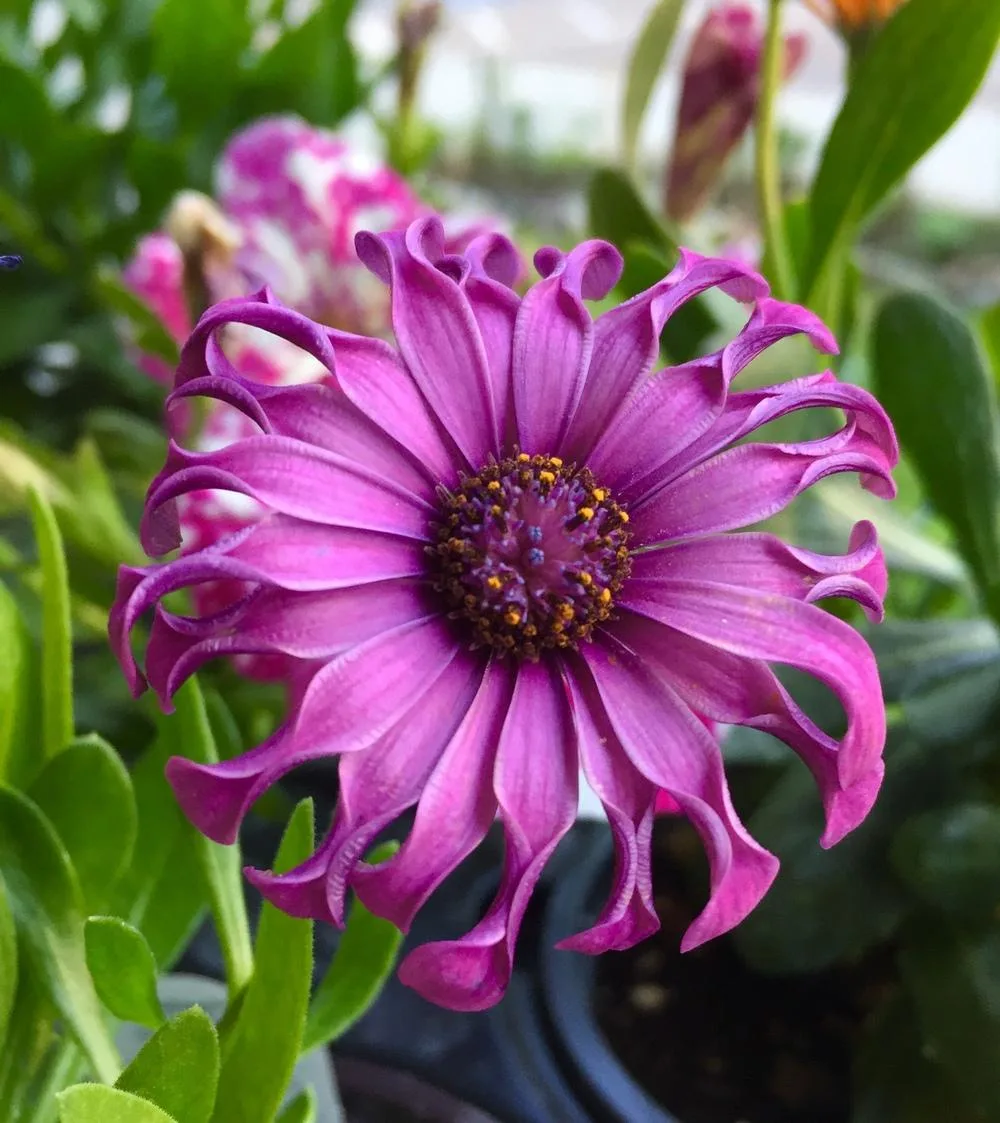
A variety belonging to the 'Sunny series' of bushy, mound-forming, tender rain daisies. An evergreen perennial, more popularly grown as seasonal annual bedding for patio and balcony summer displays. It has toothed, semi-glossy, lance- to spoon-shaped, mid-green leaves and purple-pink flowers with unusual tiny spoon like petals. The lavender underside is exposed where petals are pinched into the spoon shape, giving the petals a slight bicoloured look. The centres are a deep blue-purple.
Scientific classification
- Species
- African daisy 'Sunny Sonja' (Osteospermum 'Sunny Sonja')
- Genus
- Osteospermum
- Family
- Asteraceae
- Order
- Asterales
- Class
- Magnoliopsida
- Phylum
- Magnoliophyta
- Information to be completed
- Toxicity
- Bedding
- Plant type
- 0.1-0.5 metres
- Height
- 0.1-0.5 metres
- Spread
- Evergreen
- Foliage
- Bushy
- Habit
- Spring · Summer · Autumn
- Season of interest
- Full sun
- Sunlight
- Information to be completed
- Ideal temperature









African daisy 'Sunny Sonja' pictures
African daisy 'Sunny Sonja' care guide
- Moderate regular watering, allowing brief slight drying between soakings
- Watering
- Full sun
- Sunlight

Watering
Moderate regular watering, allowing brief slight drying between soakings
Fertilizing
 Fertilizing
Balanced perennial feed every four weeks from spring through summer
Pruning
 Pruning
Pinch out growing tips when young for a well-balanced and well-branched plant. Dead-head thoroughly to prolong the flowering display.
Propagation
 Propagation
Propagate by softwood cuttings in spring of non flowering shoots
Growing
 Growing
Grow in warm frost free conditions. Acclimatise plants before planting outside in early summer. Pinching out tips when young will create a well balanced compact plant that is perfect for container cultivation. A useful bedding plant for any well-drained fertile soil in a sunny site. A plant that performs best in sunny and bright, but relatively cool summers.
Common pests and diseases
Diseases
Generally disease-free. May be susceptible to downy mildews and Verticillium wilt
Pests
Generally pest-free. May be susceptible to aphids
Explore the plant health library →




