
Wlassov's cranesbill 'Blue Star'
Also known as: Information to be completed
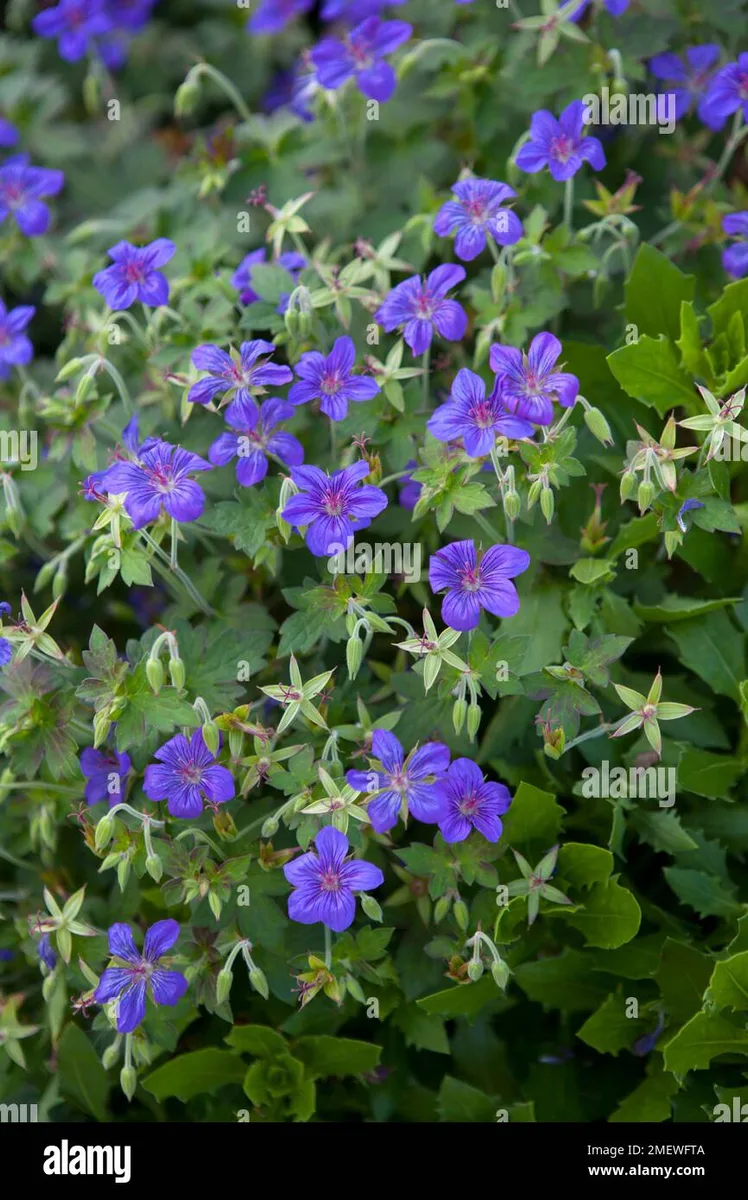
a clump-forming herbaceous perennial, 30-60cm high, with deciduous, seven-lobed, velvety leaves, 5-15cm across, which are dark green flushed with brown and which turn red and orange in autumn, and broadly funnel-shaped flowers, 3cm across, of dark bluish-purple with darker violet-purple veins, from early summer to late summer
Scientific classification
- Species
- Wlassov's cranesbill 'Blue Star' (Geranium wlassovianum 'Blue Star')
- Genus
- Geranium
- Family
- Geraniaceae
- Order
- Geraniales
- Class
- Magnoliopsida
- Phylum
- Tracheophyta
- Information to be completed
- Toxicity
- Herbaceous Perennial
- Plant type
- 0.5-1 metres
- Height
- 0.5-1 metres
- Spread
- Deciduous
- Foliage
- Clump forming
- Habit
- Autumn · Spring · Summer
- Season of interest
- Full sun · Partial shade
- Sunlight
- Information to be completed
- Ideal temperature









Wlassov's cranesbill 'Blue Star' pictures
Distribution of Wlassov's cranesbill 'Blue Star'
Distribution map
- Native
- Introduced
- Cultivated
Source:WCVP v16 · Royal Botanic Gardens, Kew · CC BY 3.0 · Boundaries:WGSRPD / TDWG
Wlassov's cranesbill 'Blue Star' care guide
- Moderate regular watering, avoid prolonged drought and stagnant waterlogging
- Watering
- Full sun · Partial shade
- Sunlight

Watering
Moderate regular watering, avoid prolonged drought and stagnant waterlogging
Fertilizing
 Fertilizing
Balanced perennial feed every four weeks spring through summer growth
Pruning
 Pruning
No pruning required
Propagation
 Propagation
Propagate by division in spring
Growing
 Growing
Grow in full sun or light shade in moist but well-drained soil
Common pests and diseases
Diseases
Generally disease-free, but may be affected by a rust, a downy mildew, leafy gall, and virus diseases; may also be affected by powdery mildews in dry conditions
Pests
Generally pest-free, but may be affected by capsid bug, geranium sawfly, vine weevil, slugs and snails
Explore the plant health library →




