
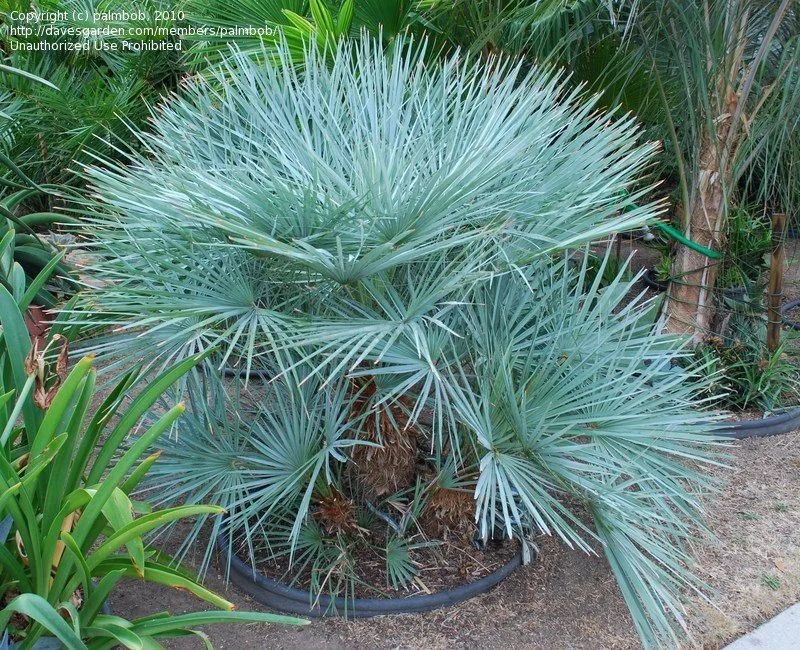
blue Mediterranean fan palm
Also known as: Information to be completed
A shrubby palm to 2m tall, suckering when mature. The silvery-blue, fan-shaped leaves are composed of linear leaflets held on spiny stalks. A good plant for a tropical border, where it is both drought-resistant and hardy to -5°C once established. Best grown as a conservatory or greenhouse plant where winters are not reliably mild
Scientific classification
- Species
- blue Mediterranean fan palm (Chamaerops humilis var. argentea)
- Genus
- Chamaerops
- Family
- Arecaceae
- Order
- Arecales
- Class
- Liliopsida
- Phylum
- Magnoliophyta
- Information to be completed
- Toxicity
- Conservatory Greenhouse · Palms
- Plant type
- 1.5-2.5 metres
- Height
- 1.5-2.5 metres
- Spread
- Evergreen
- Foliage
- Suckering
- Habit
- Spring · Summer · Autumn · Winter
- Season of interest
- Full sun · Partial shade
- Sunlight
- Information to be completed
- Ideal temperature









blue Mediterranean fan palm pictures
Distribution of blue Mediterranean fan palm
Distribution map
- Native
- Introduced
- Cultivated
Source:WCVP v16 · Royal Botanic Gardens, Kew · CC BY 3.0 · Boundaries:WGSRPD / TDWG
blue Mediterranean fan palm care guide
- Moderate regular watering, allowing brief slight drying between soakings
- Watering
- Full sun · Partial shade
- Sunlight

Watering
Moderate regular watering, allowing brief slight drying between soakings
Fertilizing
 Fertilizing
Balanced perennial feed every four weeks from spring through summer
Pruning
 Pruning
No pruning required
Propagation
 Propagation
Propagate by sowing seed in spring at 25°C
Growing
 Growing
Under glass, grow in pots of multipurpose compost in bright, filtered light with protection from direct summer sun. Water moderately in growth and apply a balanced liquid feed every month during the growing season; mist daily to increase humidity. See palm cultivation indoors for further information. In mild areas grow outdoors in freely-draining soil in sun or partial shade; see palm cultivation outdoors for further information
Common pests and diseases
Diseases
May be susceptible to honey fungus (rarely)
Pests
May be susceptible to glasshouse red spider mite, thrips and scale insects
Explore the plant health library →




