
New Zealand myrtle 'Red Dragon'
Also known as: Information to be completed
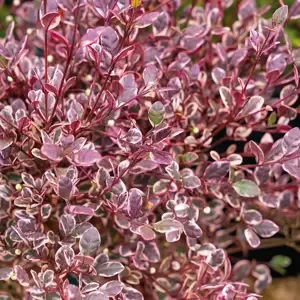
Red Dragon' is an evergreen shrub, reaching 1.5m, with small, round, slightly puckered, pinkish-red leaves that turn a deep burgundy colour when temperatures fall. Mature plants produce small, white, scented, cup-shaped flowers with a mass of stamens in late summer, followed by black berries.
Scientific classification
- Species
- New Zealand myrtle 'Red Dragon' (Lophomyrtus × ralphii 'Red Dragon')
- Genus
- Lophomyrtus
- Family
- Myrtaceae
- Order
- Myrtales
- Class
- Magnoliopsida
- Phylum
- Magnoliophyta
- Information to be completed
- Toxicity
- Shrubs
- Plant type
- 1-1.5 metres
- Height
- 0.5-1 metres
- Spread
- Evergreen
- Foliage
- Bushy
- Habit
- Spring · Summer · Autumn · Winter
- Season of interest
- Partial shade
- Sunlight
- Information to be completed
- Ideal temperature









New Zealand myrtle 'Red Dragon' pictures
Distribution of New Zealand myrtle 'Red Dragon'
Distribution map
- Native
- Introduced
- Cultivated
Source:WCVP v16 · Royal Botanic Gardens, Kew · CC BY 3.0 · Boundaries:WGSRPD / TDWG
New Zealand myrtle 'Red Dragon' care guide
- Moderate regular watering, avoid prolonged drought or waterlogging
- Watering
- Partial shade
- Sunlight

Watering
Moderate regular watering, avoid prolonged drought or waterlogging
Fertilizing
 Fertilizing
Balanced feed in spring and light repeat in growth season
Pruning
 Pruning
Little pruning is needed. Remove diseased, damaged, crowded or crossing shoots and unwanted growth. Timing depends on the plant: generally late winter or early spring; plants prone to bleeding and deciduous magnolias need different timing, and deciduous azaleas and lilacs are pruned after flowering.
Propagation
 Propagation
Root semi-ripe heel cuttings in summer with bottom heat
Growing
 Growing
Under glass, grow in loam-based potting compost in bright, filtered light. In mild areas grow outdoors in fertile, humus rich, moist but well-drained soil in a sheltered position in partial shade.
Common pests and diseases
Diseases
Generally disease free
Pests
Glasshouse red spider mite may be a problem under glass
Explore the plant health library →




