
witch hazel 'Ostergold'
Also known as: Information to be completed
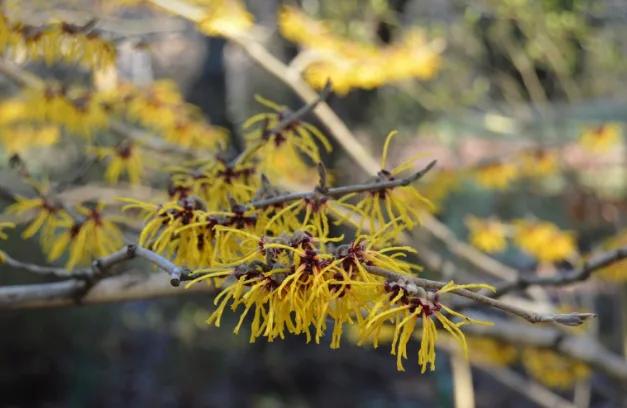
Ostergold' is a large, rather spreading shrub with broad, rounded leaves flushed purple in spring and turning yellow in autumn. The flowers, produced in late winter, have straight, egg-yolkyellow petals but lack fragrance
Scientific classification
- Species
- witch hazel 'Ostergold' (Hamamelis × intermedia 'Ostergold')
- Genus
- Hamamelis
- Family
- Hamamelidaceae
- Order
- Saxifragales
- Class
- Magnoliopsida
- Phylum
- Magnoliophyta
- Information to be completed
- Toxicity
- Shrubs
- Plant type
- 2.5-4 metres
- Height
- 2.5-4 metres
- Spread
- Deciduous
- Foliage
- Bushy
- Habit
- Autumn · Spring · Summer · Winter
- Season of interest
- Full sun · Partial shade
- Sunlight
- Information to be completed
- Ideal temperature









witch hazel 'Ostergold' pictures
witch hazel 'Ostergold' care guide
- Water regularly, especially during dry spells; keep the soil moist but well-drained.
- Watering
- Full sun · Partial shade
- Sunlight

Watering
Water regularly, especially during dry spells; keep the soil moist but well-drained.
Fertilizing
 Fertilizing
Apply a balanced fertilizer for acid-loving plants in spring.
Pruning
 Pruning
Little pruning is needed. Remove diseased, damaged, crowded or crossing shoots and unwanted growth. Timing depends on the plant: generally late winter or early spring; plants prone to bleeding and deciduous magnolias need different timing, and deciduous azaleas and lilacs are pruned after flowering.
Propagation
 Propagation
Propagate by simple layering of suitable shoots in spring, by grafting in late winter or by chip budding in late summer
Growing
 Growing
Best in an open, sunny spot, avoiding exposed or windy positions, with well-drained, humus-rich, acid or neutral soil. See hamamelis cultivation
Common pests and diseases
Diseases
May be susceptible to coral spot, honey fungus, phytophthora root rot and powdery mildews
Pests
Generally pest-free
Explore the plant health library →




