
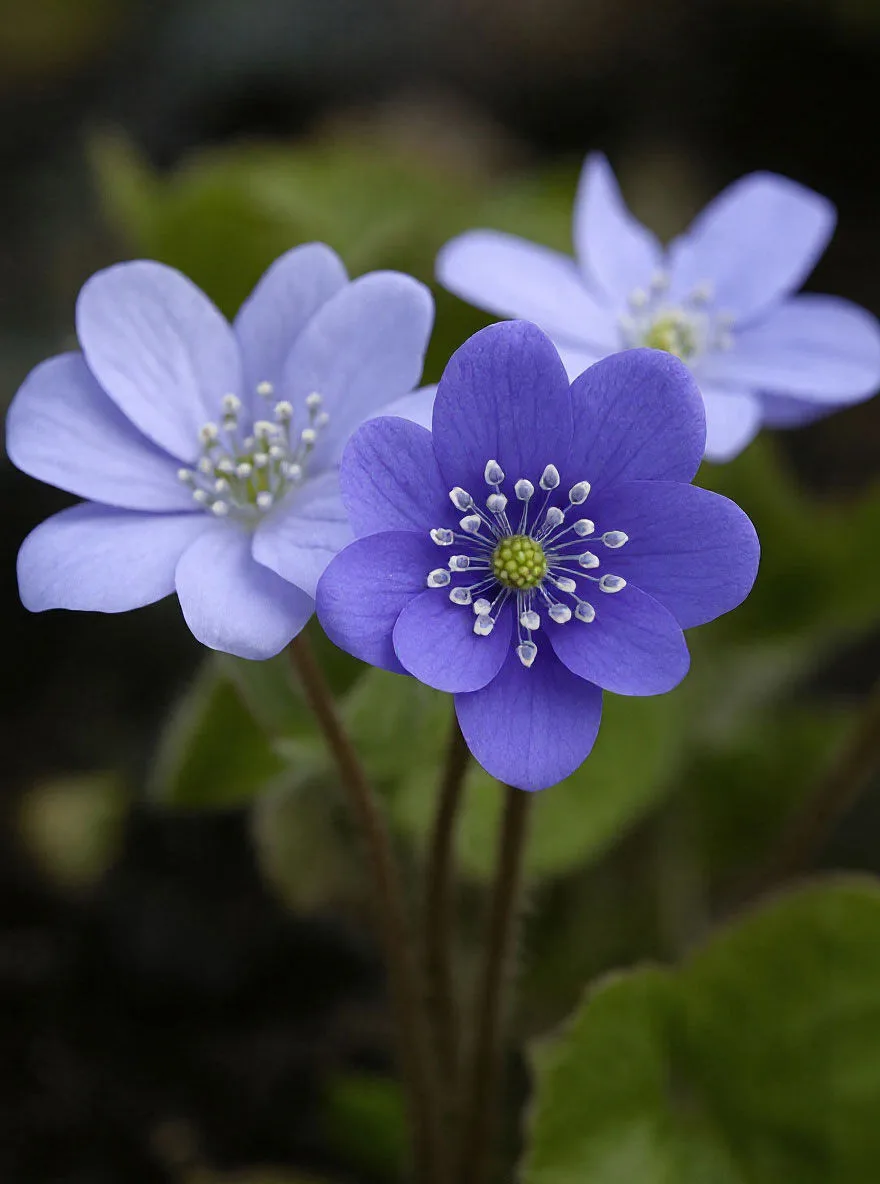
large blue hepatica 'Blue Jewel'
Also known as: Information to be completed
Blue Jewel' is a slowly-spreading, compact perennial to 15cm tall and wide with green, hairy, three-lobedleaves and bowl-shaped, deep blueflowers up to 4cm across borne in spring
Scientific classification
- Species
- large blue hepatica 'Blue Jewel' (Hepatica transsilvanica 'Blue Jewel')
- Genus
- Hepatica
- Family
- Ranunculaceae
- Order
- Ranunculales
- Class
- Magnoliopsida
- Phylum
- Magnoliophyta
- Information to be completed
- Toxicity
- Alpine Rockery · Herbaceous Perennial
- Plant type
- 0.1-0.5 metres
- Height
- 0.1-0.5 metres
- Spread
- Semi evergreen
- Foliage
- Clump forming
- Habit
- Spring · Summer · Autumn · Winter
- Season of interest
- Partial shade
- Sunlight
- Information to be completed
- Ideal temperature









large blue hepatica 'Blue Jewel' pictures
Distribution of large blue hepatica 'Blue Jewel'
Distribution map
- Native
- Introduced
- Cultivated
Source:WCVP v16 · Royal Botanic Gardens, Kew · CC BY 3.0 · Boundaries:WGSRPD / TDWG
large blue hepatica 'Blue Jewel' care guide
- Keep woodland soil evenly moist, rich and cool
- Watering
- Partial shade
- Sunlight

Watering
Keep woodland soil evenly moist, rich and cool
Fertilizing
 Fertilizing
Light balanced feed in spring only
Pruning
 Pruning
No pruning required
Propagation
 Propagation
Propagate by seed sown in an open frame, as soon as ripe, or by division in spring. Transplants and divisions are slow to establish
Growing
 Growing
Grows well in humus-rich soils and thrives in heavier soils. Top dress annually in autumn with leaf mould. Resent root disturbance
Common pests and diseases
Diseases
Generally disease free
Pests
Slugs and snails may be a problem with young growth
Explore the plant health library →




