
turnip
Also known as: rapini; turnip
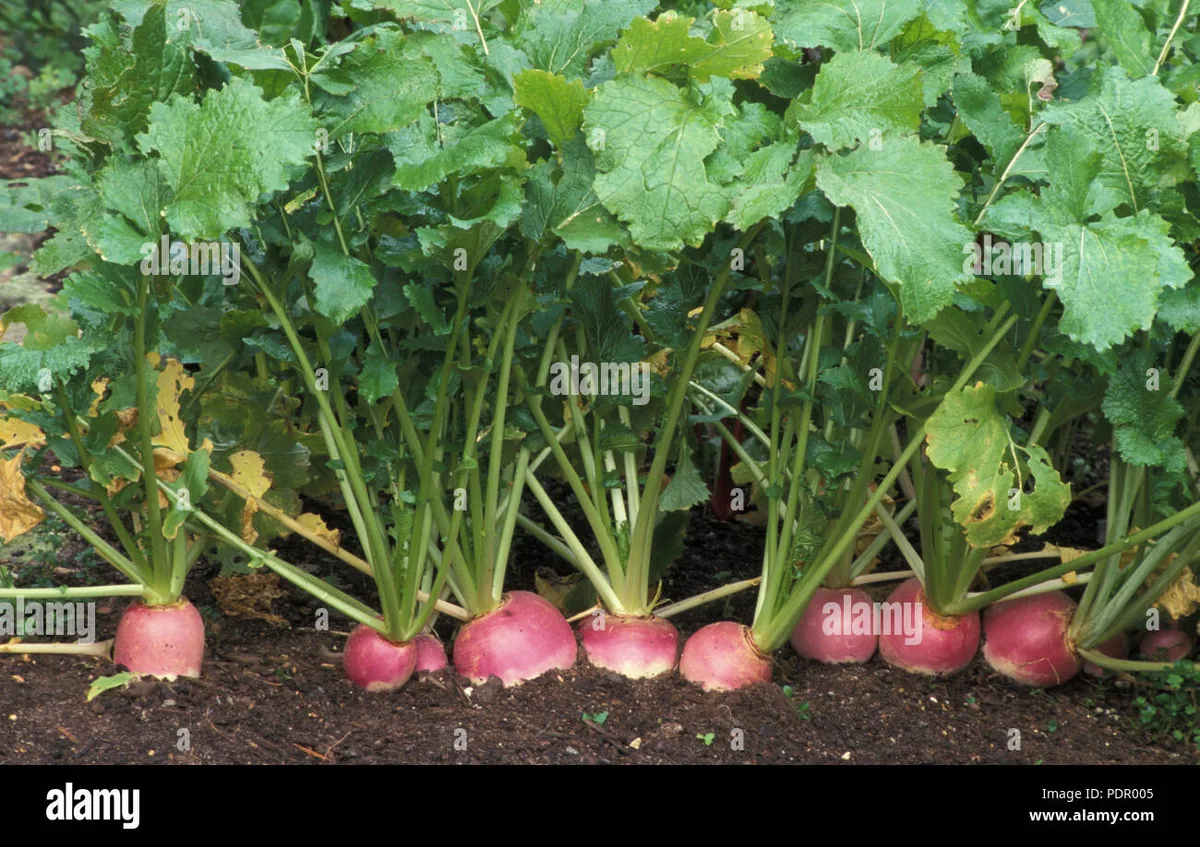
A cultivated group of biennial plants, selected for its round, swollen root/stem and known and eaten as turnip. Turnips are usually purple at the top and white beneath the ground. Green leaves, covered with short, rough hairs form a rosette-like bunch. They are fast-growing and can be harvested over a long time. Both leaves and the swollen roots are edible. If left grown into the second year, they will form an erect stem bearing bright yellow, cross-shaped flowers followed by elongated seedpods
Scientific classification
- Species
- turnip (Brassica rapa (Rapifera Group))
- Genus
- Brassica
- Family
- Brassicaceae
- Order
- Brassicales
- Class
- Magnoliopsida
- Phylum
- Tracheophyta
- Information to be completed
- Toxicity
- Annual Biennial
- Plant type
- 0.1-0.5 metres
- Height
- 0.1-0.5 metres
- Spread
- Evergreen
- Foliage
- Tufted · Columnar upright
- Habit
- Spring · Summer · Autumn · Winter
- Season of interest
- Full sun · Partial shade
- Sunlight
- Information to be completed
- Ideal temperature









turnip pictures
Distribution of turnip
Distribution map
- Native
- Introduced
- Cultivated
Source:WCVP v16 · Royal Botanic Gardens, Kew · CC BY 3.0 · Boundaries:WGSRPD / TDWG
turnip care guide
- Keep soil consistently moist for tender leafy growth
- Watering
- Full sun · Partial shade
- Sunlight

Watering
Keep soil consistently moist for tender leafy growth
Fertilizing
 Fertilizing
Nitrogen-rich vegetable feed during active growth
Pruning
 Pruning
No pruning required
Propagation
 Propagation
Propagate by seed. See sowing vegetable seeds
Growing
 Growing
Grow in full sun in firm, fertile soil - including coastal regions. For more advice see turnip cultivation
Common pests and diseases
Diseases
May be susceptible to brassica downy mildew and brassica white blister. In areas where brassicas have been grown before, clubroot can build up in the soil
Pests
May be susceptible to flea beetle, cabbage root fly, caterpillars, pigeons and snails, although once plants are established, this damage isn't usually severe
Explore the plant health library →




