
Chewing's fescue
Also known as: Information to be completed
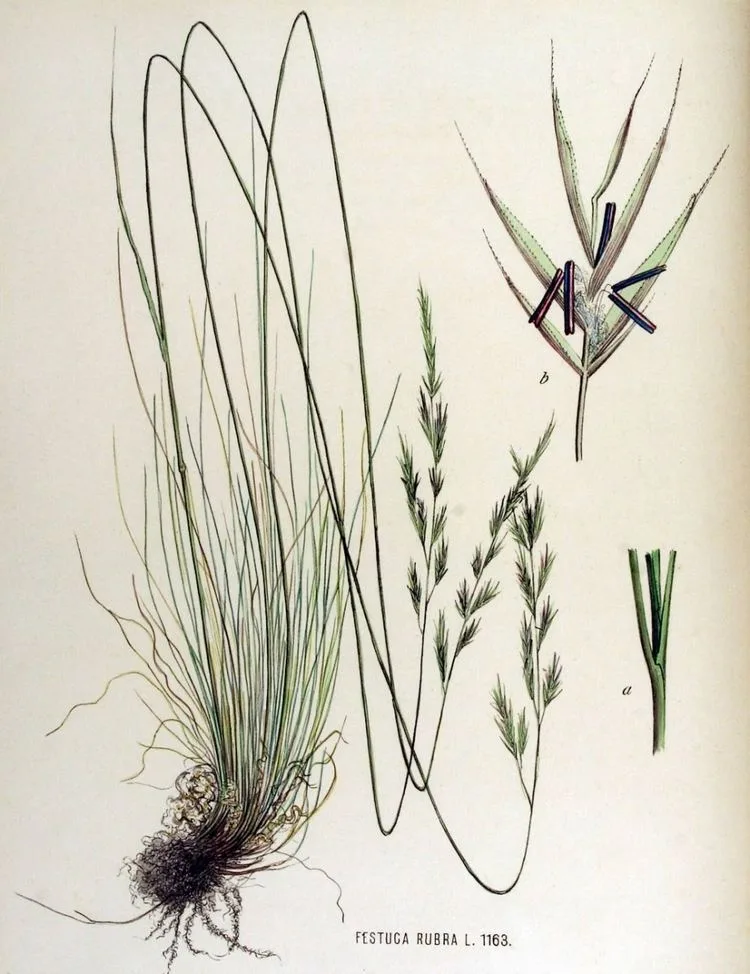
A densely tufted, perennial grass about 30cm or more tall, forming open clumps of fine, bristly, mid green, hair-like leaves often with red veins. Flower spikes to 30cm tall, are pale brown and produced in summer in clusters of spikelets. Often grown as a dense turf or lawn grass
Scientific classification
- Species
- Chewing's fescue (Festuca rubra subsp. commutata)
- Genus
- Festuca
- Family
- Poaceae
- Information to be completed
- Toxicity
- Grass Like
- Plant type
- 0.1-0.5 metres
- Height
- 0.1-0.5 metres
- Spread
- Evergreen
- Foliage
- Tufted · Clump forming
- Habit
- Spring · Summer · Autumn · Winter
- Season of interest
- Full sun
- Sunlight
- Information to be completed
- Ideal temperature









Chewing's fescue pictures
Distribution of Chewing's fescue
Distribution map
- Native
- Introduced
- Cultivated
Source:WCVP v16 · Royal Botanic Gardens, Kew · CC BY 3.0 · Boundaries:WGSRPD / TDWG
Culture
Information to be completed
Toxicity
Information to be completed
Quick identification of Chewing's fescue
Information to be completed
Chewing's fescue care guide
- Moderate regular watering, avoid prolonged drought or waterlogging
- Watering
- Full sun
- Sunlight
- Information to be completed
- Ideal temperature

Watering
Moderate regular watering, avoid prolonged drought or waterlogging
Fertilizing
 Fertilizing
Balanced feed in spring and light repeat in growth season
Pruning
 Pruning
Comb out dead foliage and trim damaged parts of older leaves in spring, for lawns, mow regularly when actively growing
Propagation
 Propagation
Propagate by seed from autumn to spring or by division of clumps in spring
Growing
 Growing
Grow in poor to moderately fertile, well-drained soil in full sun. See ornamental grasses cultivation advice
People also ask
Information to be completed
Common pests and diseases
Diseases
Generally disease-free
Pests
Generally pest-free
Explore the plant health library →




