
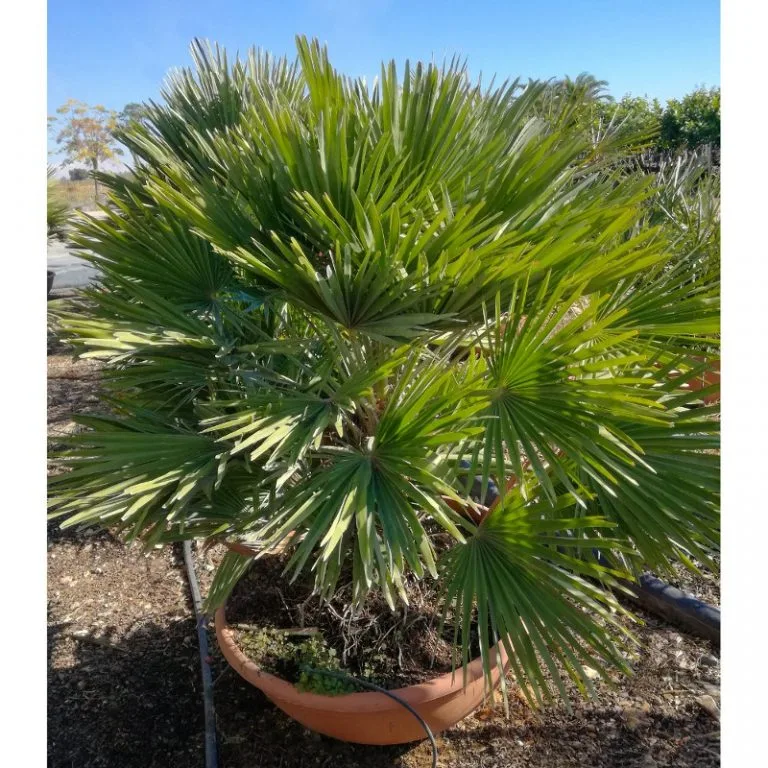
dwarf fan palm 'Vulcano'
Also known as: Information to be completed
A compact, bushy, suckering palm up to 2m high with one or more stems covered in leaf bases, spiny leafy stalks, stiff broad leaves divided into leaflets, bluish or greyish green above and silvery beneath, and flowers from spring to summer, the male flowers bright yellow and the female flowers yellow-green, followed by yellow to orange-brown fruit
Scientific classification
- Species
- dwarf fan palm 'Vulcano' (Chamaerops humilis 'Vulcano')
- Genus
- Chamaerops
- Family
- Arecaceae
- Order
- Arecales
- Class
- Liliopsida
- Phylum
- Magnoliophyta
- Information to be completed
- Toxicity
- Palms
- Plant type
- 1.5-2.5 metres
- Height
- 1-1.5 metres
- Spread
- Evergreen
- Foliage
- Suckering
- Habit
- Spring · Summer · Autumn · Winter
- Season of interest
- Full sun · Partial shade
- Sunlight
- Information to be completed
- Ideal temperature









dwarf fan palm 'Vulcano' pictures
Distribution of dwarf fan palm 'Vulcano'
Distribution map
- Native
- Introduced
- Cultivated
Source:WCVP v16 · Royal Botanic Gardens, Kew · CC BY 3.0 · Boundaries:WGSRPD / TDWG
dwarf fan palm 'Vulcano' care guide
- Infrequent deep watering, full dry between winter irrigation
- Watering
- Full sun · Partial shade
- Sunlight

Watering
Infrequent deep watering, full dry between winter irrigation
Fertilizing
 Fertilizing
Diluted low-nitrogen palm feed monthly warm growth phase
Pruning
 Pruning
No pruning required
Propagation
 Propagation
Propagate by seed sown at 22°C or more in spring, or by division, by separating suckers from established plants in late spring
Growing
 Growing
Under glass, grow in a cool glasshouse or as a houseplant in loam-based potting compost such as John Innes No. 3 in full bright indirect light - for more advice, see palm cultivation indoors; outside grow in well-drained soil in full sun or partial shade; will tolerate poor, dry soil - for more advice, see palm cultivation outdoors
Common pests and diseases
Diseases
May be susceptible to honey fungus (rarely)
Pests
May be susceptible to glasshouse red spider mite, thrips and scale insects
Explore the plant health library →




