
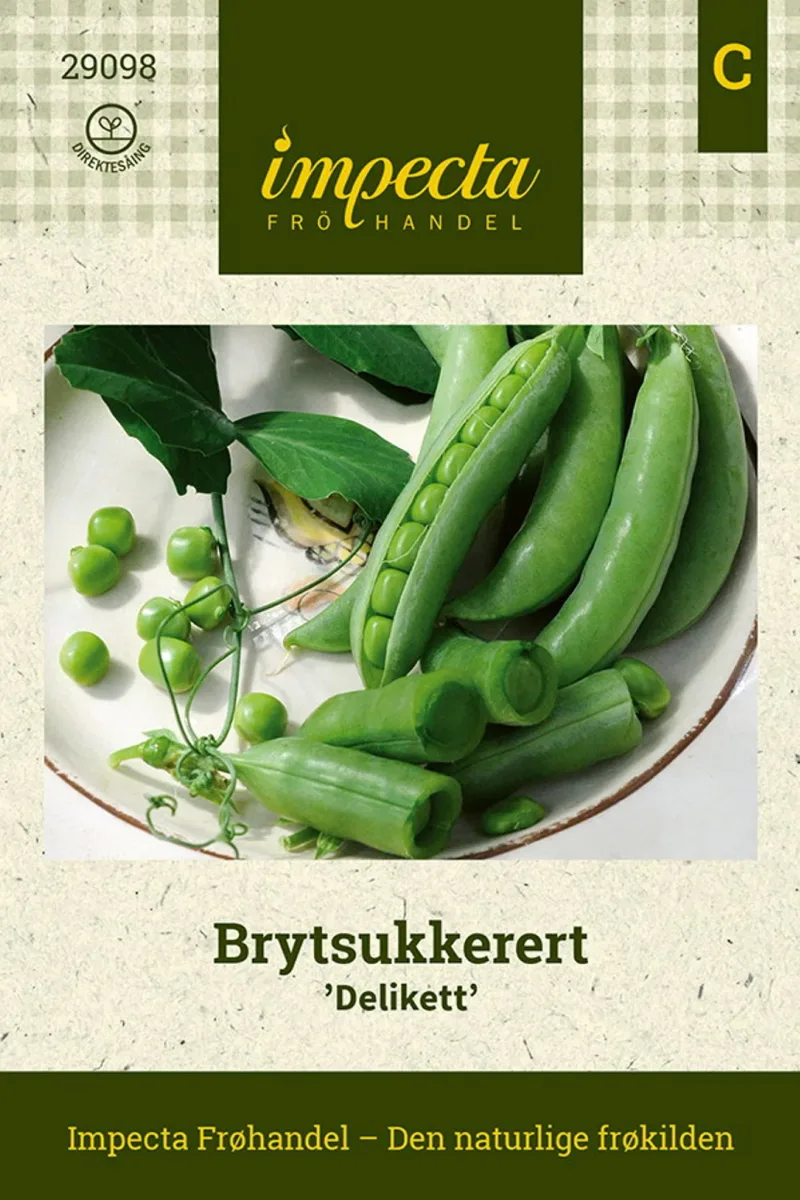
pea (sugarsnap) 'Delikett'
Also known as: Information to be completed
A compact sugarsnap variety growing to 0.6-1.5m high, with fleshy, sweet, green edible pods, about 8cm long, 1.3cm wide, and 0.8cm thick, which are stringless when young but become fleshier and sweeter as well as stringier with age, and can be picked over a long season. Peas are nitrogen-fixing annuals, climbing by tendrils up to 2m high, with pinnate leaves of up to eight glaucous, rounded elliptic to oblong leaflets, up to 7cm long, and usually white flowers up to 3cm long, in summer, followed by round, green, edible, protein-rich seeds, in long cylindrical pods from summer until the first frosts; the pods as well as the seeds of sugarsnap varieties are also edible, as are the flattened pods of mangetout varieties; the young shoots and leaves are also edible.
Scientific classification
- Species
- pea (sugarsnap) 'Delikett' (Pisum sativum 'Delikett')
- Genus
- Pisum
- Family
- Fabaceae
- Order
- Fabales
- Class
- Magnoliopsida
- Phylum
- Magnoliophyta
- Information to be completed
- Toxicity
- Annual Biennial
- Plant type
- 1-1.5 metres
- Height
- 0.5-1 metres
- Spread
- Deciduous
- Foliage
- Climbing
- Habit
- Spring · Summer · Autumn
- Season of interest
- Full sun
- Sunlight
- Information to be completed
- Ideal temperature









pea (sugarsnap) 'Delikett' pictures
Distribution of pea (sugarsnap) 'Delikett'
Distribution map
- Native
- Introduced
- Cultivated
Source:WCVP v16 · Royal Botanic Gardens, Kew · CC BY 3.0 · Boundaries:WGSRPD / TDWG
pea (sugarsnap) 'Delikett' care guide
- Keep soil consistently moist for steady leafy growth without drought stress
- Watering
- Full sun
- Sunlight

Watering
Keep soil consistently moist for steady leafy growth without drought stress
Fertilizing
 Fertilizing
Nitrogen-rich vegetable feed every two to three weeks in active growth
Pruning
 Pruning
No pruning required
Propagation
 Propagation
Propagate by seed sown 5cm deep, from early spring to early summer
Growing
 Growing
Sow seed from early spring, once the soil is warm, to early summer, in a double row at about 7cm spacings in a flat-bottomed drill 5cm deep and 15cm wide, in full sun in well-drained but humus-rich, moisture-retentive, preferably near-neutral soil, provide support such as twiggy hazel sticks, trellis or netting, and pick pods regularly to ensure a continuous crop; for more advice, see pea cultivation
Common pests and diseases
Diseases
May be susceptible to powdery mildews, downy mildews, foot and root rot, Fusarium wilt, grey moulds, pea leaf and pod spot, and virus diseases
Pests
May be susceptible to pea moth, aphids, pea and bean weevil, pea thrips, pigeons, slugs, and snails; mice may eat newly-sown seeds
Explore the plant health library →




