
Mexican scarlet sage
Also known as: Mexican red sage
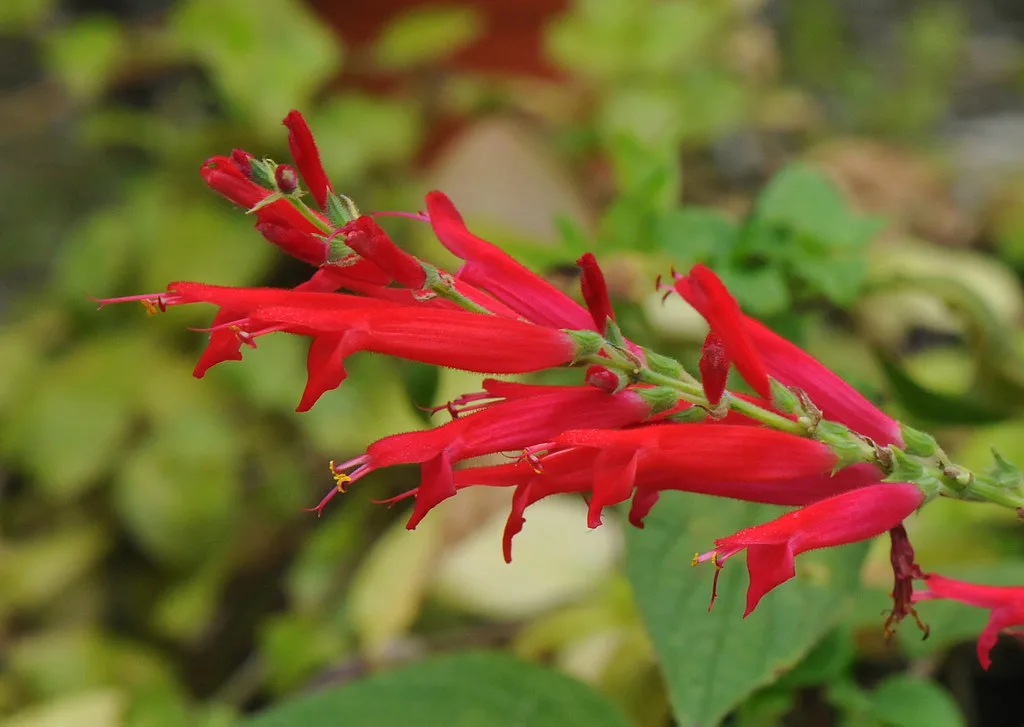
a small, erect, bushy evergreen sub-shrub with light green oval leaves 3-8cm in length, and brilliant scarlet, hairy, tubular flowers 3cm in length, arranged in well-spaced whorls forming racemes to 45cm in length
Scientific classification
- Species
- Mexican scarlet sage (Salvia fulgens)
- Genus
- Salvia
- Family
- Lamiaceae
- Order
- Lamiales
- Class
- Magnoliopsida
- Phylum
- Tracheophyta
- Information to be completed
- Toxicity
- Conservatory Greenhouse · Shrubs
- Plant type
- 0.5-1 metres
- Height
- 0.5-1 metres
- Spread
- Evergreen
- Foliage
- Bushy
- Habit
- Spring · Summer · Autumn · Winter
- Season of interest
- Full sun
- Sunlight
- Information to be completed
- Ideal temperature









Mexican scarlet sage pictures
Distribution of Mexican scarlet sage
Distribution map
- Native
- Introduced
- Cultivated
Source:WCVP v16 · Royal Botanic Gardens, Kew · CC BY 3.0 · Boundaries:WGSRPD / TDWG
Mexican scarlet sage care guide
- Allow soil to partially dry between thorough deep waterings
- Watering
- Full sun
- Sunlight

Watering
Allow soil to partially dry between thorough deep waterings
Fertilizing
 Fertilizing
Light balanced fertilizer every month from spring through early autumn
Pruning
 Pruning
Prune lightly as needed to remove unwanted shoots and keep the shrub in shape. Prune in mid- to late spring.
Propagation
 Propagation
Propagate by seed sown in containers in a cold frame in spring or root softwood cuttings in spring or early summer. Semi-hardwood cuttings can be taken in late summer or autumn, with bottom heat
Growing
 Growing
Under glass grow in loam-based or loam-less compost, in full light with shade from hot sun. During growth, water freely and apply a balanced liquid fertiliser monthly. Keep just moist in winter and maintain low to moderate humidity. Can be grown outdoors in frost-free areas in moderately fertile, humus-rich, moist-but-well-drained soil. Protect form cold, drying winds and excessive winter wet
Common pests and diseases
Diseases
May be susceptible to honey fungus (rarely), powdery mildews, verticillium wilt and foot and root rots
Pests
May be susceptible to sage leafhopper, slugs, snails and rosemary beetle
Explore the plant health library →




