
bluebeard 'Blue Cascade'
Also known as: Information to be completed
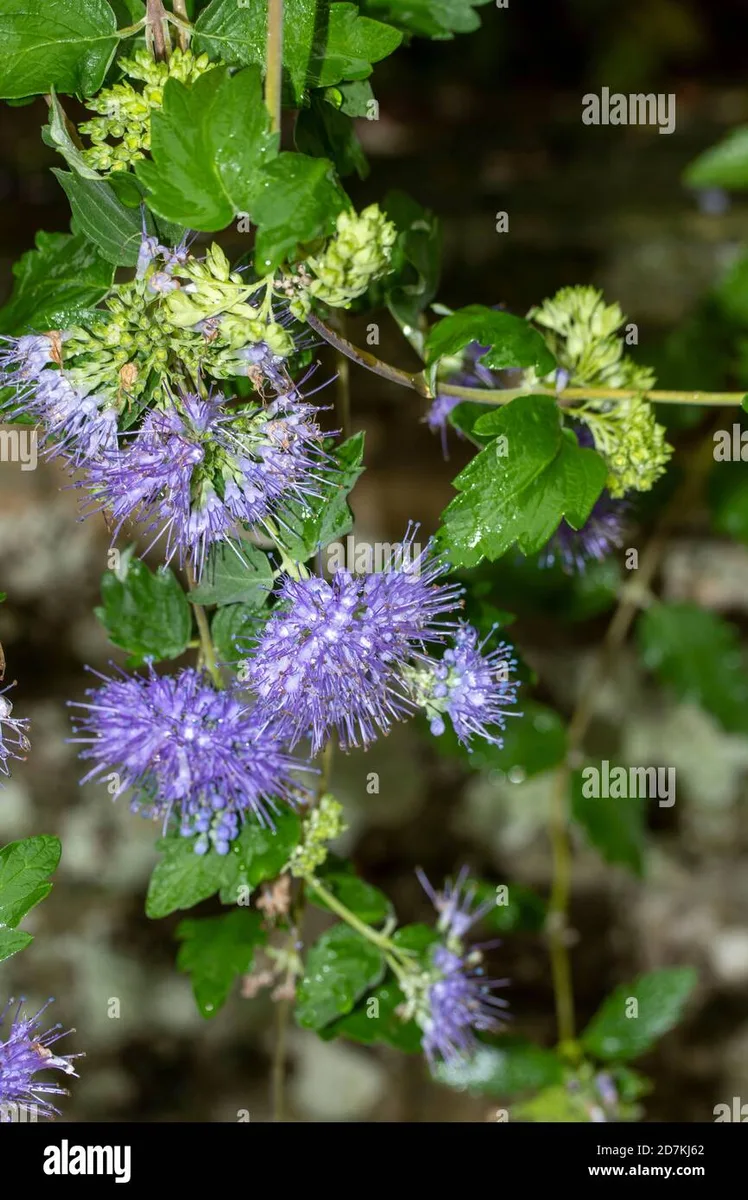
A small, deciduous shrub to 1.5m tall and wide with a greyish,felt-like covering andweeping branches. Ovate, aromatic leaves to 7.5cm long are coarsely toothed; violet-blue flowers borne in dense cymes extending from the upper leaf axils appear from midsummer to early autumn
Scientific classification
- Species
- bluebeard 'Blue Cascade' (Caryopteris incana 'Blue Cascade')
- Genus
- Caryopteris
- Family
- Lamiaceae
- Order
- Lamiales
- Class
- Magnoliopsida
- Phylum
- Magnoliophyta
- Information to be completed
- Toxicity
- Shrubs
- Plant type
- 1-1.5 metres
- Height
- 1-1.5 metres
- Spread
- Deciduous
- Foliage
- Pendulous weeping · Bushy
- Habit
- Spring · Summer · Autumn
- Season of interest
- Full sun
- Sunlight
- Information to be completed
- Ideal temperature









bluebeard 'Blue Cascade' pictures
Distribution of bluebeard 'Blue Cascade'
Distribution map
- Native
- Introduced
- Cultivated
Source:WCVP v16 · Royal Botanic Gardens, Kew · CC BY 3.0 · Boundaries:WGSRPD / TDWG
bluebeard 'Blue Cascade' care guide
- Moderate regular watering, allowing brief slight drying between soakings
- Watering
- Full sun
- Sunlight

Watering
Moderate regular watering, allowing brief slight drying between soakings
Fertilizing
 Fertilizing
Balanced perennial feed every four weeks from spring through summer
Pruning
 Pruning
Shorten last year's flowering stems to one or two buds from the older woody framework. Remove thin, weak and dead shoots. Prune in early to mid-spring as growth resumes; avoid winter pruning that exposes new shoots to frost.
Propagation
 Propagation
Root softwood cuttings from spring to midsummer, semi-ripe cuttings from mid to late summer or hardwood cuttings from late autumn to midwinter
Growing
 Growing
Grow in moderately fertile, light, well-drained soil in full sun. Best positioned near a warm, sunny wall
Common pests and diseases
Diseases
May be susceptible to honey fungus
Pests
Capsid bug may cause leaf distortion
Explore the plant health library →




