
Ilex crenata 'Convexed Gold'
Also known as: Information to be completed
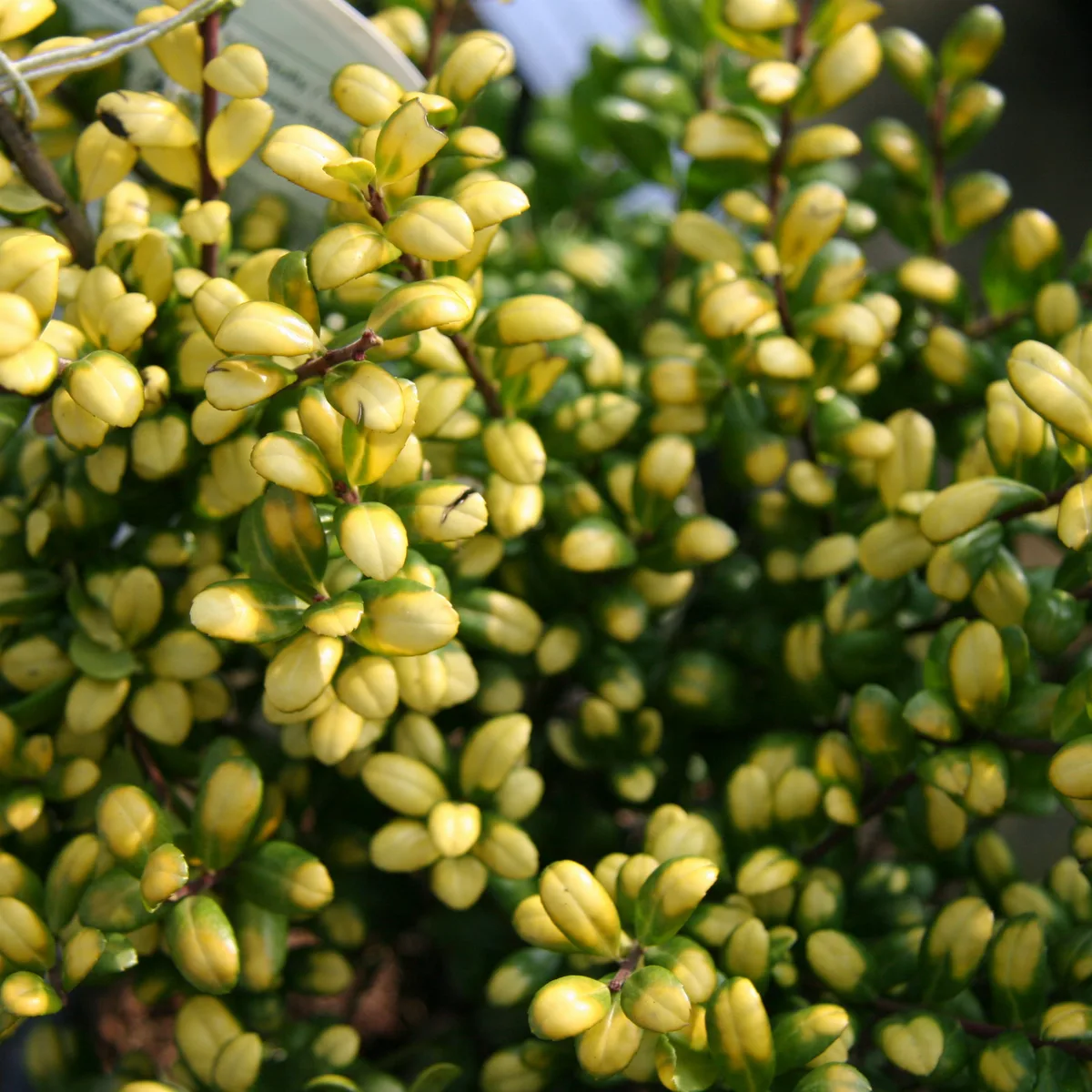
Broad, dense, bushy evergreen shrub about 1m tall, with small glossy, convex (curved) green leaves to 1.5cm long, heavily flushed creamy-yellow. Flowers small and white, followed by abundant glossy black berries if pollinated by a male Japanese holly. Makes an excellent low hedge
Scientific classification
- Species
- Ilex crenata 'Convexed Gold' (Ilex crenata 'Convexed Gold')
- Genus
- Ilex
- Family
- Aquifoliaceae
- Order
- Aquifoliales
- Class
- Magnoliopsida
- Phylum
- Magnoliophyta
- Fruit are ornamental - not to be eaten. Wear gloves and other protective equipment when handling
- Toxicity
- Shrubs
- Plant type
- 0.5-1 metres
- Height
- 1-1.5 metres
- Spread
- Evergreen
- Foliage
- Bushy
- Habit
- Spring · Summer · Autumn · Winter
- Season of interest
- Full sun · Partial shade
- Sunlight
- Information to be completed
- Ideal temperature









Ilex crenata 'Convexed Gold' pictures
Distribution of Ilex crenata 'Convexed Gold'
Distribution map
- Native
- Introduced
- Cultivated
Source:WCVP v16 · Royal Botanic Gardens, Kew · CC BY 3.0 · Boundaries:WGSRPD / TDWG
Toxicity
Fruit are ornamental - not to be eaten. Wear gloves and other protective equipment when handling
Ilex crenata 'Convexed Gold' care guide
- Deep soak when top soil dries, mild drought tolerance established
- Watering
- Full sun · Partial shade
- Sunlight

Watering
Deep soak when top soil dries, mild drought tolerance established
Fertilizing
 Fertilizing
Slow release evergreen shrub feed once per early spring yearly
Pruning
 Pruning
Little pruning is needed. Remove diseased, damaged, crowded or crossing shoots and unwanted growth. Timing depends on the plant: generally late winter or early spring; plants prone to bleeding and deciduous magnolias need different timing, and deciduous azaleas and lilacs are pruned after flowering. Trim hedges in early spring.
Propagation
 Propagation
Propagate by semi-ripe cuttings in late summer or hardwood cuttings in autumn to midwinter
Growing
 Growing
Grow in well-drained soil in a sunny position. Although partial shade is suitable, there will be better leaf colour in full sun
Common pests and diseases
Diseases
May be susceptible to holly leaf blight, Phytophthora root rot and sometimes honey fungus
Pests
May be susceptible to scale insects, holly leaf miner and young shoots may be susceptible to aphids
Explore the plant health library →




